

Can you recognize a state flag when its name is hidden, or do you remember it only after seeing choices? A useful American state flag quiz should test both quick recognition and recall, and make clear whether it covers all 50 states. If you want a visual starting point, our overview of the 50 U.S. state flags gives you a place to begin.
A state-name quiz and a flag quiz test different things. In one, you recall a place name; in the other, you connect a design to a state. The question format matters too: choices can make a quiz feel easier, while typing an answer asks you to remember it without prompts. Pick a format that suits your goal, then raise the difficulty as you learn.
What should an American state flag quiz test?
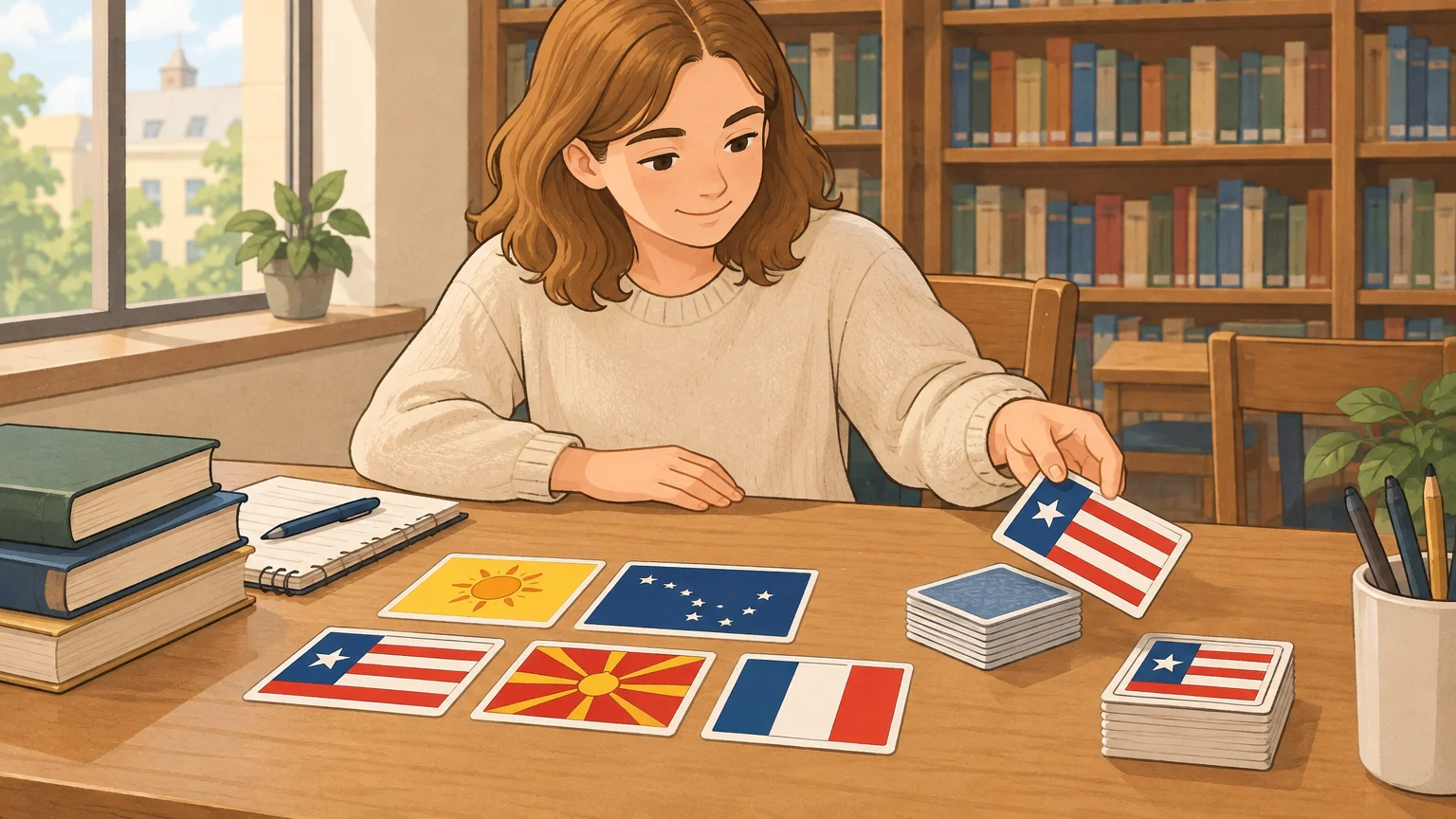
Start with the coverage: does the quiz include all 50 state flags, or only a selection? A short quiz can be a useful warm-up, but it won’t tell you whether you can identify every state. Check whether the instructions distinguish state flags from the flags of territories or other U.S. jurisdictions.
Next, check how you answer. A multiple-choice format builds recognition by asking you to choose among names. Typed recall removes those prompts, while map placement adds a location task by asking you to connect each flag to a state on a map. Each tests a different skill, so choose based on what you want to practise.
Look for clear feedback after each answer. If you miss a flag, note the correct state and one feature that distinguishes its design. A quiz that lets you review mistakes gives you a useful next step; a score without answers is harder to learn from.
How can you spot flags that look alike?
When two flags blur together, look for one detail before trying to memorize the whole design. Check the central emblem, the number and placement of stars, any border or stripe, and whether the flag includes lettering. Then say the state name aloud or write it down before revealing the answer. This turns a quick visual impression into a deliberate flag identification.
For context beyond matching a picture to a name, a federal reference on state flags describes designs and their symbolism. Use historical descriptions to build memory cues, then compare the image with a current flag reference. A distinctive emblem or color pattern gives you a more useful cue than a vague note like “mostly blue.”
You can also make your own comparison pairs from the flags you confuse. Put the two designs side by side and write one difference for each: a symbol, a color, or the position of an element. Review those pairs again later without looking at your notes. This works especially well when the first difference you notice isn’t the detail you remember the next time.
How can you learn all 50 without cramming?
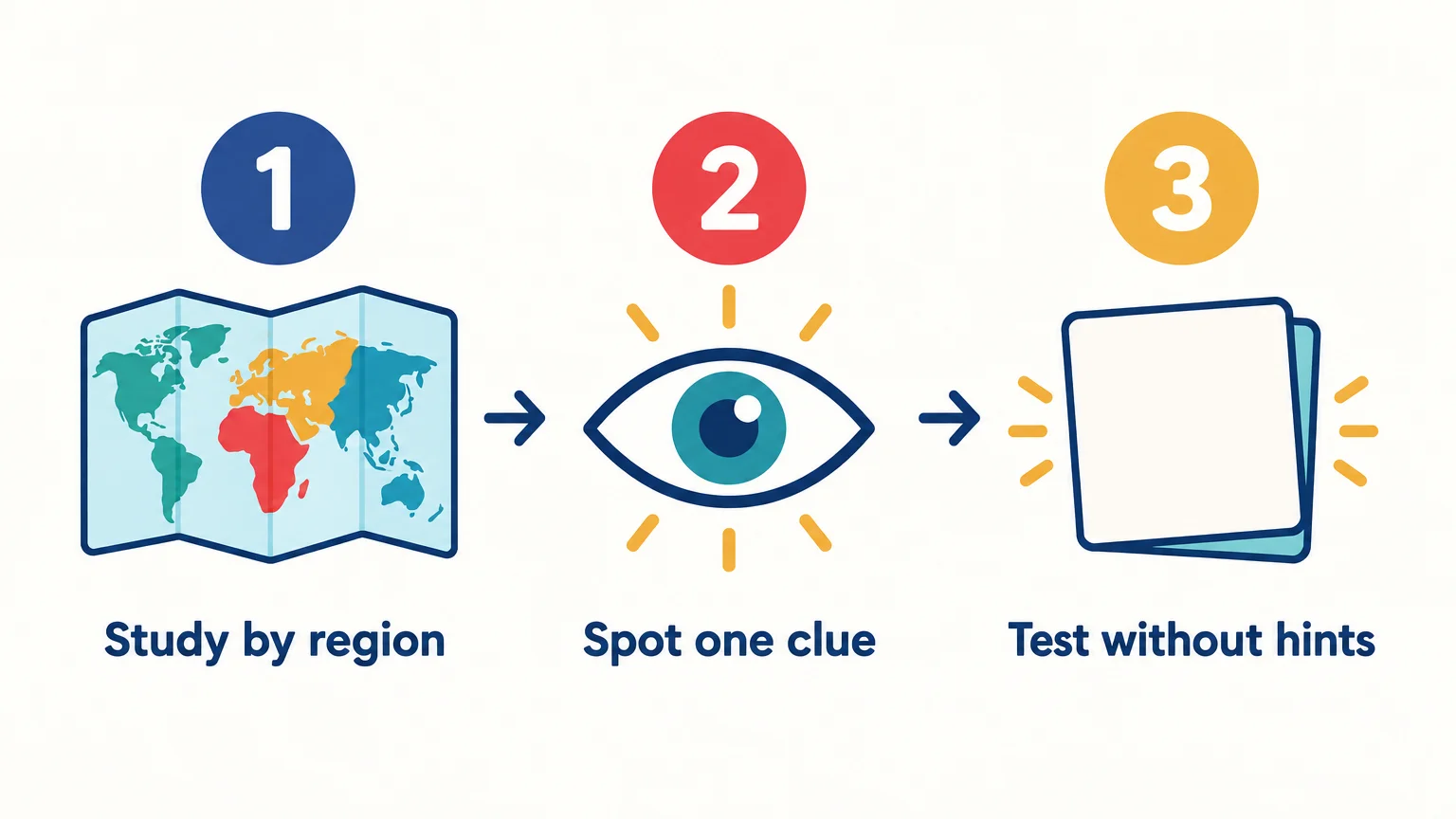
Try a simple three-stage routine. First, scan the flags with state names visible. Next, cover the names and use a clue or multiple-choice answer. Finally, test yourself with no hints and review only the flags you missed. This sequence moves from recognition to active recall without making the first round unnecessarily difficult.
- Study by region: Work through a smaller group of states at a time, then mix them into a wider set.
- Record one clue: Write down the feature that helps you tell each flag apart.
- Retry missed flags: Return to incorrect answers later, rather than repeating only the ones you already know.
History can provide another memory hook. The National Conference of State Legislatures’ 2026 overview traces a wave of state flag adoptions that followed the 1893 World’s Columbian Exposition, and notes that Utah and Minnesota unveiled new designs in 2024. Connecting a design to its place and history can make it easier to remember than studying colors alone. Read the NCSL flag overview for more context.
If you like reviewing away from a screen, our printable resources for learning flags offer another way to practise. You can also read about the benefits of flag quizzes for ideas on using short recall rounds as part of a learning routine.
How do you check that a quiz uses current flags?
Before you treat a perfect score as proof that you know every current design, check when the quiz was last updated. State flags can change, so an older image set may not reflect a newer official design. The Library of Congress’s 2026 Flag Day roundup highlights states that have recently changed or considered changing their flags. Read its 2026 flag update, then compare any uncertain image with a current state government reference.
This matters most when you use a saved worksheet or an old quiz link for repeated practice. If a design looks unfamiliar, check whether the image is outdated before memorizing it. Keep a note of the source and update date for any answer key you plan to use again.
Are state flag quizzes the same as country flag quizzes?
No. A state flag quiz asks you to match U.S. states with their flags; a country flag quiz asks you to identify flags of countries. Practising one can build general visual attention, but it doesn’t replace learning the other set of names and designs.
For broader geography practice, explore our flags of the Americas. Our Flags mode focuses on country flags, not U.S. state flags; it progressively reveals a flag as you make guesses, and offers replay practice. Treat it as a separate way to practise flag recognition, not as a state-flag answer key.
Make your flag practice count
The most useful U.S. state flag quiz practice combines full coverage, clear answers, and repeat attempts without hints. Start with a format that gives you enough support to learn, then switch to typed recall or map placement. Keep a short list of confusing designs and check that your answer key reflects current flags.
Keep Building Your Flag Knowledge
Once you’ve practised matching state flags, you might want to test yourself on flags from around the world. Keep the two topics distinct: U.S. state flags belong to a different quiz set from country flags.

Our free, browser-based geography games cover 195 UN-recognised countries and are available in English and French, with no account required. In Flags mode, a country flag is revealed progressively as you guess, and replay gives you more country-flag practice after the daily puzzle. Try our free browser-based geography games whenever you’re ready to broaden your flag knowledge.
Frequently Asked Questions
What does a U.S. state flag quiz ask you to do?
It shows a state flag and asks you to identify the state, often by selecting or typing its name. Some quizzes also ask you to place flags on a map.
Should a quiz cover all 50 state flags?
If you want to test your knowledge of every state, check that all 50 flags are included. A shorter quiz is still useful for a quick practice round, but it covers only part of the set.
How can I remember similar state flags?
Compare the designs and note one distinguishing feature, such as a symbol, border, or star arrangement. Revisit flags you missed later without looking at your notes first.
Are state flag quizzes different from country flag quizzes?
Yes. They test different groups of places, so learning country flags doesn’t teach you which flag belongs to each U.S. state.
Can I use Flagdle to practise U.S. state flags?
No. Our Flags mode practises country flags from 195 UN-recognised countries, not U.S. state flags. Use it for broader country-flag practice instead.
