
What makes a geography game worth returning to after the first round? If you are comparing the best 2026 geography games, start with a format that turns curiosity into a repeatable habit. Our best geography games for 2026 should help you compare daily puzzles, map quizzes, immersive exploration, and family-friendly options without treating every game as the same.
Good geography practice involves more than memorizing country names. A 2026 research framework describes digital game maps as interactive environments that can develop map reading, spatial interpretation, and decision-making skills. The value depends on the mechanics, the feedback, and how actively the player interprets geographic information.
What should you look for in a geography game?
The right choice depends on what you want to learn. A flag game trains visual recognition, while a silhouette puzzle develops shape awareness. A street-view challenge asks you to interpret signs, vegetation, buildings, and road systems. A map quiz usually focuses on location recall and speed.
Start with five practical questions. Does the game cover the regions or subjects you need? Can you replay it after the daily round? Does it work on your device without complicated setup? Can you play alone, with friends, or in a classroom? Finally, does it give useful feedback instead of simply marking an answer right or wrong?
The NAEP geography framework groups geographic understanding into space and place, environment and society, and spatial dynamics and connections. That is a helpful reminder that the best learning routine should combine country recognition with relationships, context, and spatial reasoning.
| Game format | What you practice | Good fit for |
|---|---|---|
| Daily country guessing | Recognition, deduction, recall | Short solo sessions and shared scores |
| Interactive map quiz | Locations, capitals, regions, physical features | Students and structured revision |
| Street-view exploration | Visual clues, cultural geography, observation | Players who enjoy longer investigations |
| Silhouette guessing | Country shapes, relative position, distance | Quick warm-ups and shape practice |
| Board or card game | Facts, discussion, memory, social play | Families, classrooms, and game nights |
Flagdle is a strong all-round daily choice
If you want one browser game that combines several types of geography practice, Flagdle provides a particularly broad daily routine. Its main Daily Challenge follows one mystery country through nine linked mini-games. You may identify a flag, country shape, coat of arms, capital, neighboring flag, population and currency, GDP per capita, languages, and land area.
The shared-country structure gives each answer a purpose. Once you identify the continent or recognize a clue, that information helps you approach the next round. This creates a connected learning experience instead of a series of unrelated questions.
Flagdle also includes standalone Flags, Capitals, Hints, Worldle, and Themed Quiz modes. The platform covers 195 UN-recognized countries, supports English and French, and runs directly in a browser without an account. Daily, weekly, and monthly leaderboards add a social reason to return, while replay mode lets you practise after completing the daily puzzle.
If you prefer a short routine rather than an open-ended quiz library, our guide to best daily geography games shows how different daily mechanics train different skills. Flagdle fits well when you want variety without switching between several websites.
Why map literacy matters more than simple recall
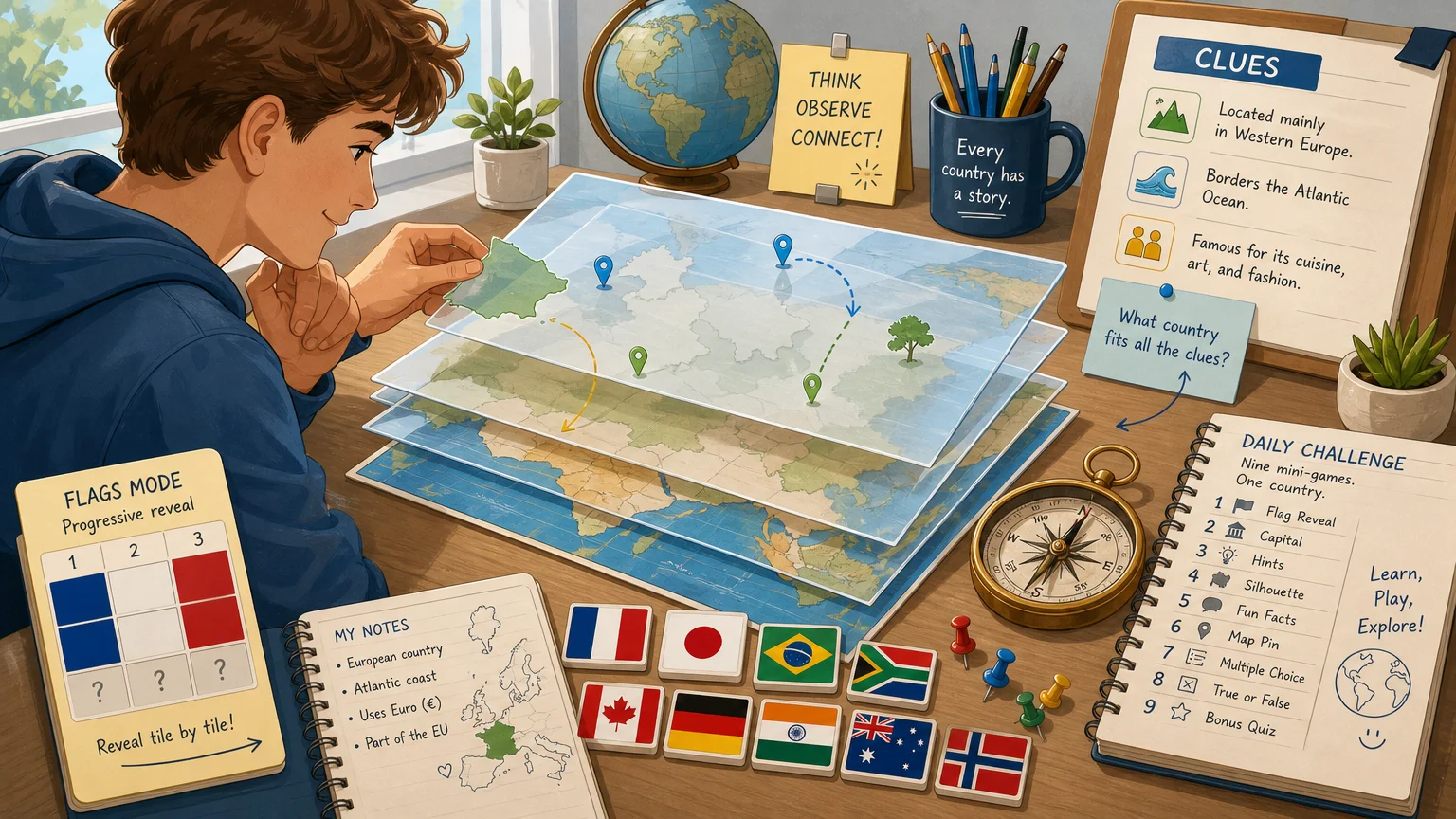
A country quiz can tell you whether you remember an answer. A well-designed map game can also teach you how places relate to one another. You may use borders, direction, distance, coastlines, scale, or regional patterns to narrow down a solution.
A 2026 article in a geography education framework explains that game-based maps differ from static maps. They may reveal information gradually, shift between two-dimensional and three-dimensional views, or require players to make decisions with incomplete information.
That distinction matters when you compare the best 2026 geography games. A simple flag drill is useful for recognition, but it should not be judged by the same standard as a game built around spatial deduction. Both can support learning, provided you understand the skill each one targets.
The best routine combines formats. Use flags and capitals for fast recall. Add silhouettes for shape recognition. Try location or street-view games when you want to reason from environmental clues. Then discuss why the answer makes sense, rather than relying only on the score.
Which games suit different play styles?
Different players need different levels of structure. A student preparing for a test may prefer focused map drills. A traveler may want country and capital recognition. A curious adult may enjoy street-level deduction or historical settings. A family may need a physical game that supports conversation away from screens.
| Option | Main focus | Practical profile |
|---|---|---|
| Flagdle | Flags, capitals, clues, silhouettes, country facts, themed quizzes | Free browser play, no account required, English and French support |
| Seterra | Interactive map quizzes covering countries, capitals, flags, and physical features | Useful for focused drills, with web and mobile access |
| GeoGuessr | Street-view location deduction using visual and cultural clues | Designed for immersive solo and multiplayer exploration |
| Worldle | Country silhouettes with distance and direction feedback | Short daily rounds built around shape recognition |
| Globle | Country guessing through hot-and-cold geographic feedback | Open-ended daily deduction with simple rules |
| Physical geography games | Cards, trivia, route building, maps, and family discussion | Useful when several people want to play together offline |
Flagdle is especially practical when you want several formats in one place. Its daily challenge provides structure, while the separate modes let you focus on a single skill or continue with replay practice.
What works best for classrooms and family learning?
A teacher usually needs a game that starts quickly, works on common school devices, and gives the class something to discuss. A family may care more about shared participation, flexible difficulty, and whether the game remains enjoyable for different ages.
For a five-minute classroom activity, daily country games can work well. The teacher can display one puzzle, collect suggestions, and ask students to explain their reasoning. Map quizzes are better when the lesson has a clear recall objective, such as learning European capitals or locating rivers.
Research published in 2008 found significant learning gains and higher intrinsic motivation in a specific primary-school geography game intervention. The earlier geography study also examined implementation issues, so its findings support careful use rather than a promise that every game produces the same result.
A 2026 systematic review examined 36 studies published between 2016 and 2025. It highlighted the educational potential of digital game-based learning while calling for more inclusive, long-term research. In practice, that means a game works best alongside explanation, discussion, maps, and other forms of study.
For a ready-made daily activity, our best 2026 daily geography quizzes can help you choose short formats for geography, history, sport, and literature. A teacher can use one round as a warm-up, while a family can solve it together before dinner.
How should you choose among the best 2026 geography games?
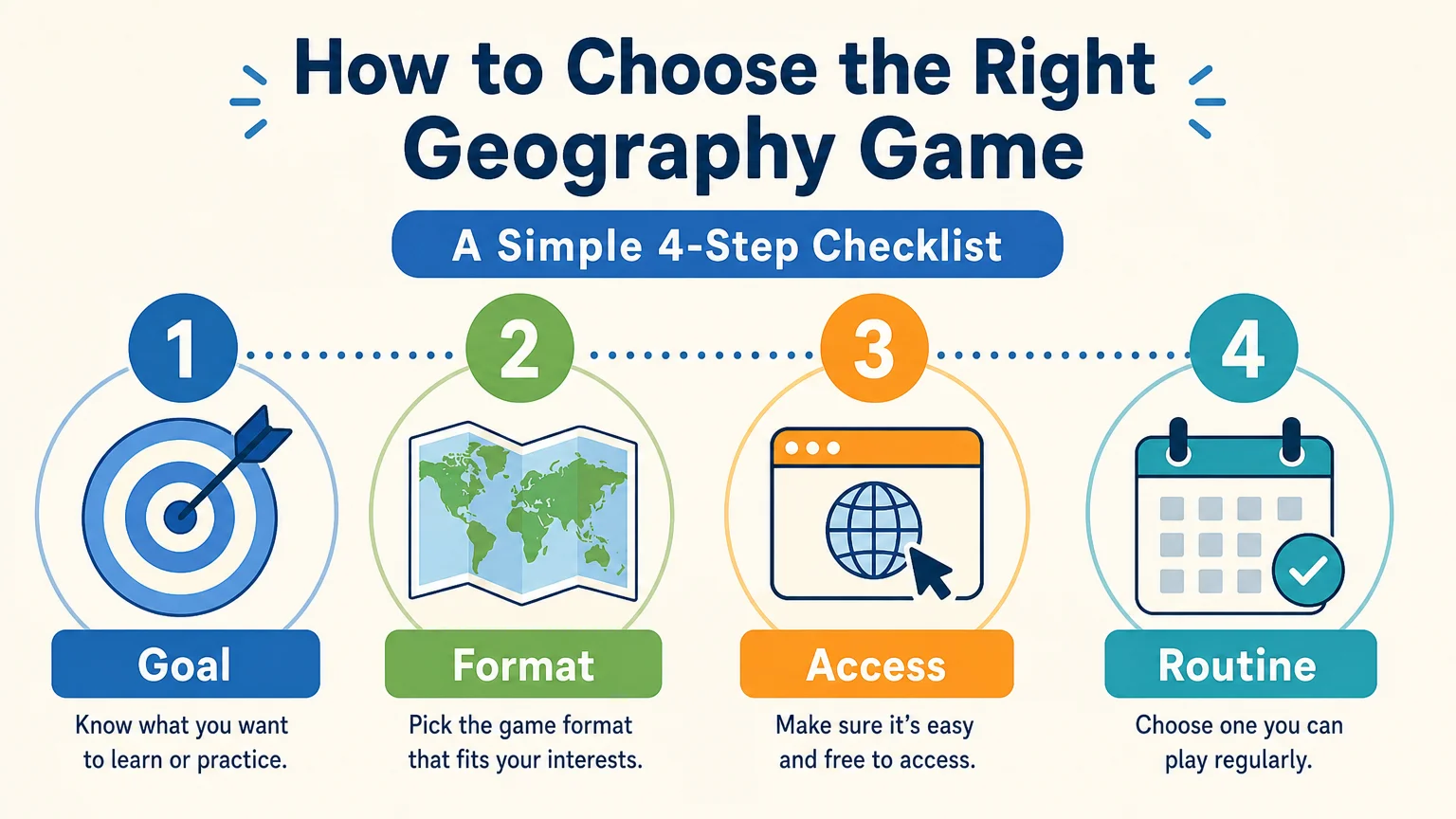
Use the following filter before you commit to a game. First, define the learning goal. If you need country recognition, choose flags, capitals, silhouettes, or map drills. If you want geographic intuition, choose games built around visual clues, distance, direction, or real-world scenes.
Next, check the access model. Browser games are convenient because they avoid downloads and work across computers, tablets, and phones. Account requirements, advertising, paid archives, and device compatibility can still differ, so check those details before using a game in class or recommending it to children.
Then consider repetition. A daily puzzle creates a natural habit, while replay mode gives you more control over practice. A platform that combines both can support casual players and students who want to improve a weak area.
Finally, look at feedback. Useful feedback should help you understand why an answer is close, what clue matters, or where the country sits geographically. Our guide to online geography games is useful when you want to compare browser-based formats by pace, mechanics, and learning style.
How can you turn a game into a learning habit?
The easiest routine is short and consistent. Play one daily puzzle, write down one country you missed, and look at its neighbors or region afterward. The next day, try to recall that country before starting the new challenge.
You can also rotate the skill. Use Monday for flags, Tuesday for capitals, Wednesday for silhouettes, Thursday for map locations, and Friday for a broader quiz. This prevents geography practice from becoming a single memorization task.
For students, keep a small error log with three columns: country, clue, and correction. For families, ask one follow-up question after each round, such as which countries border the answer or what languages are spoken there.
Score comparison can add motivation, but it should remain secondary to understanding. A lower score that leads to a useful discussion may produce more learning than a fast guess based on luck.
Choose the game that matches your geography goal
The best 2026 geography games are not identical, and that is their strength. Daily country puzzles build a repeatable habit, map quizzes support structured recall, immersive games develop observation, and physical formats make geography social. Start with one clear goal, choose a game that provides meaningful feedback, and return often enough for the places to become familiar.
Make geography part of your daily routine
If you want a simple way to practise geography without setting up a lesson or downloading an app, a short daily challenge can fit naturally into your morning, study break, or classroom routine.

Flagdle brings flags, capitals, country clues, silhouettes, facts, and themed quizzes together in a free browser experience. You can explore 195 UN-recognized countries, replay practice rounds, and compare Daily Challenge scores through the free daily geography games.
Frequently Asked Questions
What is the best geography game for daily practice?
Flagdle is a strong choice if you want several geography mechanics in one daily routine. Its Daily Challenge links nine mini-games around one mystery country, while standalone modes provide extra practice.
Which geography game is best for learning country locations?
Interactive map quizzes and silhouette games are useful for learning where countries are located. Street-view games add visual context, while Flagdle combines country clues with flags, capitals, shapes, and related facts.
Are geography games useful for students?
They can support recall, motivation, and classroom discussion when matched to a clear learning objective. They work best alongside maps, explanations, written work, and teacher guidance rather than replacing a complete geography curriculum.
Can you play geography games without an account?
Some browser games allow immediate play without registration, while others reserve archives, progress tracking, or expanded modes for accounts. Flagdle runs in the browser without an account, and its statistics are stored locally on the device.
How often should you play geography games to improve?
A short daily session is easier to maintain than occasional long sessions. Focus on missed countries, review the surrounding region, and alternate flags, capitals, maps, and clues so your practice covers more than one type of recall.