

Ever stared at a plain tricolor and blanked completely? You're not alone. Recognizing the flags of countries without their names is a genuine memory workout, and it gets weirdly addictive once you start. If you want a fast way to test yourself, our Flag Guess Quiz hands you a masked flag and lets you close the gap in just a few tries. The real trick isn't cramming 195 images into your head, it's spotting the visual logic hiding in plain sight.
Here's the thing most people miss: flags aren't random. They follow families, color rules, and recurring symbols. Once you learn to read those, a wall of confusing banners suddenly makes sense. Below, we'll break down why nameless flags trip us up, the shortcuts that unlock most of them, and the sneaky look-alikes worth memorizing on purpose.
Why Flags Without Names Are Trickier Than They Look
Strip away the label and your brain loses its favorite crutch. That's the whole challenge behind identifying countries flags without names: you can't lean on the country's shape, its position on a map, or a caption. You've got pure visual recognition to work with, and it turns out most of us are worse at it than we assume.
Research backs this up. In a study of undergraduates run through EBSCO's research database, students recognized their home country's outline 92% of the time but crashed to just 12% for a less familiar neighbor like Brunei. Familiarity does almost all the heavy lifting, and unfamiliar flags feel like noise until you give your brain a system to sort them.
The Patterns That Unlock Most World Flags
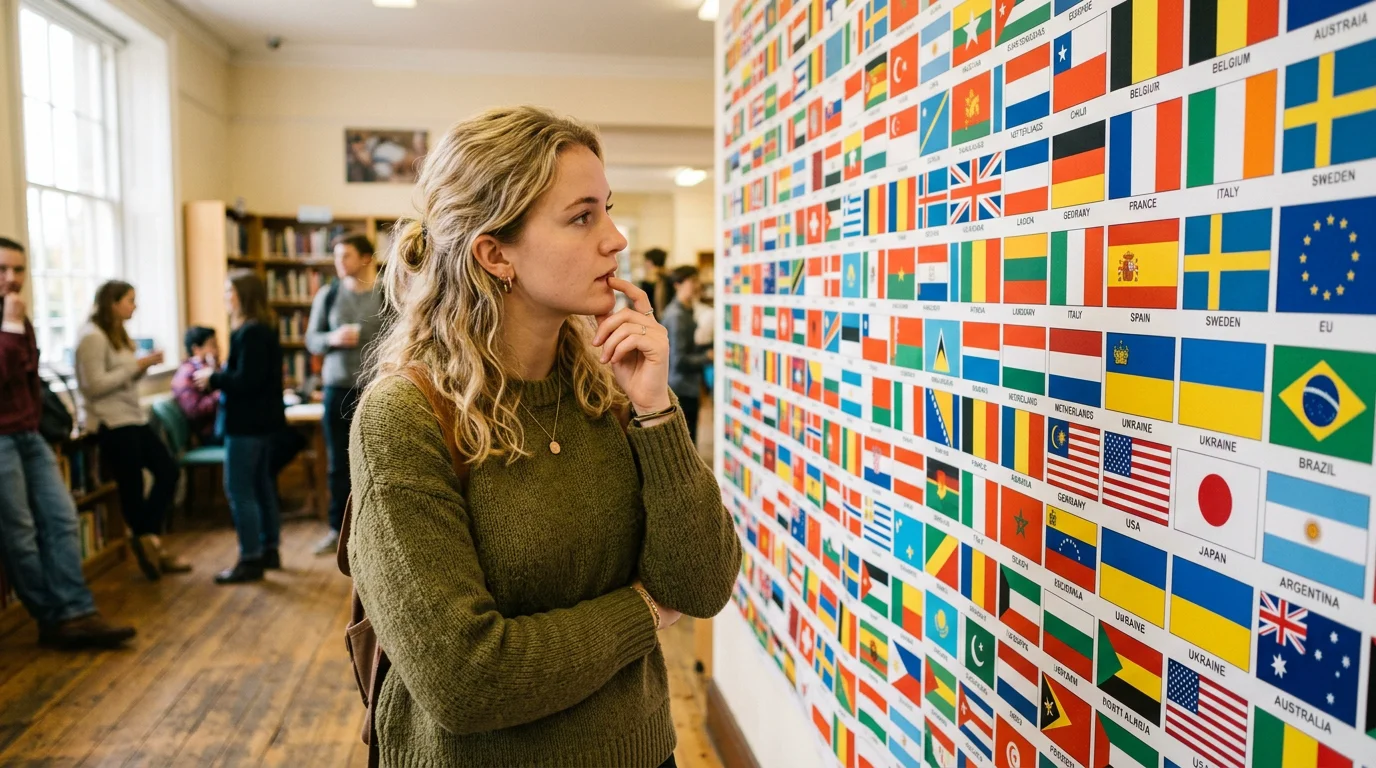
Good news: you don't need to memorize 195 separate pictures. You need to learn maybe 15 to 20 recurring designs. Vertical tricolors, horizontal stripes, a canton in the corner, a central emblem, a crescent and star. Chunk flags into these families and the mountain shrinks fast.
There's also a surprising amount of geography baked into the fabric. According to a vexillology study, about 86% of national flags contain geographical elements, with 45% featuring at least one natural element and 65% including a human-made one. Once you notice those cues, stars for constellations, blue bands for rivers or coasts, you start decoding flags instead of just staring at them.
Try grouping by dominant color too. Pan-African flags lean on red, green, gold and black. Pan-Arab flags cycle red, white, black and green. Nordic countries share the off-center cross. When you want to drill these families in one sitting, our Every Flag Quiz lets you run through the full set so the patterns stick through repetition rather than luck.
The Look-Alike Flags You'll Keep Confusing
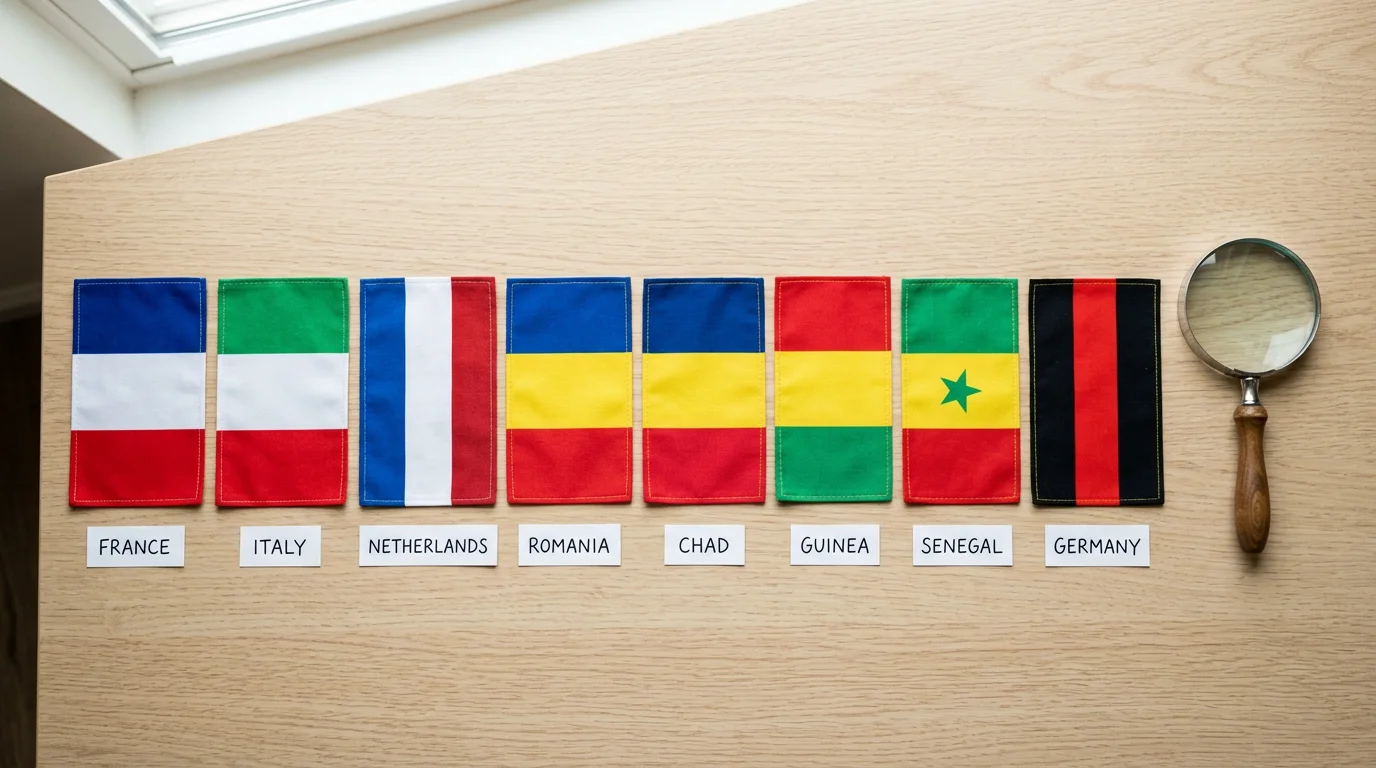
Some flags exist purely to ruin your streak. Chad and Romania are nearly identical blue-yellow-red tricolors. Indonesia and Monaco are both red-over-white, differing mainly in proportions. Ireland and Ivory Coast are the same green-white-orange, just flipped. Slovakia, Slovenia and Russia all crowd the same red-blue-white space.
The fix isn't willpower, it's deliberate pairing. Study the confusable ones side by side and anchor each with one distinguishing detail: an emblem, a shade, a stripe order. Your brain remembers differences far better than it remembers isolated images. As WorldAtlas notes, the smartest way to learn flags is by studying their patterns and drilling them through repetition rather than one-off glances.
Learn the differences, not the flags. Two banners that look 90% alike are really one small detail you just haven't locked in yet.
How Daily Games Rewire Your Flag Memory
Passive looking doesn't work. You have to actively recall, guess, get it wrong, and correct. That feedback loop is what moves a flag from "vaguely familiar" to "instant." A short daily rep beats an occasional cram session every time, because spaced repetition is how visual memory actually sticks.
That's why a five-minute daily format fits so well. A fresh masked flag each day, a limited number of tries, tiles that peel back clue by clue. If you'd rather grind through the entire roster in one go instead of waiting for tomorrow's puzzle, our All Countries Flag Quiz covers all 195 UN-recognized nations so nothing gets left out of your practice.
Which Flag Practice Format Fits You?
Not every learner wants the same thing. Some like a daily ritual, others want to hammer the full list. Here's how the common approaches stack up so you can pick your lane.
| Format | Best for | Coverage | Cost |
|---|---|---|---|
| Our daily Flagdle | A 5-minute habit with shared daily scores | 195 countries + capitals, Worldle, quiz modes | Free, no account |
| Static flag quizzes | One-off testing sessions | Varies by quiz | Free with ads |
| Printed flashcards | Offline study | Limited by deck size | Paid |
The daily format wins on consistency because the same flag lands for every player worldwide, so you can compare scores with friends and turn practice into a bit of friendly competition.
A Simple 30-Day Plan to Nail Nameless Flags
Want a concrete routine? Keep it small and repeatable. Overloading yourself is the fastest way to quit.
- Days 1 to 10: Learn the design families, tricolors, crosses, cantons, crescents. Don't chase countries yet, just the shapes.
- Days 11 to 20: Add regional color groups (Pan-African, Pan-Arab, Nordic) and tackle one continent at a time.
- Days 21 to 30: Drill the notorious look-alikes in pairs and test yourself daily with quick recall games.
Stack that with a daily challenge and the progress compounds. By week three you'll surprise yourself, telling Chad from Romania without a second thought.
Conclusion
Recognizing the flags of countries without their names isn't about a photographic memory, it's about systems. Remember the headline number: around 86% of national flags carry geographical clues, so almost every banner is telling you something if you learn to read it. Start with design families, group by color, and drill the look-alikes in pairs. Add a short daily rep and the whole world map slowly clicks into place. The best part is you can do all of this in five free, no-account minutes a day, comparing your score against players everywhere and actually enjoying the grind. Ready to see how many you already know? Jump into our Find the Flag Game and put your pattern-spotting to the test today.
Frequently Asked Questions
How many flags should I learn first?
Start with the 15 to 20 recurring design families rather than individual countries. Once those click, most flags sort themselves into groups you already recognize, which makes the remaining ones far easier.
What's the fastest way to stop confusing similar flags?
Study the look-alikes in pairs and anchor each to one distinguishing detail. Then test yourself with active recall. Our daily Flag Guess Quiz is built for exactly this kind of quick, repeated practice.
Do I really need to know all 195 countries?
Not to have fun, but full coverage helps if you're revising for an exam or travel. Working through all 195 UN-recognized nations in short daily sessions is more realistic than one big cram.