


Here's a number that surprises most people: there are only 195 countries recognized by the UN, yet the average person can name barely a couple dozen flags on sight. The good news? Flags follow patterns, and once you see them, the whole map starts clicking into place. If you want a low-pressure way to start, our Flag Geography Game turns the whole process into a daily habit.
Learning country flags the easy way isn't about brute-force memorization. It's about working with your brain instead of against it. Flags are visual, colorful, and packed with meaning, which makes them stickier than random facts. In fact, according to a vexillology study, geographical elements appear in the flags of 86% of the world's countries, so every flag you learn teaches you something about the place itself.
Why flags are easier to learn than you think
Most people assume they're "bad at geography." Really, they just never had a system. Flags are designed to be recognized quickly, from a distance, on a battlefield or a stadium. That built-in simplicity works in your favor.
There's also a memory bonus baked in. Because researchers found that colors, symbols, and emblems on flags carry specific meanings tied to a country's land, history, and culture, you're never memorizing something abstract. A cedar tree, a rising sun, a specific shade of green, each one is a hook your brain can grab onto.
So the trick isn't more effort. It's smarter effort. When you stop treating flags as 195 unrelated pictures and start seeing families, colors, and stories, the mountain shrinks fast. That's exactly why searching for country flags easy to learn is such a common starting point for beginners.
Start by grouping flags into patterns
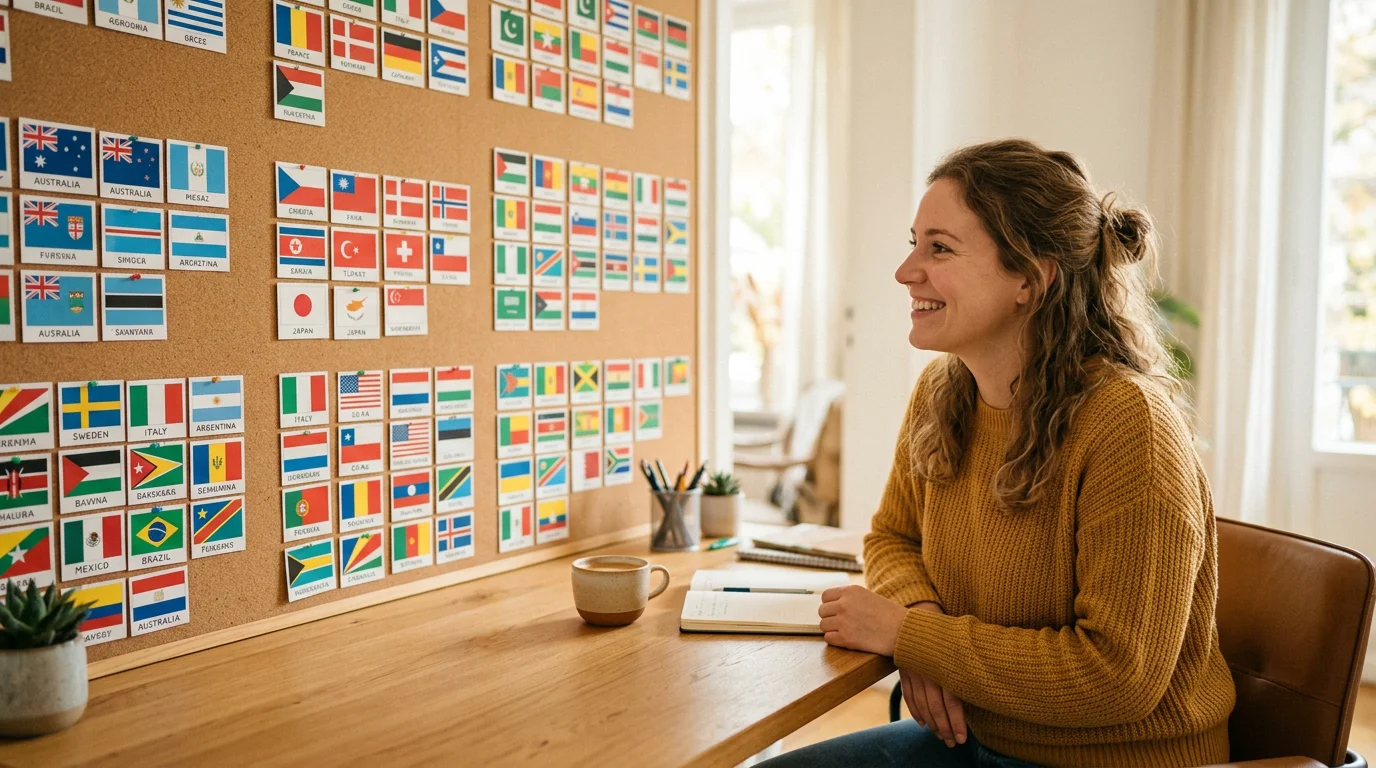
The fastest shortcut is to sort flags into visual families. Once you know the categories, you can place a new flag in seconds instead of guessing blindly.
- Tricolor stripes: vertical (France, Italy, Ireland) or horizontal (Germany, Russia, Netherlands).
- Nordic crosses: Denmark, Sweden, Norway, Finland, Iceland, all sharing an offset cross.
- Pan-African colors: red, gold, and green across many African nations.
- Stars and crescents: common across flags with Islamic heritage, like Turkey, Tunisia, and Pakistan.
- Union Jack corners: a giveaway for former British territories such as Australia, New Zealand, and Fiji.
Anchoring yourself to the full set helps too. Worldometer lists all 195 flags alphabetically, which is handy when you want to double-check a design or quiz yourself continent by continent. Work through one region at a time and the patterns start repeating in a way that feels almost predictable.
The daily habit that makes flags actually stick
Cramming 195 flags in one night doesn't work. Short, spaced repetition does. Five focused minutes a day beats a two-hour marathon every time, because your brain files information better when it revisits it across days.
This is where a daily challenge shines. A single flag, a few guesses, and a fresh puzzle tomorrow keeps the habit light and repeatable. Our Flag Identification Games lean into exactly this: the flag hides behind nine tiles that reveal more with each attempt, so you're nudged toward the answer instead of just failing cold.
Habit-building matters more than raw talent here. Geography knowledge is closely tied to consistent, well-structured learning, the same principle that education researchers highlight when they note that the top-performing school systems in 2026 rely on steady, repeated practice rather than one-off effort. Turn flags into a daily ritual and you'll retain far more than someone who binges once and forgets.

Easy flags first, tricky lookalikes later
Not all flags are created equal. Start with the ones your brain already half-knows, then tackle the confusing twins.
Begin with instantly recognizable designs: Japan's red circle, Canada's maple leaf, the Stars and Stripes. These give you quick wins and momentum. Then move to the notorious lookalikes that trip everyone up:
- Chad vs. Romania: nearly identical blue-yellow-red tricolors.
- Indonesia vs. Monaco: red over white, differing mainly in proportions.
- Chad vs. Romania and Ireland vs. Ivory Coast: same colors, flipped order.
- Slovenia, Slovakia, and Russia: white-blue-red with subtle crests.
The mental trick is to attach one distinguishing detail to each. Romania's yellow is brighter; Ireland leads with green on the left. When you're ready to test whether the difference has stuck, learning how to find the flag against similar options is one of the best ways to lock in those fine distinctions.
Comparing ways to learn flags
There are plenty of methods out there. Here's how the main approaches stack up for a beginner who wants results without the grind.
| Method | Best for | Daily effort | Keeps it fun? |
|---|---|---|---|
| Flashcards | Raw memorization | Medium | Low |
| Static flag lists | Quick reference | Low | Low |
| One-off quizzes | Testing yourself | Variable | Medium |
| Our daily flag challenge | Long-term retention | 5 minutes | High |
Flashcards and lists work, but they get dull fast, and boredom kills consistency. A daily game covering all 195 countries keeps the streak alive because there's always a fresh puzzle waiting. For a broader workout, the ultimate all countries flag quiz guide walks you through covering every region without burning out.
Putting it all together
Learning flags isn't a memory contest reserved for geography nerds. Sort them into visual families, start with the easy wins, attach one detail to each tricky lookalike, and practice a few minutes every day. Remember the big picture: with only 195 national flags to cover, the finish line is genuinely reachable, and each one teaches you a piece of the world's story.
The reason a daily flag habit works so well is that it stays short, stays fun, and gives every player the same puzzle to compare scores against. That's the whole idea behind making country flags easy and enjoyable to master. Ready to start your streak? Try our daily flag identification game and see how many you can name by next week.
Frequently Asked Questions
How many country flags are there to learn?
There are 195 flags for the countries recognized by the United Nations. If you also count dependencies and territories, lists can run past 250, but 195 is the standard goal for most learners.
What's the fastest way to memorize flags?
Group flags by shared patterns, then practice a little every day rather than cramming. Our daily flag game reveals a hidden flag tile by tile, which reinforces recognition through spaced repetition.
Which flags are hardest to tell apart?
Classic mix-ups include Chad and Romania, Indonesia and Monaco, and Ireland and Ivory Coast. The fix is to memorize one small distinguishing detail, like a specific color shade or the order of stripes.