
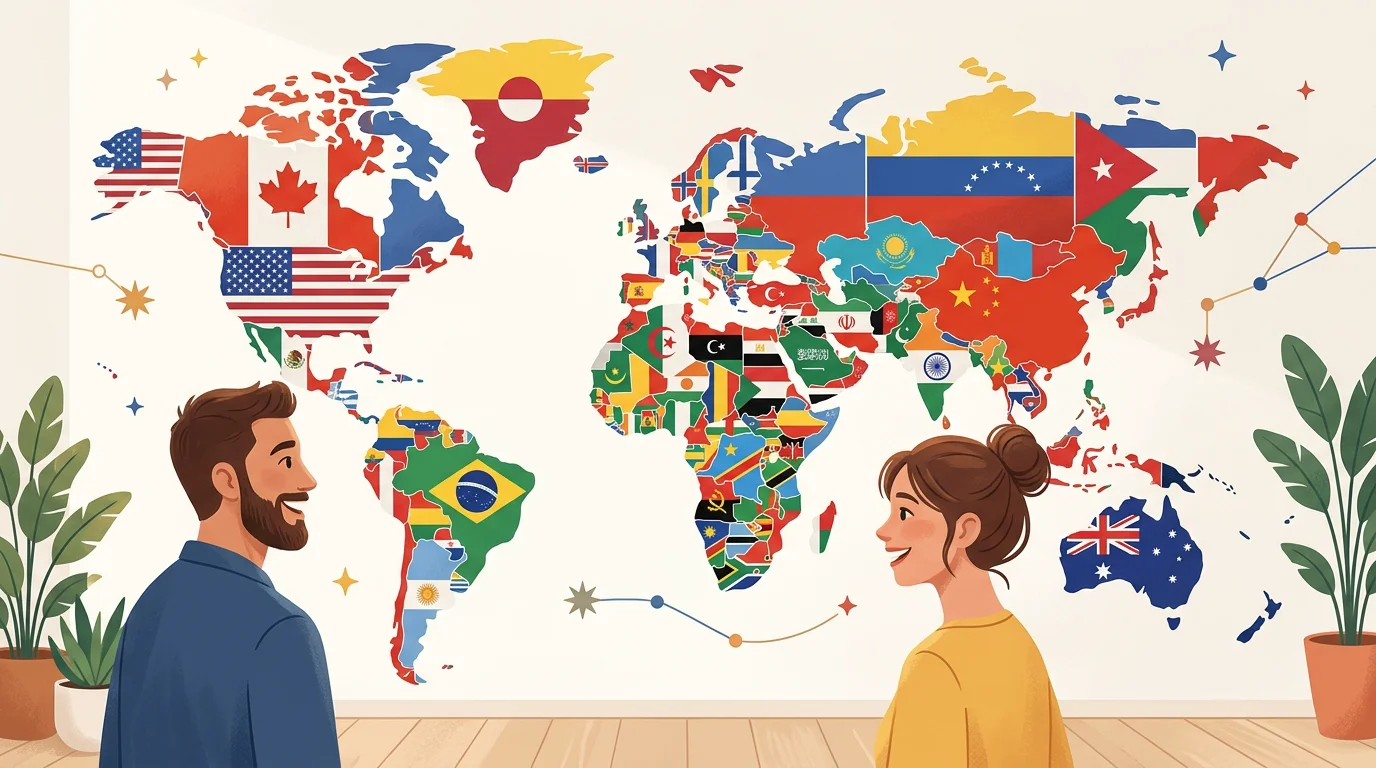

Quick question: can you match the flag of Brunei to a spot on the map? Most people can't, and that's totally normal. In one university study, only 12% of students recognized Brunei's map outline, while 92% nailed Singapore's. That gap is exactly why connecting flags to geography works so well. Flags are tiny, memorable hooks that pull whole countries into your head. Want a playful place to start? Our daily flag game shows you one masked flag a day and lets you guess where it belongs.
The trick is treating flags as a doorway, not a trivia dead end. Each banner carries colors, symbols and a location you can anchor on a mental map. According to a Cartographica study, people often read the imagery on flags as clues about geographic location. Learn to see that, and 195 flags stop being random rectangles.
What flag geography actually means
Let's define it simply. The idea behind flag geography is using a country's flag as the entry point to everything else about it: where it sits, its capital, its neighbors and its region. Instead of memorizing a dry list, you build associations. Red maple leaf equals Canada. Rising sun equals Japan. Cedar tree equals Lebanon.
The scope is well defined too. Worldometer lists the flags of all 195 recognized countries, and that's the same set most serious learners aim to cover. Some quiz apps stretch to around 197 or add dependent territories, but the 195 UN members are the backbone. Master those and you've basically got the whole planet mapped.
Why flags are a shortcut to learning the map
Here's the honest problem: geography knowledge is patchy. In the United States, the NAEP geography assessment found that eighth-grade scores in 2018 were lower than in 2014, with the biggest drops among lower-performing students. Traditional map drills clearly aren't sticking for everyone.
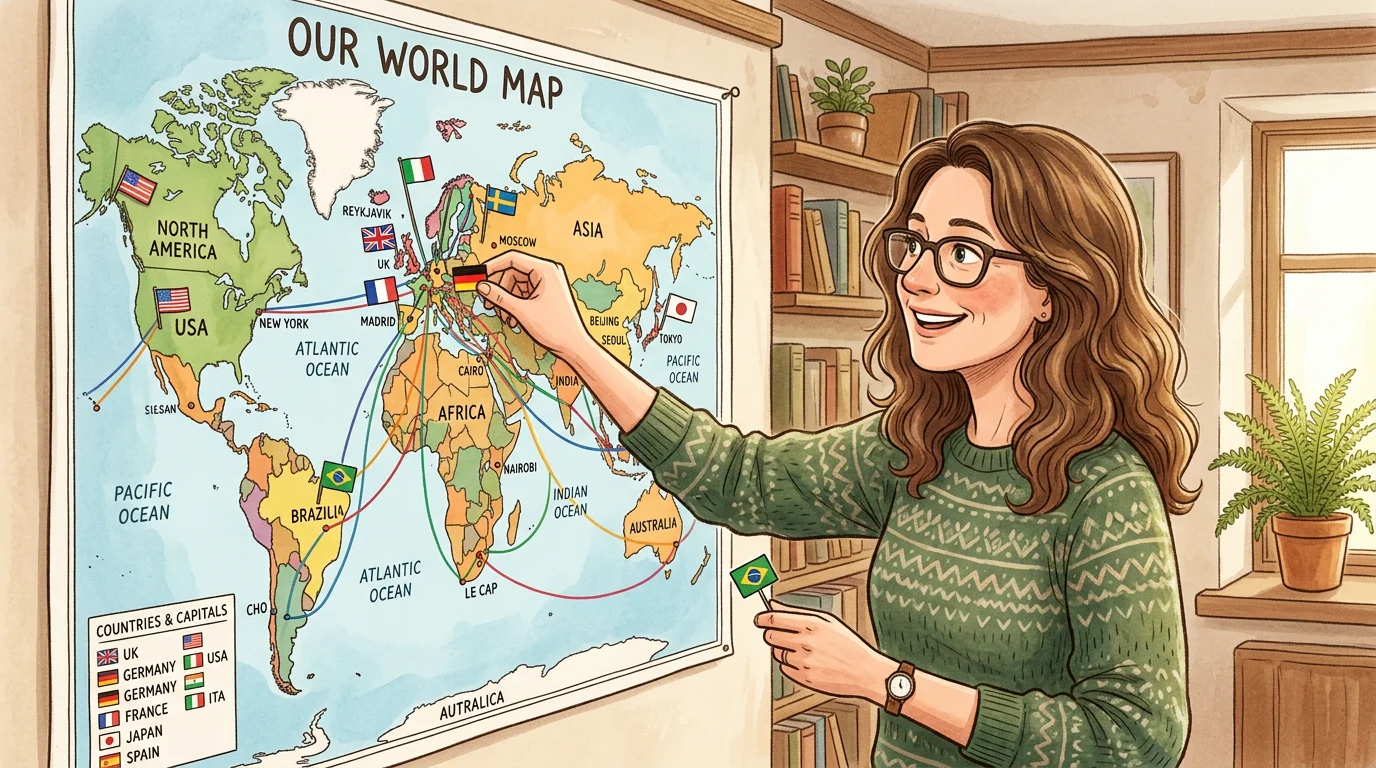
Flags flip the approach. They're visual, colorful and emotionally loaded, which makes them easier to remember than a bare country name. Once a flag is locked in, you can hang extra facts on it: the capital city, the surrounding continent, the language. It's the same reason teachers use flag activities. You attach a story to an image, and the country's location comes along for the ride.
That's especially handy for travelers and trivia fans. Spot a flag on a jersey, a building or a news broadcast, and you instantly place the country. The flag becomes a mental bookmark for an entire region.
The science of reading flags as geography
Flags aren't random art. Many literally encode location and identity, and that's a field of its own called vexillology. In the same flag recognition research at the National University of Singapore, students often linked maps printed on flags to the theme of geographic location, yet only 13% correctly identified which flags actually contain maps.
The takeaway is encouraging: recognition improves fast with exposure. The study noted big differences between familiar and unfamiliar countries, which means the flags you struggle with today are simply the ones you haven't seen enough. Repetition closes the gap. That's the whole logic behind a short daily habit instead of one giant cram session.
Turning flags into a daily habit
Cramming 195 flags in one sitting is miserable and forgettable. A small daily dose works far better, and it's where a game format shines. This is our angle at Flagdle: one masked flag reveals gradually across nine tiles, and you get three tries to name the country. It takes a couple of minutes and it renews every day.
Because the challenge is identical for every player worldwide, you can compare scores with friends through daily, weekly and monthly rankings. Prefer testing your full range? Our Every Flag Quiz walks through the complete set so you can spot exactly which regions trip you up. Here's how a daily guessing game stacks up against other common ways to study flags.
| Approach | Countries covered | Account needed | Format | Cost |
|---|---|---|---|---|
| Our daily flag game | 195 UN countries | No | Daily guess, 3 tries, tiles reveal | Free, no intrusive ads |
| Multiple-choice flag apps | Up to ~245 with territories | Sometimes | Pick from 4 to 6 options | Free with ads or paid |
| Printable worksheets | Varies by pack | No | Color and label by hand | Usually paid |
| Timed online quizzes | ~197 flags | Optional | Type answers against a clock | Free with ads |
Multiple-choice apps and timed quizzes each have their place, but guessing from a partially revealed flag forces active recall, which tends to stick better than picking from a list.

Tips to memorize flags faster
Want to speed things up? A few simple habits make a huge difference.
- Group by region. Learn a continent at a time so nearby flags reinforce each other.
- Hunt for patterns. Pan-African red, green and gold, Nordic crosses, and Arab tricolors repeat across neighbors.
- Tie the flag to the capital. When you learn Kenya's flag, learn Nairobi too. Two facts, one image.
- Space it out. Short daily reps beat marathon sessions, as the recognition research suggests.
- Test the weak spots. Focus on the flags you keep missing rather than the easy ones.
If you like a bit of pressure, our find the flag game asks you to pick the right banner quickly, which is great for drilling the ones that still slip your mind. Mix modes, keep sessions short, and the map fills in surprisingly fast.
From flags to a whole mental map
Once flags click, the rest of geography follows. You start noticing which countries border which, how regions share colors and history, and where capitals sit. A flag is small, but it's a doorway into culture, politics and place. That's why it beats staring at a blank map: you're learning through images and stories, not brute force.
Best of all, you don't need a classroom. A couple of minutes a day, one flag at a time, and within a few weeks you can recognize dozens you'd never have placed before.
Conclusion
The evidence is clear: recognition of unfamiliar flags is low, with some sitting around 12%, but it climbs quickly with regular exposure. That's the real promise of flag geography, turning intimidating memorization into a light daily ritual that connects colors, countries and capitals. Start with the flags you see most, group them by region, and let a short daily challenge do the heavy lifting over time. The best part is that a quick, free, account-free game keeps you coming back without the friction of ads or sign-ups. Ready to test yourself against the world's flags? Play our flag geography game and see how many of the 195 you can already name.
Frequently Asked Questions
How many flags are there to learn?
Most learners target the 195 countries recognized by the United Nations. Some apps add a few disputed states and dependent territories, pushing the total closer to 245, but the 195 core flags cover every UN member.
What's the fastest way to memorize flags?
Short daily sessions grouped by continent, plus active recall instead of multiple choice. Our daily flag game reveals one flag across nine tiles in three tries, which trains recognition better than passively scanning a list.
Do I need to learn capitals too?
It helps a lot. Pairing each flag with its capital gives you two anchors for one image, so the country's location sticks faster and stays put longer.