

Can you tell Chad's flag from Romania's? Most people can't, and that's exactly why a quick daily puzzle beats a textbook. There are 195 countries to learn, and staring at a wall map rarely makes them stick. Playing does. That's the whole idea behind our Country Flag Guessing Game: you guess the country, the flag reveals itself bit by bit, and your brain quietly builds a map of the world along the way.
The appeal of a flag geography game isn't just nostalgia for trivia night. Learning through play actually works, and the research backs it up. According to a 2023 meta-analysis, gamified learning produces a large positive effect on student outcomes. So if you've struggled to memorize flags before, the problem probably wasn't you. It was the method.
What makes a flag geography game worth your time
Not every quiz is built the same. A good flag quiz game does more than flash images and tally a score. It connects each flag to a real place, a capital, a neighbor, a story. That connection is what turns a random rectangle of color into something you actually remember.
The best versions also respect your time. You don't need an hour. You need three minutes a day, every day, with a fresh challenge waiting when you come back. That rhythm matters more than marathon sessions, and we'll get to why in a moment.
Why flags stick when you learn them through play
Here's the fun part: this isn't wishful thinking. The science of game-based learning is pretty clear. That same 2023 review pulled together 41 studies covering more than 5,000 participants and found a strong, measurable boost in learning outcomes when game mechanics were involved.
Retention is where it really shows. A longitudinal study tracked 617 students over two years and found that gamified designs measurably improved how much knowledge people held onto over time. Translation: the points, the streaks, and the "one more try" pull aren't gimmicks. They're what makes the flags actually stay in your head.
It works because games tap motivation and repetition at the same time. You want to beat yesterday's result, so you show up again. And showing up again is, conveniently, the exact thing memory needs.
How the daily flag challenge works
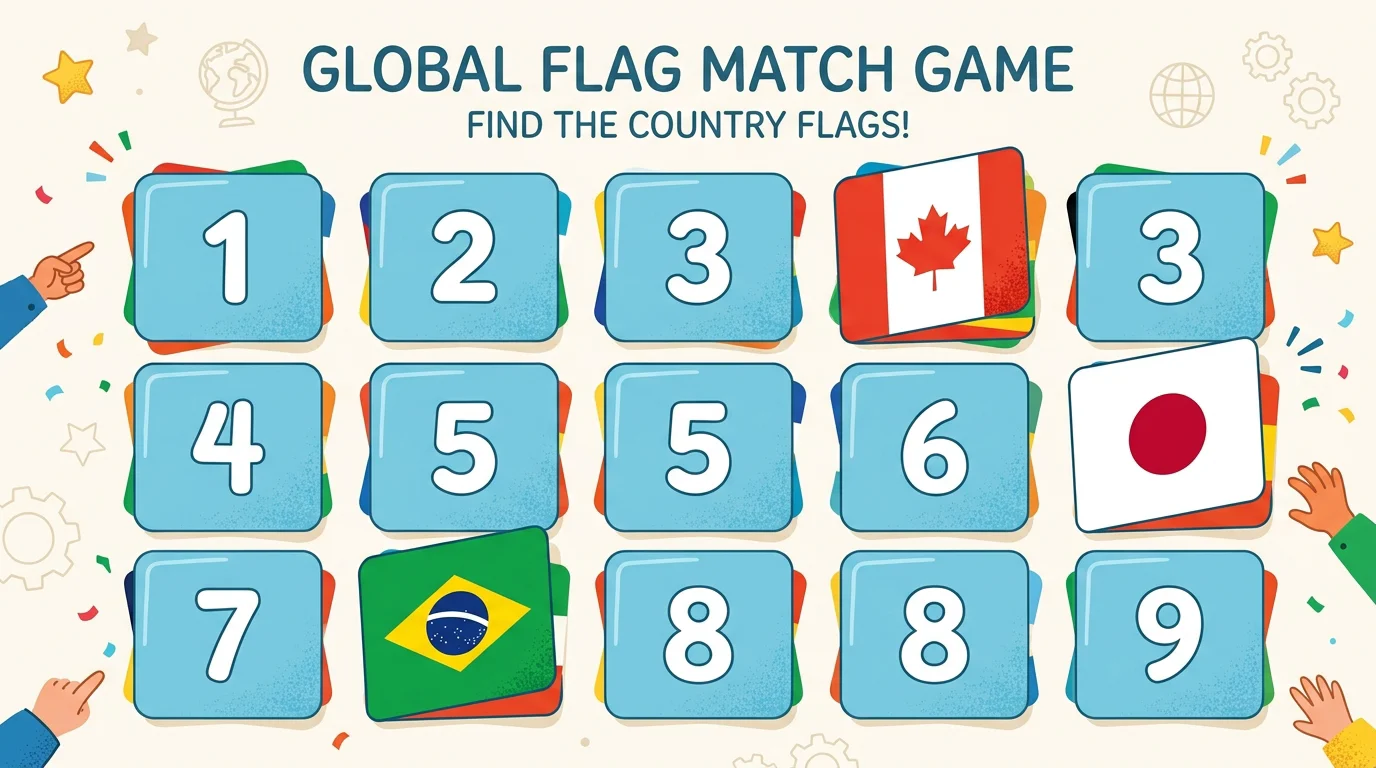
This is the differentiator, so let's get specific. In our daily challenge, the flag starts hidden behind nine tiles. Each guess you make peels back one tile in full color. Guess smart, and you can name the country before the whole flag is exposed.
A few things make this format click:
- Progressive reveal: you reason from partial clues instead of just recognizing or failing.
- One puzzle for everyone: the same flag drops daily worldwide, so you can compare results with friends.
- Built-in return loop: a new country every day gives you a small reason to come back.
If you'd rather not wait 24 hours between rounds, there are endless and timed modes too. Want to bounce between flags, capitals, and country clues in one place? Our Countries Games Online bundle several mini games around country data like shape, capital, currency, and neighbors, and our geography quiz games make it easy to keep practicing.
Flags, capitals, and maps: the full picture
Flags are a fantastic entry point, but real geographic literacy comes from connecting them to location. Knowing the flag of Fiji is great. Knowing where Fiji sits in the Pacific is better. Pairing the two builds far stronger memory than either alone.
This holds up in classrooms too. A 2026 review of school geography found that gamified approaches had a positive effect on students' motivation and cognitive development. Educators have used game-based methods to make abstract geography concepts feel concrete, an idea echoed in research from a University of Northern Iowa paper on bringing complex geography to life through interactive play.
So mix your modes. Once flags feel comfortable, layer in maps. Our Mapdle map game challenges you to pin down countries on the world map, which locks the "where" to the "what" you already know.
How the main flag game modes compare
Geography games come in a few flavors. Some test pure recall, some race the clock, some drip clues. Here's how the common formats stack up, including how our daily approach fits in.
| Format | How it works | Best for | Daily challenge? |
|---|---|---|---|
| Our daily flag reveal | Guess the country as 9 tiles uncover the flag | Building a habit and reasoning from clues | Yes, plus endless and timed modes |
| Multiple-choice flag quiz | Pick the right flag from options | Quick beginner practice | Usually no |
| Type-the-answer flag list | Name as many flags as possible against the clock | Testing total recall | Usually no |
| Flag-to-map clicking | See a flag, click its country on a map | Linking flags to location | Varies |
The point isn't that one format wins. It's that a daily reveal keeps you coming back, while the other modes are handy for cramming a region before a test or a trip.
Tips to memorize flags faster
Want results quicker? A few habits make a real difference, and they line up neatly with what the retention research suggests about steady, repeated practice.
- Go region by region. Learn one continent before moving on. European flags lean on crosses and tricolors; African flags often use red, yellow, and green.
- Group the lookalikes. Tackle Chad and Romania, Monaco and Indonesia, or Australia and New Zealand together so you learn the difference, not the confusion.
- Practice little and often. Short daily reps beat rare long sessions. That two-year study on knowledge retention found steady, repeated play kept knowledge from fading.
- Tie flags to facts. Connect each flag to a capital, a neighbor, or a fun detail. More hooks mean better recall.
Stick with these for a couple of weeks and the flags you once mixed up will start feeling obvious.
Wrapping up
Learning the world's flags doesn't require flashcards or a rainy Sunday afternoon. It requires showing up for a few minutes a day, which is exactly what a good flag-based geography game makes easy. The research is encouraging: gamified learning delivers a large, measurable boost to outcomes, and steady daily practice is what cements it. So instead of forcing yourself to memorize, let the game do the heavy lifting through curiosity and small wins. The progressive tile reveal turns each puzzle into a tiny mystery worth solving, and a fresh country every day keeps the habit alive without ever feeling like homework. Ready to put your flag knowledge to the test and actually remember it? Start with our Flag Identification Games guide and learn every flag faster.
Frequently Asked Questions
How many country flags are there to learn?
There are 195 widely recognized countries, each with its own flag. Many games also include territories, so the total you'll encounter can be higher depending on the mode you play.
Are flag geography games actually good for learning?
Yes. A 2023 meta-analysis of more than 5,000 participants found gamified learning produces a large positive effect on outcomes. Daily play also supports long-term retention better than occasional cramming.
What's the fastest way to memorize flags?
Practice a little every day, learn one region at a time, and group lookalike flags together. Our daily flag challenge builds that habit by giving you a fresh country to guess each day.