
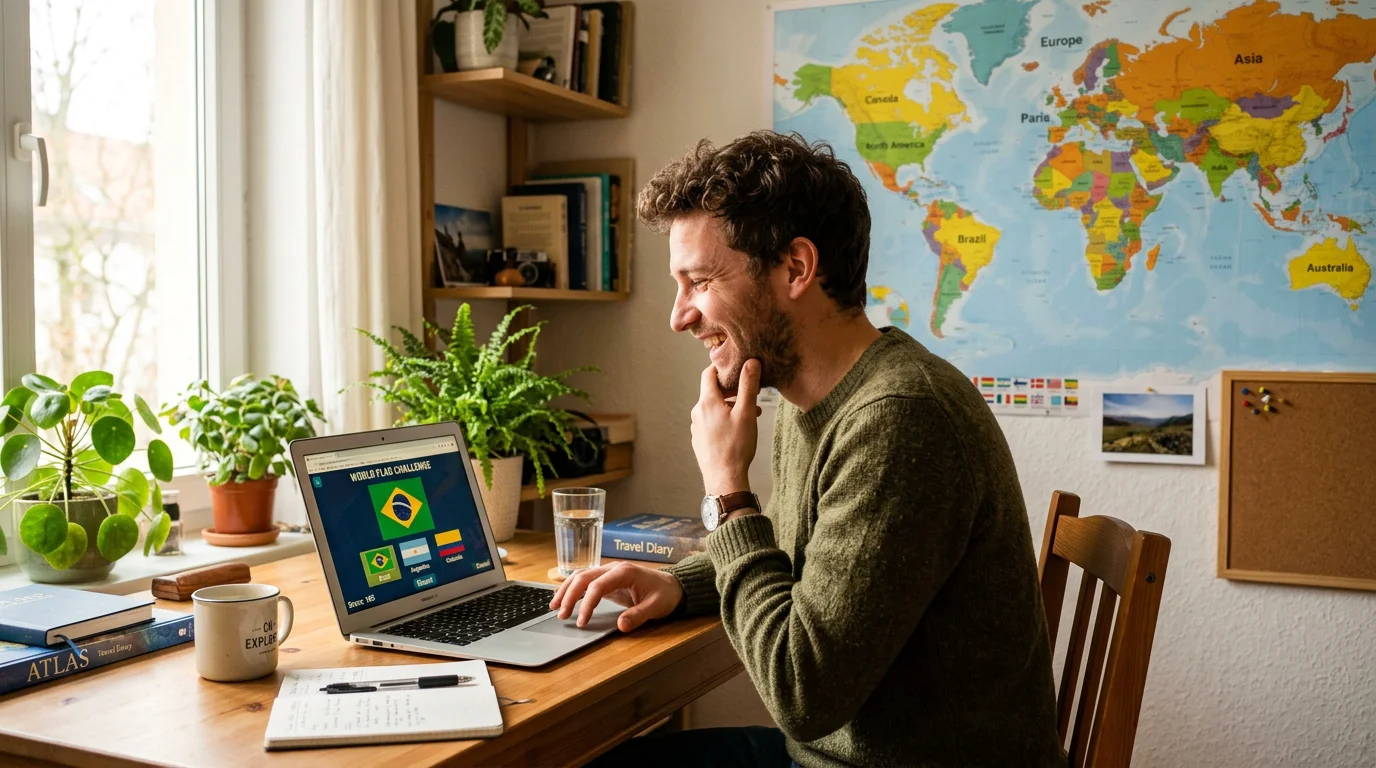

Ever stared at a flag and felt it was on the tip of your tongue? You're not alone. Memorizing 195 national flags sounds like a school chore, but it doesn't have to be. Turn it into a quick daily challenge and something clicks. That's exactly the promise of a good flag learning game, and our Flag Identification Games: how to learn every flag fast guide shows how fast it can happen.
The science backs the fun. According to gamification research, playful learning experiences can boost knowledge retention by as much as 90% compared to passive study. Flags are perfect fuel for this: they're visual, colorful, and tied to real places you actually care about. Play a few rounds a day and the map of the world starts living in your head.
Why a game beats flashcards for learning flags
Think about the last time you crammed with flashcards. Boring, right? And most of it faded within a week. A game flips that script by adding stakes, feedback, and a reason to come back tomorrow.
The numbers are hard to argue with. A case study cited by Zippia found a class raised average test scores from 49% to 83% over four months once lessons went gamified, a 34% jump. The same research notes that roughly 67% of students simply prefer learning this way. When something feels like play, you stick with it, and sticking with it is the whole battle when you're trying to learn world flags.
There's also the memory mechanics at work. Short, repeated rounds tap into what researchers call spaced retrieval, spreading practice across time so each recall session strengthens the memory. A daily flag round is basically spaced retrieval disguised as fun.
The daily challenge: one flag, everyone, same tiles
Here's where things get addictive. Imagine every player on the planet gets the same hidden flag today. You compare scores with friends, brag a little, and come back tomorrow to defend your streak. That shared daily puzzle is the engine behind our approach.
In our game, the flag starts hidden behind 9 tiles that reveal progressively, and you get 3 tries to name the country. It's quick, it's tense, and it rewards pattern recognition. Want to feel the mechanic yourself? Our Flag Guessing Game: learn flags the fun way lays it all out. The identical-daily-flag format also makes leaderboards fair, since everyone faces the exact same challenge.
This matters because completion and consistency drive results. Gamification data from AmplifAI shows gamified programs reaching a 90% completion rate versus just 25% for non-gamified ones, while lifting knowledge retention by around 45%. A daily ritual you actually finish beats a giant study plan you abandon.
Not just flags: capitals, silhouettes, and quizzes
Flags are the gateway, but geography is bigger than that. Once you can spot Chad from Romania (yes, they're nearly identical), you'll want more. That's why variety keeps the learning fresh instead of repetitive.
Our modes stretch your brain in different directions. There's a Capitals mode with 6 tries and progressive hints (first the continent, then the first letter), a Worldle-style mode where you guess a country from its silhouette in 6 tries, and daily themed quizzes of 10 questions. Mixing formats keeps you engaged, and you can start simple with our Flag quiz game before branching out.
The best way to learn 195 countries isn't to study them once. It's to bump into a few of them, playfully, every single day.
How a flag game stacks up against other options
Not all flag tools are built the same. Some throw multiple-choice questions at you, some drill regions, and some hide the whole thing behind ads or paywalls. Here's an honest look at the common formats and where our approach lands.
| Feature | Our daily game | Regional multiple-choice quizzes | App-store flag apps |
|---|---|---|---|
| Coverage | 195 UN-recognized countries | Often region-limited | Around 200 flags |
| Core format | 9 tiles reveal, 3 tries | 4-option multiple choice | Timed matching |
| Daily shared challenge | Yes, same flag worldwide | Rare | Rare |
| Cost | Free, no account | Usually free | Often ads or in-app purchases |
| Extra modes | Capitals, silhouette, quizzes | Limited | Varies |
Regional quizzes are handy if you only care about, say, Europe. App-store options offer landmarks and currencies too, though many now carry ads and in-app purchases. If you want a clean, free ritual that covers the full world map, a shared daily challenge is tough to beat.
Who actually benefits from playing daily
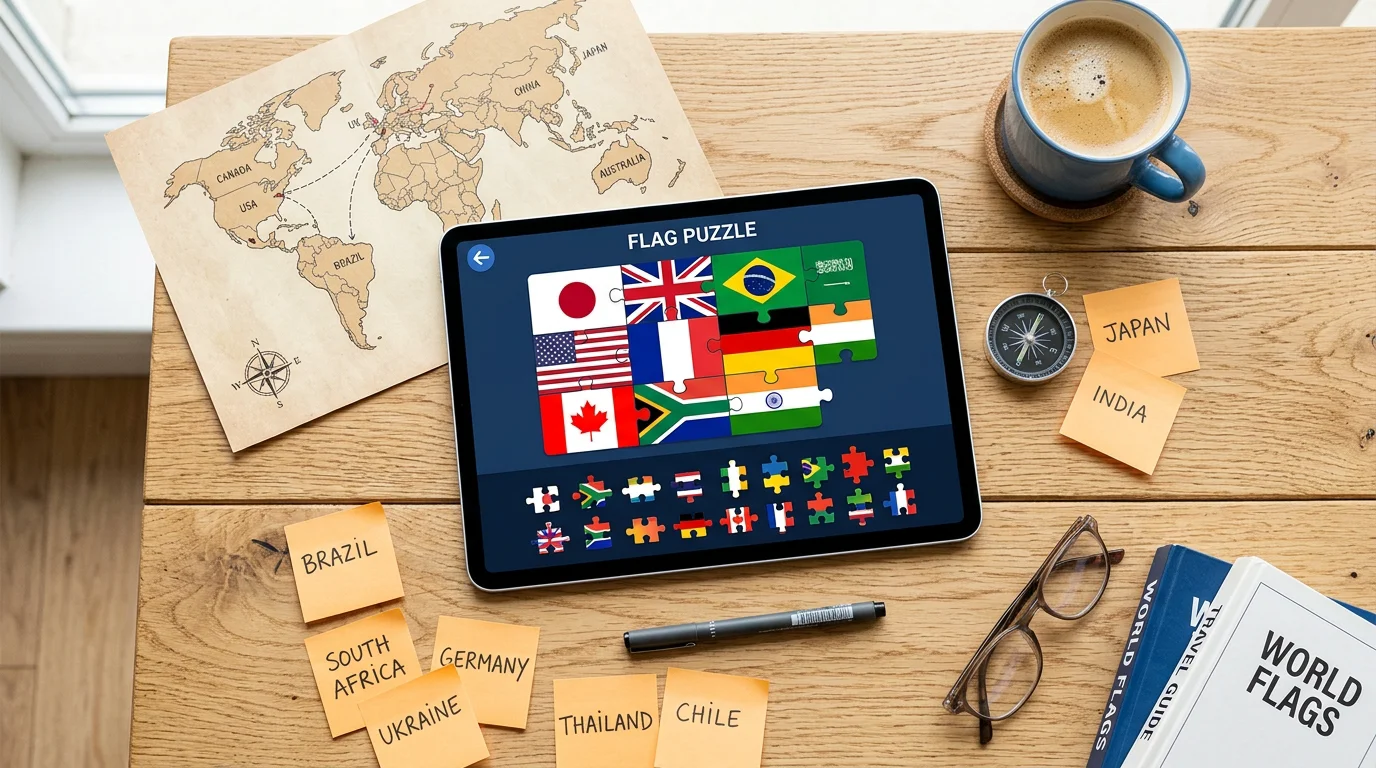
Picture a teacher opening class with a 5-minute flag round. Or a student prepping for a geography exam. Or a traveler learning the flags they'll see on their next trip. Each one gets something different from the same simple habit.
Students build durable recall through repetition, teachers get an instant classroom warm-up, and trivia fans just love the competition. The appeal is broad because the format is flexible. Gamified education isn't a niche experiment anymore either: analysts project the gamification-in-education market to reach $48.72 billion by 2029, growing at nearly a 26% annual clip. That momentum reflects a real shift in how people prefer to learn.
If your goal is memorizing all 193 UN member flags without burning out, structured daily practice is the trick. Our Every Flag Quiz explained: learn 193 flags fast breaks down exactly how to get there step by step.
Getting started (and actually sticking with it)
The hardest part isn't difficulty, it's consistency. So make it easy on yourself. Play at the same time each day, coffee in hand, and treat it like a two-minute brain snack rather than a study session.
Start with the flags you half-know to build confidence, then let the tougher lookalikes challenge you. Track your streak, compare with a friend, and don't sweat the misses, because a wrong guess you correct sticks better than an easy win. Since our stats are stored locally on your device and there's no account or intrusive ads to slow you down, you just open your browser and go.
Bottom line: turning geography into a daily flag learning game works because it aligns with how memory actually forms, and gamified learning consistently drives retention gains up to 90%. Small rounds, real progress, zero pressure. The habit compounds quietly until one day you realize you can name almost every flag on Earth. Because our game is completely free, needs no sign-up, and gives everyone the same puzzle to compare, there's nothing standing between you and that first win. Ready to test yourself? Play our daily flag guessing game and start your streak today.
Frequently Asked Questions
How many flags can I learn with a daily flag game?
Our game covers all 195 countries, including the 193 UN-recognized member states. Playing a short round each day, most people can recognize the majority of world flags within a few weeks.
Is playing a flag game really effective for memorization?
Yes. Gamified learning taps into repetition and immediate feedback, and research links it to retention gains of up to 90%. Daily short rounds work far better than one long cram session.
Do I need to pay or create an account to play?
No. Our game is completely free, requires no account, and has no intrusive ads. Your stats are stored locally on your device, so you can just open your browser and start guessing.