
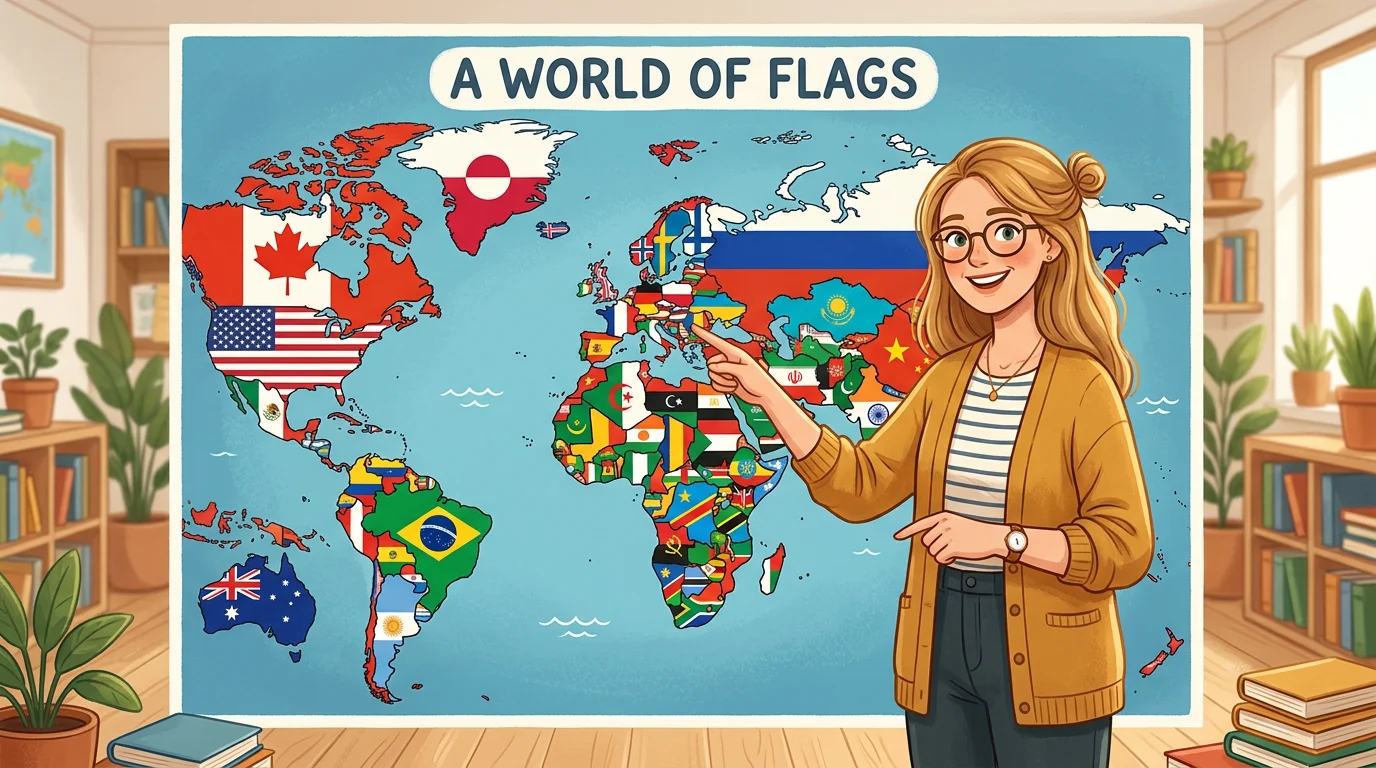

Quick, can you tell Chad from Romania? Most people can't, and that's totally normal. There are 195 UN-recognized countries, dozens of near-identical designs, and a brain that forgets fast. That's exactly why a playful, repeatable approach beats staring at a poster. If you want the world's flags to actually stick, a good flag memorization game does the heavy lifting for you. You can start today with our Flag Learning Game and see how quickly things click.
Here's the thing: memorizing flags isn't about talent or a "good memory." It's about how you practice. Turn it into a short daily challenge with instant feedback, and suddenly those confusing stripes and stars become second nature. Below, we'll break down why flags are tricky, what the science says about learning them, and how to go from clueless to confident.
Why flags are surprisingly hard to remember
Flags are abstract. A tricolor here, a crescent there, a star in the corner. Your brain has almost nothing to anchor them to, so they slip away quickly. This isn't a personal failing; it's just how memory works.
Back in 1885, German psychologist Hermann Ebbinghaus ran the first systematic experiments on forgetting and found something striking. According to a review of the evidence, most forgetting happens rapidly in the first hours and days after learning, then levels off. So if you cram 50 flags on Monday and never revisit them, most are gone by Wednesday.
Add the lookalikes and it gets worse. Chad and Romania share nearly identical vertical stripes. Indonesia and Monaco are both red over white. That's why a system built around repetition and testing works so much better than a one-time study session.
The science: why games make flags stick
Two techniques dominate the research on durable learning: active recall (testing yourself instead of rereading) and spaced repetition (reviewing at increasing intervals). A good flag game quietly uses both. Every guess is a retrieval attempt, and playing daily naturally spaces your reviews.
The payoff is big. Research in medical training found that long-term retention can be 2 to 3 times greater using active recall compared with passive methods like rereading highlighted notes. Guessing a flag, getting it wrong, then seeing the answer is exactly that kind of high-value retrieval.
What makes a flag game actually work
Not every quiz is built for memory. The best ones give you immediate feedback, keep sessions short, and make you retrieve the answer rather than recognize it from a list. A few features matter most:
- Progressive reveals: a flag hidden behind tiles that uncover as you guess keeps you thinking instead of skipping.
- Limited attempts: a tight guess budget forces genuine recall, not lucky clicking.
- Daily renewal: a fresh challenge each day spaces your practice automatically.
- Multiple modes: flags, capitals, and country silhouettes reinforce the same knowledge from different angles.
Our own gameplay leans into this. In our flag mode, one flag sits behind 9 tiles and you get 3 tries to name the country, with tiles peeling back to nudge you along. If you prefer a pairing style, our Flag Matching Games let you test recognition in a different, faster format that pairs nicely with daily play.
Beating the lookalike flags
The trickiest part of learning flags is the near-twins. Instead of memorizing each in isolation, learn them as contrasting pairs and attach a tiny mental hook to each one.
- Chad vs Romania: nearly identical stripes; Romania's blue is a touch brighter.
- Senegal vs Mali: same green-yellow-red bands, but Senegal adds a green star in the center.
- Indonesia vs Monaco: both red-over-white, but Indonesia's is wider.
- Australia vs New Zealand: both carry the Union Jack; New Zealand has fewer stars, and they're red with white borders.
Little tricks help too. For flags like São Tomé and Príncipe or Saint Kitts and Nevis, the two stars can remind you of the two islands. Seeing these pairs side by side, again and again, is what finally breaks the confusion.
Why a daily challenge keeps you learning
Motivation fades fast when studying feels like a chore. A short daily ritual solves that. Five minutes, one flag, a streak to protect: it's tiny enough to keep up and frequent enough to build real memory.
The spacing is doing real work here. A Journal of Experimental Psychology study reported that people using spaced repetition reached about 80% recall accuracy, versus roughly 60% for those who crammed in one sitting. Coming back daily naturally spreads your reviews across the ideal intervals.
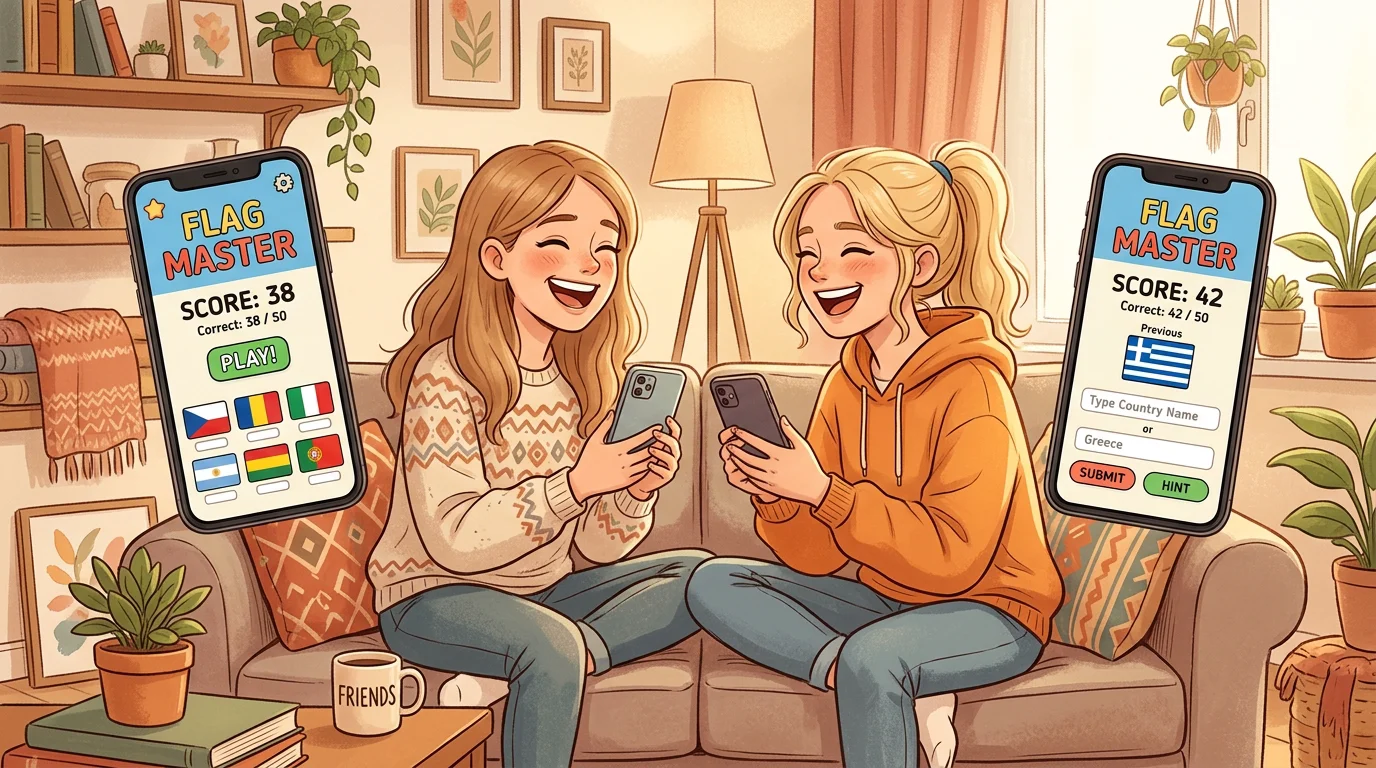
It's also social. When everyone plays the same daily flag, comparing scores with friends turns solo studying into friendly competition, which keeps you coming back.
Comparing ways to learn world flags
There's more than one route to flag mastery. Here's how common approaches stack up on the features that actually drive memory.
| Approach | Active recall | Built-in daily spacing | Handles lookalikes | Cost |
|---|---|---|---|---|
| Our daily flag game | Yes (3 guesses, tile reveals) | Yes (new flag daily) | Yes (multi-mode practice) | Free, no account |
| Printed poster | No | No | Weak | Low |
| One-off online quiz | Partial | No | Varies | Often free |
| Paper flashcards | Yes | Manual only | Depends on effort | Low |
Flashcards and quizzes can absolutely work, but they lean on your discipline to schedule reviews. A daily game handles that scheduling for you, which is why it tends to win out over the long haul.
Practical tips to memorize flags faster
Want to speed things up? Combine the game with a few smart habits:
- Play daily, briefly. Five focused minutes beats an hour once a week.
- Study by region. Tackle Africa or the Caribbean as a batch, then mix them into full quizzes.
- Learn pairs together. Always study confusing lookalikes side by side.
- Build a story. Colors, symbols, and stars are easier to recall when tied to a mini narrative.
- Test, don't reread. Guess first, check second. That retrieval is where the learning happens.
If you want a structured target, working toward every single flag gives you a clear finish line. Our guide on learning all 193 flags walks through a fast, organized path for exactly that.
Frequently Asked Questions
How long does it take to memorize all the flags?
It varies, but many players get there in a few weeks of short daily sessions. Consistency matters far more than long cram sessions, since spaced practice is what makes flags stick.
Are flag games good for classroom use?
Yes. A quick daily flag challenge works well as a five-minute warm-up, and the visual, low-pressure format appeals to students who struggle with text-heavy geography study.
Do I need an account to play?
Not with us. Our Flag Learning Game runs straight in your browser with no sign-up, and your stats stay stored locally on your device.
The takeaway is simple: flags fade fast when you just look at them, but active recall can more than double what you retain long term. Turn practice into a quick daily habit, learn the lookalikes as pairs, and let repetition do the rest. That's how a poster full of confusing stripes becomes knowledge you can rattle off on demand. Because our daily flag guessing game is free, account-free, and identical for everyone worldwide, it's easy to keep the streak going and compare scores with friends. Ready to start? Try our Every Flag Quiz and see how many you can name today.