


How many of the world's flags can you actually name? It sounds simple, but most people stall around 40 or 50 before things get really tricky. A flag quiz is one of the fastest, most addictive ways to level up your geography knowledge, and you don't need a textbook to do it. Whether you're a trivia night regular or someone who just wants to stop confusing Chad's flag with Romania's, you've come to the right place. Start exploring the world of flags right from our quiz hub whenever you're ready.
The beauty of testing yourself on flags is that it's quick, visual, and surprisingly sticky. You'll find yourself remembering details you never expected to retain. In this guide, we'll break down what makes quizzes about flags so effective for learning, which ones are trickiest, and how to go from casual player to someone who can nail all 195+ countries without breaking a sweat.
Why Quizzes About Flags Are So Addictive
There's a reason millions of people fire up a world flag quiz every single day. It taps into something deeper than just memorization. You're pattern matching, recalling colors and symbols, and building mental associations between a visual and a name. It's a lightweight brain workout that feels more like play than study.

Research into game-based learning has consistently shown that quizzes and trivia formats improve retention. Quizzes help people train their brains, and educational games develop many useful skills while also improving brain function. Flags are the perfect subject for this kind of repetition: they're visual, they're finite, and every correct answer gives you a tiny dopamine hit that keeps you going.
The competitive element matters too. On platforms like Sporcle, players race against an 18-minute timer to name all 197 flags, turning a simple exercise into a personal challenge. That's what hooks people: the desire to beat your own time, or to finally crack that one flag you keep forgetting.
How Many Flags Are There, Anyway?
This is where things get interesting. The number varies depending on who you ask. Some quizzes challenge you with 197 world flags, while others stick to the 193 UN member states, and a few go all the way up to 200+ if they include territories, dependencies, and disputed regions. Our daily game covers 195 countries, giving you a comprehensive challenge without getting bogged down in edge cases.
That number might sound manageable until you realize that dozens of flags share similar color schemes. Red, white, and blue tricolor combinations alone account for more than 30 nations. Many flags look very similar, and learning them can be tricky, but studying the different patterns in the flags is the best way to master them. The trick is to focus on what makes each one unique: a coat of arms here, a crescent there, a distinctive shade of green.
The Toughest Flags That Stump Everyone
Let's be honest: some flags are just unfair. Here are the categories that trip up even experienced players.
The Nearly Identical Twins
Chad and Romania. Monaco and Indonesia. Ireland and Côte d'Ivoire (reversed green and orange). These pairs of lookalike flags exist because countries designed their banners independently, often drawing from the same symbolic colors. The differences are subtle, sometimes just a slightly different shade.
The Ones You've Never Seen
Pacific island nations like Tuvalu, Nauru, and Palau have gorgeous, distinctive flags, but unless you've specifically studied Oceania, you've probably never encountered them. Same goes for several Caribbean and Central African nations. This is where our flag hints feature really helps. Instead of staring blankly, you get progressive clues that teach you as you play.
The Deceptively Simple Ones
Libya's old all-green flag was famously easy, but it changed in 2011. Some players still get tripped up by flags that seem "too simple," like Japan's or Bangladesh's, because they second guess themselves. Trust the minimalism.
Strategies to Ace Any Quiz on World Flags
Ready to actually get better? Here's what works, based on how top players approach it.
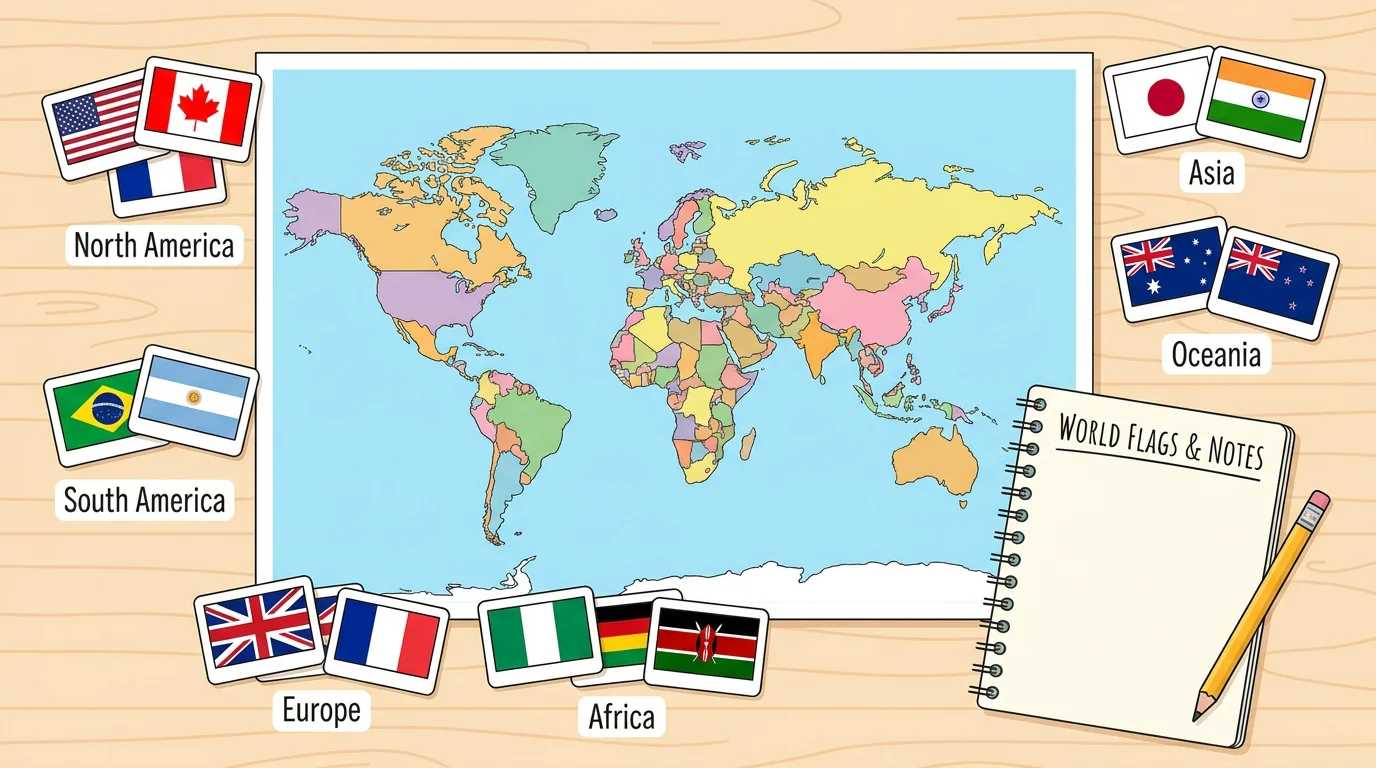
Learn by continent. Don't try to memorize all 195+ flags at once. Break them into regions. Start with the ones you're weakest on. European flags tend to be crosses and tricolors; African flags lean heavily on green, yellow, and red (Pan-African colors); Asian flags often feature stars and crescents. Practicing with continent-based flag quizzes separately is highly recommended by experienced players.
Use progressive difficulty. Starting with a multiple-choice format is totally fine. It teaches you to recognize flags even before you can recall them from memory. Then graduate to typed-answer or timed formats. If you want a time pressure workout, our timed flag challenge is built exactly for that progression.
Focus on distinguishing features. The best way to learn flags is by studying the different patterns, and repetition through quiz games helps practice those patterns. Don't just think "blue, white, blue." Think "blue, white, blue with a sun face in the center" (Argentina) vs. "blue, white, blue with a coat of arms" (El Salvador).
Play daily. Consistency beats cramming. A single five-minute session each day is more effective than a marathon session once a month. That's exactly why daily flag games have become so popular: they build a habit loop.
Why Progressive Reveal Beats Multiple Choice
Most quizzes about flags follow one of two formats: multiple choice (pick the right country from four options) or free recall (type the answer from scratch). But there's a third approach that's more engaging than both, and it's what sets our daily game apart.
In a progressive reveal format, the flag starts hidden and is gradually uncovered with each guess. You see a small section first, then more and more. This does something really clever for your brain: it forces you to work with partial information and build hypotheses. "Okay, I see red and a star. Could be Turkey, could be Vietnam, could be Morocco." Each new tile narrows the possibilities and teaches you to pay attention to specific regions of a flag.
This is fundamentally different from a standard identification quiz where you see the full image immediately. Matching a flag to its country and recognizing the symbols that appear on different flags to distinguish them are core skills that progressive formats train more deeply.
Our game covers this concept perfectly: a flag masked by nine tiles that reveal in color one by one as you guess. You get the thrill of deduction along with the satisfaction of learning.
Beyond Flags: Geography Quizzes That Sharpen Your Skills
Once you've gotten comfortable with flags, the natural next step is to expand into broader geography trivia. Capitals, country outlines, currencies, neighboring countries: they all reinforce the same mental map.
Educational geography trivia games that test multiple dimensions, from flags and capitals to independence dates and population stats, offer deeper learning than flag-only formats. That's the idea behind our geography quiz, where you're tested on capitals, borders, and more alongside flags.
Here's a quick comparison of common quiz formats:
| Quiz Format | Covers Flags | Progressive Hints | Daily Challenge | Free to Play |
|---|---|---|---|---|
| Flagdle | Yes (195 countries) | Yes (9-tile reveal) | Yes | Yes |
| Sporcle World Flags | Yes (197 countries) | No | No | Yes |
| Seterra (GeoGuessr) | Yes (by region) | No | No | Partial |
| World Geography Games | Yes (197 countries) | No | No | Yes |
How Flag Quizzes Help You in Real Life
This isn't just a party trick (though it's a great one). Knowing flags has practical applications you might not expect.
Travel. Recognizing a country's flag instantly connects you to its culture. You'll spot flags at airports, embassies, international events, and even restaurant signage. It makes the world feel smaller and more familiar.
Education. Studying a world map through interactive apps allows you to improve your knowledge of geography and also serves as good brain training. Teachers and students increasingly use quiz-based learning tools to make geography stick. Flag quizzes are designed for students, teachers, travelers, and trivia players who want to improve geography skills quickly.
Trivia and competition. Geography is one of the most common categories in trivia nights, pub quizzes, and competitive quiz shows. Knowing your flags gives you a significant edge. And the players who dominate? Many report spending years wanting to learn all the flags, then finally achieving it through regular quiz practice.
Building a Daily Flag Habit
The most successful geography learners aren't the ones who binge; they're the ones who show up every day. A daily flag guessing game creates a ritual that compounds over weeks and months.
Here's a simple routine that works: start your day with one quick round. Guess the daily flag, review what you got wrong, and move on. Over a year, that's 365 flags reviewed. Even if you see repeats (and you will), repetition is the engine of long-term memory.
What makes a daily challenge particularly effective is that everyone gets the same puzzle. You can compare your performance with friends, share your results, and push each other to improve. It turns a solo activity into a social one.
If you want to take it further, mix in a our daily flag challenge that tests you on multiple country attributes: shape, coat of arms, capital, neighbors, currency, GDP, languages, and size. It's like a full geography workout in five minutes.
Conclusion
Whether you're just starting out or you're gunning for a perfect score on all 195+ countries, quizzes about world flags offer one of the most rewarding ways to learn geography. They're fast, visual, and addictive in the best way. The key is consistency: play a little every day, focus on patterns rather than brute memorization, and expand into related topics like capitals and borders as you improve.
With a progressive reveal format that teaches you as you play, a daily challenge that keeps you coming back, and coverage of multiple country facts beyond just flags, our game turns idle curiosity into genuine knowledge. Ready to see how many you can name? Jump into our daily flag guessing game and put yourself to the test.
Frequently Asked Questions
How many country flags are there in the world?
There are 193 UN member states, plus a handful of observer states and territories, bringing the total to around 195 to 200+ depending on the source. Most comprehensive quizzes cover between 195 and 197 flags.
What's the best way to memorize world flags?
Break them down by continent and focus on distinguishing features like symbols, color order, and unique shapes. Daily repetition through interactive quizzes is far more effective than flashcards. Flagdle's progressive reveal format is especially helpful because it forces you to analyze flags piece by piece.
Which flags are the hardest to identify?
The trickiest are near-identical pairs like Chad and Romania, or Monaco and Indonesia, where only a subtle shade difference separates them. Small Pacific and Caribbean island nations also tend to stump players because they're less commonly seen in everyday life.