

Most people can rattle off maybe twenty flags before they hit a wall. Then come the tricky ones: Chad versus Romania, Chad versus Senegal, and a whole continent of stripes that blur together. If you've ever bombed a quiz on the flags of the world, you're in good company, and the fix is simpler than you'd think. Before you start guessing again, it helps to know how these quizzes are built, which you can explore in our Flag of the World Test breakdown.
Flag recognition is genuinely hard, even for well-educated adults. In one study of university students, a Cartographica study found that recognition dropped sharply for less familiar countries, with only a small fraction identifying certain designs correctly. The good news: the skill is very trainable once you know where the traps are.
What a flags of the world quiz actually tests
Sitting down to a flags of the world quiz sounds simple: see a flag, name the country. In practice, you're testing three things at once. First, visual memory (do you recognize the design?). Second, place knowledge (can you attach a name to it?). And third, speed, because most quizzes run on a timer.
That combination is why scores stay low. It's not enough to have "seen" a flag somewhere. You need to link the design, the name, and roughly where the country sits on the map. When those three connect, recall gets fast and reliable. If you want the full mechanics of how scoring and formats work, our ultimate flag quiz guide walks through it step by step.
Why the look-alike flags trip everyone up
Here's the part that quietly wrecks scores: near-identical flags. Chad and Romania use the same blue, yellow, and red vertical bands, separated only by slight shade differences. Senegal and Mali look like twins too, except Senegal adds a green star in the center. Indonesia and Monaco? Both red-over-white, just different proportions.
Once you deliberately study these pairs side by side, they stop being traps and become easy points. Group the confusable flags together, learn the one detail that separates them, and drill that difference. It's a small habit that pays off fast, and it's exactly the kind of pattern spotting covered in our flag guess quiz walkthrough.
Learn flags faster with short daily practice
The biggest mistake is trying to memorize all 195 flags in one marathon session. Your brain doesn't hold information that way. Spaced repetition, short bursts spread over days, beats cramming every time. According to Education Quizzes, doing a quick quiz and repeating it a few days later makes recall much stronger than one long sitting.
So the winning routine looks like this: a few minutes a day, mixing continents, revisiting the flags you missed. Miss Brunei on Monday? Give Southeast Asia another go on Thursday. That rhythm is exactly why a daily challenge format works so well, and it's the core of our breakdown of every flag quiz. A five-minute ritual builds more lasting knowledge than an hour of frustration.
Consistency beats intensity. Ten flags a day, reviewed regularly, will outperform a weekend cram session almost every time.
Picking a format that matches your goal
Not every flag quiz works the same way, and the format you choose shapes how much you actually learn. Some throw all the flags at you at once against the clock. Others reveal a single flag per day and give you a few guesses. Here's how the common approaches compare.
| Format | How it works | Best for |
|---|---|---|
| Daily reveal (Flagdle) | One masked flag, 9 tiles that uncover as you guess, 3 attempts, plus capitals and silhouette modes | Building lasting memory with a short daily ritual |
| Type-all-at-once | Name every country flag against a single timer | Testing what you already know |
| Click-the-map | See a flag, click its country on a map | Linking flags to locations |
| Multiple choice | Pick the right country from a list | Absolute beginners |
If your goal is genuine retention rather than a one-off score, the daily format has a clear edge. That's the approach we built around: a fresh flag each day, tiles that reveal progressively, and the same puzzle for everyone so you can compare scores with friends.
Fun facts that make flags stick
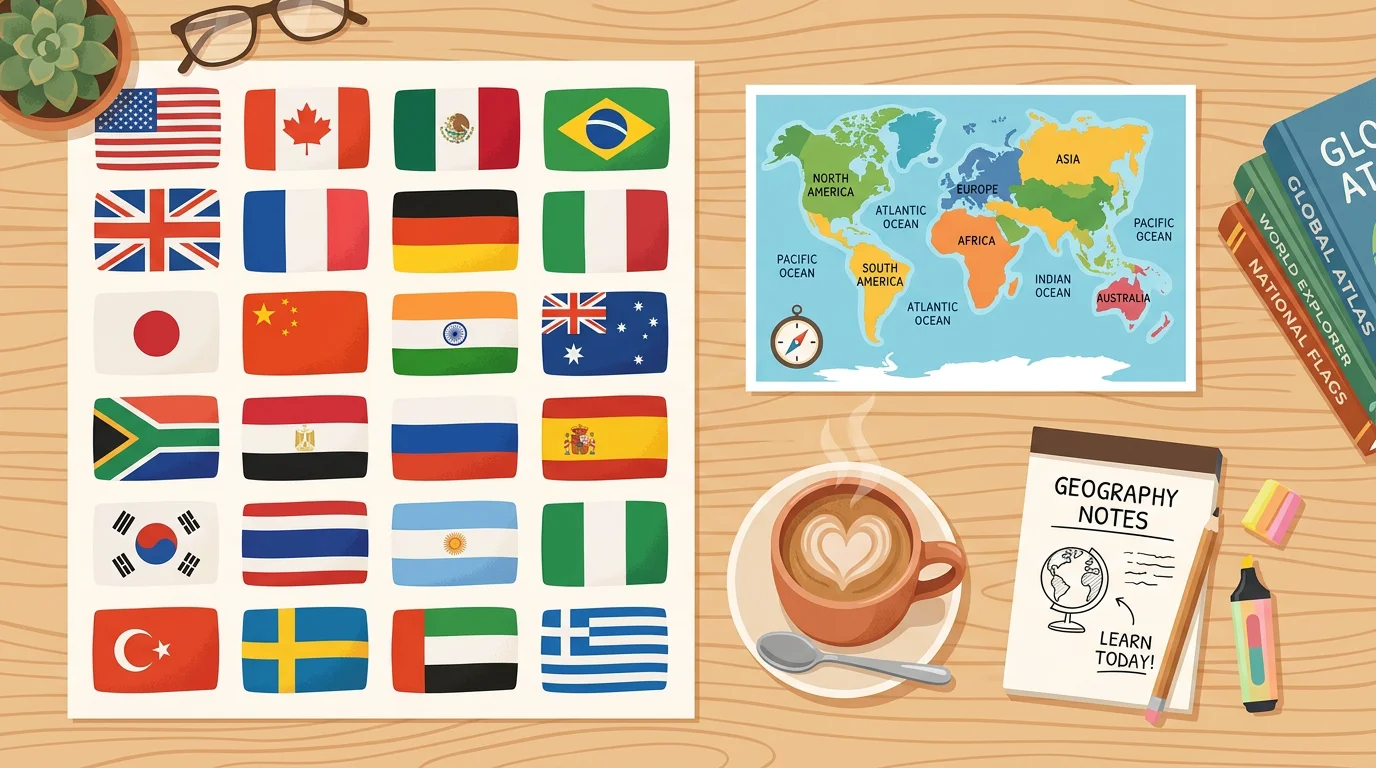
Flags are easier to remember when they carry a story. Take Denmark's flag, the Dannebrog: it's widely regarded as the oldest national flag still in use, with roots going back to the 1200s. Little hooks like that turn abstract shapes into memorable characters.
Timely context helps too. When a big international event rolls around, flags suddenly show up everywhere. A BuzzFeed quiz tied to the 2026 FIFA World Cup challenges players to match all 48 competing nations by their flags. Tying your practice to something you already follow, sports, news, travel, gives every flag a reason to stick in your head.
The takeaway on mastering world flags
Acing a quiz on the flags of the world isn't about raw memory or talent. It's about method: study the look-alike pairs, attach a small story or location to each design, and practice in short daily bursts instead of one exhausting session. Do that consistently and the 195 flags stop feeling like a wall and start feeling like a game you're actually winning. Pick one format, show up for a few minutes a day, and let the streak do the heavy lifting.
Take action with Flagdle
Ready to turn all this into a habit that actually sticks? The hardest part of learning flags is simply showing up regularly, and a short daily puzzle removes every excuse: no account, no intrusive ads, just open your browser and play.
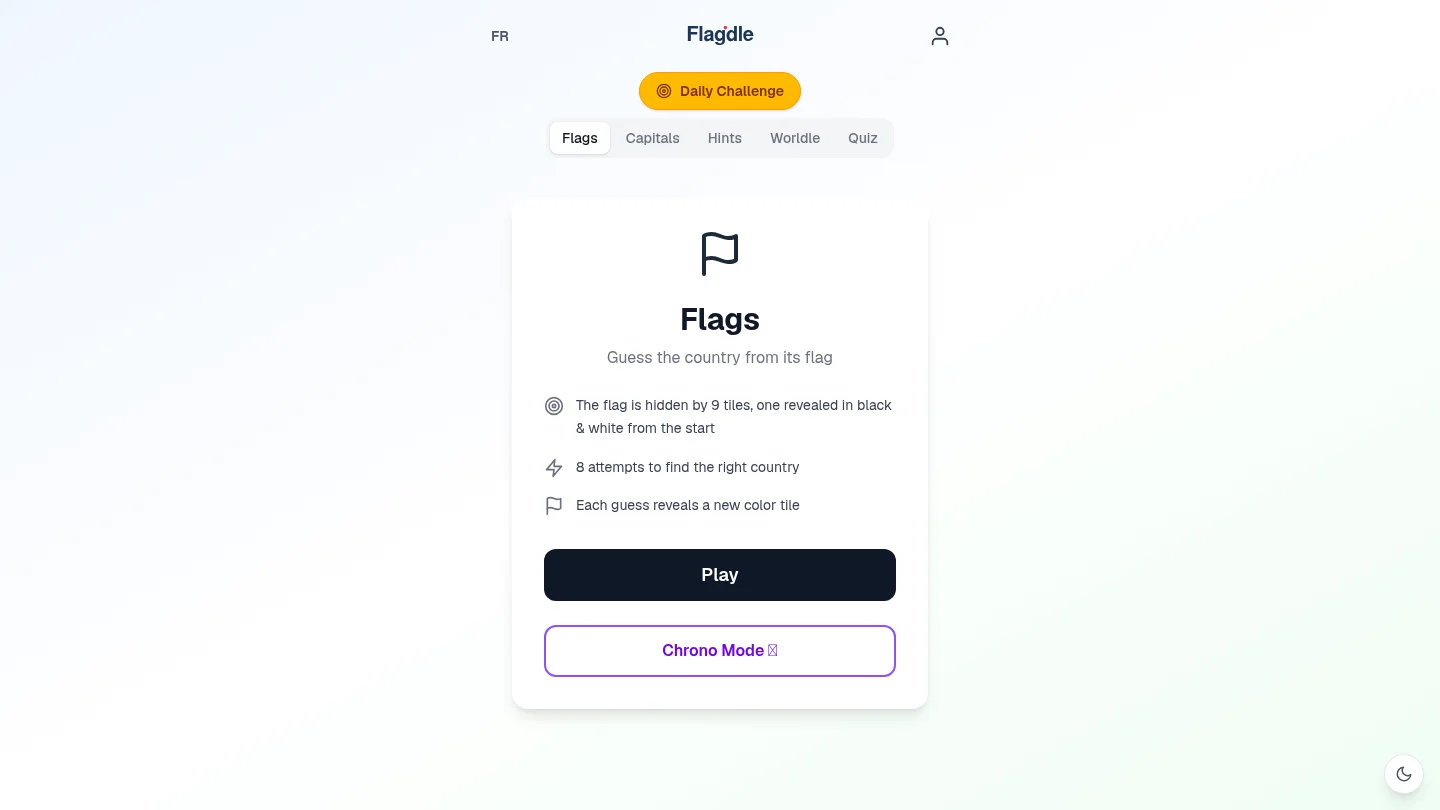
With our free daily flag guessing game, you get one masked flag to crack in 3 tries, plus extra modes for capitals and country silhouettes, all covering the 195 UN-recognized countries. Everyone worldwide gets the same daily challenge, so you can compare scores on the daily, weekly, and monthly leaderboards. Your stats stay on your device, and five minutes a day is all it takes to watch your flag knowledge climb.
Frequently Asked Questions
How many flags are in a full world flags quiz?
Most comprehensive quizzes cover the 195 UN-recognized countries, though some include territories and push the total higher. The exact number depends on whether dependencies and observer states are counted. For a consistent challenge, stick to the 195 recognized nations.
What are the hardest flags to tell apart?
Chad and Romania are the classic trap, with nearly identical blue-yellow-red bands. Senegal and Mali are another pair, differing mainly by Senegal's green central star. Indonesia and Monaco also cause confusion since both are red over white.
What's the fastest way to memorize world flags?
Use short, spaced practice rather than one long cramming session. Group look-alike flags, learn the single detail that separates them, and revisit the ones you miss a few days later. Our daily challenge format is built exactly around this rhythm.
Are flag quizzes actually good for learning geography?
Yes, because they link a country's name, its flag, and its location all at once. That connection strengthens place knowledge and visual recognition together. Teachers often use them as quick warm-ups or homework refreshers.
Do I need to create an account to play a flag quiz?
Not with every tool. Our game runs straight in your browser with no account and no intrusive ads, and your stats are stored locally on your device. That means you can start playing immediately and keep your progress private.