

Ever stared at a mystery flag and felt certain you knew it, only to blank completely? You're not alone. On one popular platform, players have tackled geography quizzes more than 1.5 billion times, proof that guessing your way around the world is a genuine global habit. The appeal is simple: it's quick, it's competitive, and it actually teaches you something.
That's the whole idea behind a geography guess game. Instead of memorizing a dull list of capitals, you're actively retrieving answers under a bit of pressure, which is exactly how lasting memory forms. Whether you want to ace a class quiz, prep for a trip, or just settle a friendly rivalry, learning to guess countries from clues is a skill you can build fast. Let's break down how it works and how to get good at it.
What a Geography Guessing Game Actually Is
At its core, the format is dead simple. You get a clue, you make a guess, and the game nudges you closer with feedback. The clue might be a partially hidden flag, a country's silhouette, or a capital city. You usually have a limited number of tries, which forces you to think rather than spray random answers.
Different games lean on different clues. Some show you only a shape and give distance and direction arrows after each guess. Others reveal a flag tile by tile, or ask you to match a capital to its country. If you want a full rundown of the main clue types, our guide on How to Guess a Country by Its Flag, Shape and Capital walks through each one with examples.
Why Guessing Beats Memorizing
Here's the counterintuitive part. Cramming a list of 195 countries barely works, but guessing them one at a time sticks. The reason is active recall: when you struggle to retrieve an answer, your brain strengthens the memory far more than rereading ever could.
Most people learn geography from a textbook, memorize a few capitals for a test, and forget it all a week later. According to a 2026 analysis of geography games, actively retrieving answers under time pressure is exactly how long-term memory forms, which is why a quick daily game outperforms passive reading. You're not just filling in blanks; you're building a mental map you can actually navigate.
That's also why variety matters. Rotating between flags, shapes, and capitals keeps your brain from coasting. Our roundup of Countries Games Online: The Best Way to Learn Geography shows how mixing modes covers more of the map than any single quiz can.
The Clues That Trip Everyone Up
Think flags and capitals are the hard part? The data says otherwise. A study of over 25,000 completed games found the classics aren't what break people. The research from Geography Worlds reported that quizzes built on capitals and flags sit comfortably in the easy half, while the brutal ones strip away every familiar label and leave you with nothing but a raw shape.
In other words, silhouette modes are where confidence goes to die. Without color, text, or scale, a country's outline is genuinely tough. The fix is to train your eye on distinctive coastlines, island chains, and unusual borders. Once you recognize Italy's boot or Chile's ribbon, shapes become an advantage instead of a trap.
How to Get Better, Fast
Improvement comes from smart habits, not marathon sessions. A few tactics separate casual players from the ones who nail the answer on the first try:
- Start broad, then narrow. Open with a guess that reveals a continent, then use distance and direction clues to close in.
- Study silhouettes deliberately. Spend a minute a day just looking at outlines. Distinctive shapes are your fastest wins.
- Don't forget small countries. Tiny nations and territories are easy to overlook and often the answer.
- Play the same challenge as friends. A shared daily puzzle lets you compare scores and learn from each other.
Want to stretch beyond flags and countries into pure map skills? Our breakdown of Mapdle: The Map Guessing Game You Need to Try in 2026 is a natural next step once you've got the basics down.
Choosing the Right Game for You
Not every geography game fits every goal. Some throw you into street-level photos, others focus purely on shapes, and some (like ours) reveal a flag gradually across a few tries. Here's how the common formats stack up on the things players care about.
| Game | Main clue | Tries | Account needed | Cost |
|---|---|---|---|---|
| Flagdle (ours) | Flag, capital, shape, quiz | 3 to 6 | No | Free |
| Silhouette guessers | Country shape | 6 | For archive | Free with ads |
| Street-view guessers | Photo location | Varies | Yes | Paid tiers |
| Multiple-choice quizzes | Text questions | N/A | Varies | Free |
If you want the most learning per minute, look for a game that runs instantly in your browser and skips the sign-up. We built our daily flag challenge around exactly that: no account, no intrusive ads, and the same puzzle for everyone so you can compare scores fairly across the leaderboard.
Making It a Daily Habit
The real magic isn't in one lucky guess; it's in showing up every day. Teachers have figured this out already. Classroom research from GeoProwl found the most effective use of geography games is a three to five minute daily warm-up that builds a routine and grows cumulative knowledge before the main lesson.
You can borrow that trick at home. Attach the game to something you already do, like your morning coffee, and let the streak do the work. Add a weekly friendly competition (highest score or most improved) and suddenly you're learning the world without feeling like you're studying at all.
Bringing It All Together
A good geography guessing game works because it turns memorization into play. You retrieve answers actively, you get instant feedback, and you come back tomorrow for one more round. Keep your sessions short, rotate between flags, shapes, and capitals, and train your eye on the tricky silhouettes that fool everyone else. Do that daily and you'll be spotting countries in a couple of tries before you know it. The world map stops being a blur and starts feeling like a place you actually know.
Take action with Flagdle
Ready to turn all this into a five-minute daily habit that actually sticks? You don't need an account, a download, or a credit card. You just need one flag, a few tries, and the itch to beat yesterday's score.
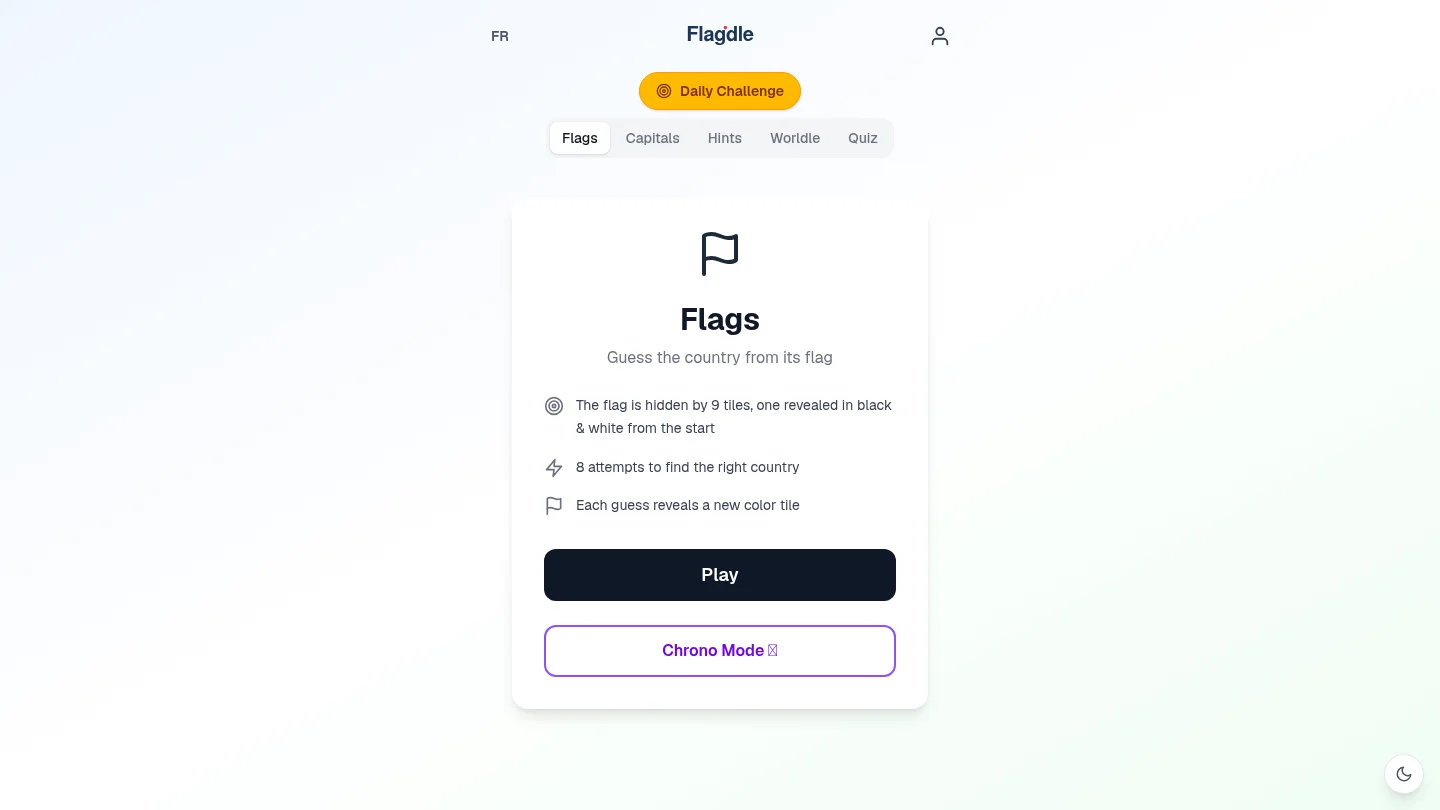
With our free daily flag and capitals challenge, you get a new puzzle every day covering all 195 UN countries, plus modes for capitals, silhouettes, and themed quizzes. The flag hides behind nine tiles that reveal as you guess, your stats stay on your device, and everyone plays the same challenge so you can compare scores on the daily, weekly, and monthly leaderboards. Jump in and see how few tries it takes you.
Frequently Asked Questions
What is a geography guess game?
It's a game where you identify a country from limited clues like its flag, outline, or capital city. You get a set number of guesses and receive feedback after each one. The goal is to nail the answer in as few tries as possible.
Do these games actually help you learn?
Yes, because they rely on active recall rather than passive reading. Retrieving an answer under a little pressure strengthens memory far more than rereading a list. Short daily sessions are especially effective for making the knowledge last.
Is Flagdle free to play?
It is completely free, with no account required and no intrusive ads. You get a daily flag challenge plus modes for capitals, country shapes, and themed quizzes covering all 195 UN countries. Your statistics are stored locally on your device.
How many guesses do I usually get?
It depends on the mode, but most flag challenges give you around three tries while shape and capital modes often allow six. Fewer tries means each guess counts, so start broad and narrow down. The limited attempts are what make the game rewarding.
What's the fastest way to improve?
Play a little every day and rotate between flags, shapes, and capitals so you cover more of the map. Study distinctive country silhouettes, since those trip up the most players. Comparing scores with friends adds motivation that keeps you coming back.