
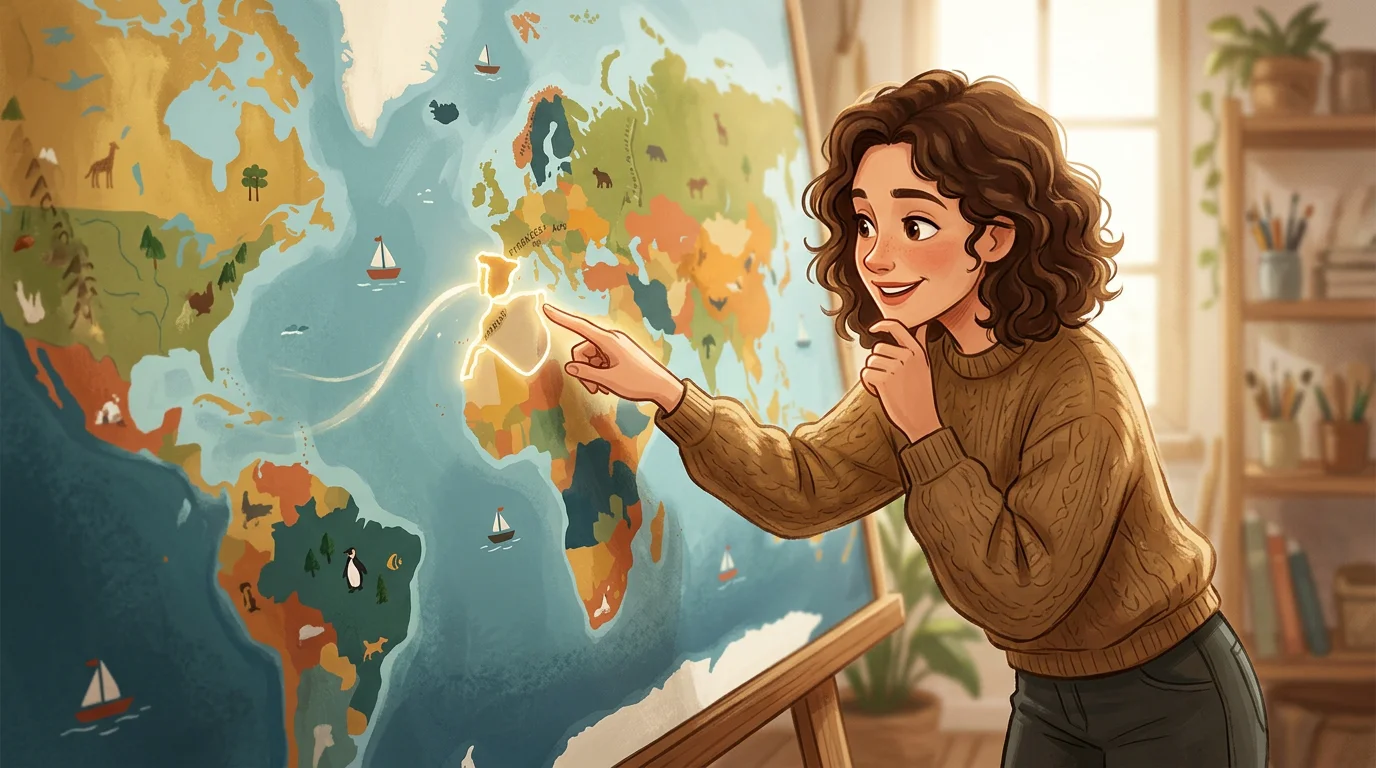

Ever stared at a wobbly outline on a screen and thought, "Is that Chile or a long noodle?" You're not alone. Being able to guess the country by its shape feels like a party trick, but it's really pattern recognition you can train. Want a daily nudge? Guess the country by its shape with Worldle and you'll start spotting outlines faster than you'd expect.
Here's the sobering part. Geographic knowledge is shakier than most people assume. In a landmark National Geographic survey, only 17 percent of young Americans could find Afghanistan on a map, even during a period when it dominated the news. Recognizing borders isn't hardwired. It's a muscle, and this is your gym.
Why country shapes are easier to learn than you think
Your brain loves silhouettes. Italy's boot, Chile's ribbon, India's diamond point: these stick because they're distinct visual anchors. Once you connect a shape to a name, it rarely leaves.
The problem isn't difficulty. It's exposure. Most people never practice reading unlabeled outlines. When they're tested cold, results drop fast. In one classic study, only 71 percent of surveyed Americans could locate the Pacific Ocean, the largest body of water on the planet.
That gap is opportunity. A few minutes of daily play builds the mental map schools often skip. And unlike memorizing capitals from a textbook, learning to identify countries by their outlines feels like a puzzle, not homework.

What actually happens when people are tested cold
The data is humbling across the board, not just in one country. A 2002 nine-nation survey found the top performers still had plenty of blind spots. Swedes topped the ranking yet located only about 13 of 16 countries on the world map test.
Americans landed near the bottom. In that same 2002 Roper study, the United States came in second to last, ahead of only Mexico. And this isn't new. Back in 1988, a National Geographic survey found young U.S. adults scored lower than respondents in a similar 1947 poll.
The takeaway? Geographic skill decays without practice, and it doesn't improve on its own. But the flip side is encouraging: people who traveled and engaged with maps consistently scored higher. Regular, playful contact with world geography moves the needle.
How to get good at guessing countries fast
Start with the loud shapes. A handful of countries are instantly recognizable, and they become your reference points for everything nearby.
- Distinctive silhouettes first: Italy, Chile, Norway, India, and Japan are hard to confuse once learned.
- Group by region: Learn West Africa or Southeast Asia as clusters, not isolated blobs.
- Use size and orientation: Is it long, blocky, coastal, or landlocked? These cues narrow it down fast.
- Lean on hints when stuck: A nudge about continent or a first letter turns a guess into a deduction.
That last point matters more than pride. When you're staring at an unfamiliar outline, a smart clue keeps momentum going instead of killing it. You can Use hints to guess the country shape faster and still feel like you earned the win.
Daily play beats cramming every time
Here's the differentiator backed by the research: exposure and repetition build durable knowledge, while one-off cramming fades. The surveys repeatedly linked stronger scores to people who engaged with the wider world often, not those who studied once.
A short daily ritual works because it's sustainable. Five minutes a day for a month teaches you more shapes than a single panicked hour. That's the whole logic behind our approach: one shared challenge each day, identical for every player worldwide, so you can compare scores with friends. If you want a structured routine, our Geography quiz focused on country guessing keeps things fresh with ten new questions daily.

Comparing ways to practice country shapes
There are several formats for learning outlines, and each suits a different mood. Here's how the common approaches stack up.
| Approach | Attempts / Format | Best for | Cost |
|---|---|---|---|
| Our Worldle silhouette mode | 6 attempts with distance and direction hints | Daily shape recognition, score comparison | Free, no account |
| Multiple-choice shape quizzes | Pick 1 of 4 outlines | Quick casual guessing | Free |
| Unlimited-guess map games | No attempt limit | Relaxed practice | Free |
| Textbook memorization | Self-paced | Exam prep | Varies |
Multiple-choice formats are gentle but give away the answer set. Unlimited-guess games remove pressure, though they also remove the satisfying challenge of a limited run. Our setup keeps it tight: our Try Mapdle to guess countries from the map mode balances challenge with helpful directional feedback so you learn from every miss.
Beyond shapes: shapes, flags, and capitals together
Outlines are one lens. Real geographic fluency links a country's shape to its flag, capital, and neighbors. That web of connections is what makes knowledge stick long term.
Mixing modes prevents the plateau. One day you're decoding a silhouette, the next you're matching a flag to a capital. This variety mirrors what the research favored: broad, repeated engagement over narrow drilling. To connect outlines with banners, our Flag Geography Game to learn countries faster pairs visual recognition with real place knowledge.
Common mistakes that slow you down
Most people trip on the same things. Fix these and your accuracy jumps quickly.
- Ignoring scale: A tiny outline and a giant one can look identical when zoomed. Check relative size cues.
- Forgetting rotation: Shapes aren't always shown upright. Mentally rotate before guessing.
- Skipping hints out of stubbornness: Clues speed up learning; they don't cheapen it.
- Practicing randomly: A daily habit beats sporadic marathons every single time.
Frequently Asked Questions
How long does it take to recognize most country shapes?
With five focused minutes a day, most people recognize dozens of distinctive outlines within a few weeks. Start with the boldest shapes, then expand by region. Consistency matters far more than session length.
Are hints considered cheating?
Not at all. Hints turn a wild guess into reasoning, which is exactly how memory forms. Our hint modes reveal the continent or first letter progressively, so you stay challenged while still learning from every attempt.
Why can't most people identify countries from a map?
It comes down to a lack of practice, not ability. Surveys have long shown that even top-scoring nations located only around 13 of 16 countries when tested cold. Regular playful exposure closes that gap fast.
The pattern across decades of research is clear: geographic knowledge fades without practice, yet it rebuilds quickly with regular, playful exposure. Remember, even the highest-scoring group in those surveys placed just 13 of 16 countries correctly, so nobody's born fluent in the world map. The fix is small and repeatable. A few minutes a day training your eye to recognize a country from its outline compounds into real fluency. Because our daily challenge is identical for every player and completely free with no account needed, you can jump in instantly and compare your run with friends anywhere. Ready to sharpen your eye? Try our daily Worldle silhouette challenge and see how many you nail today.