
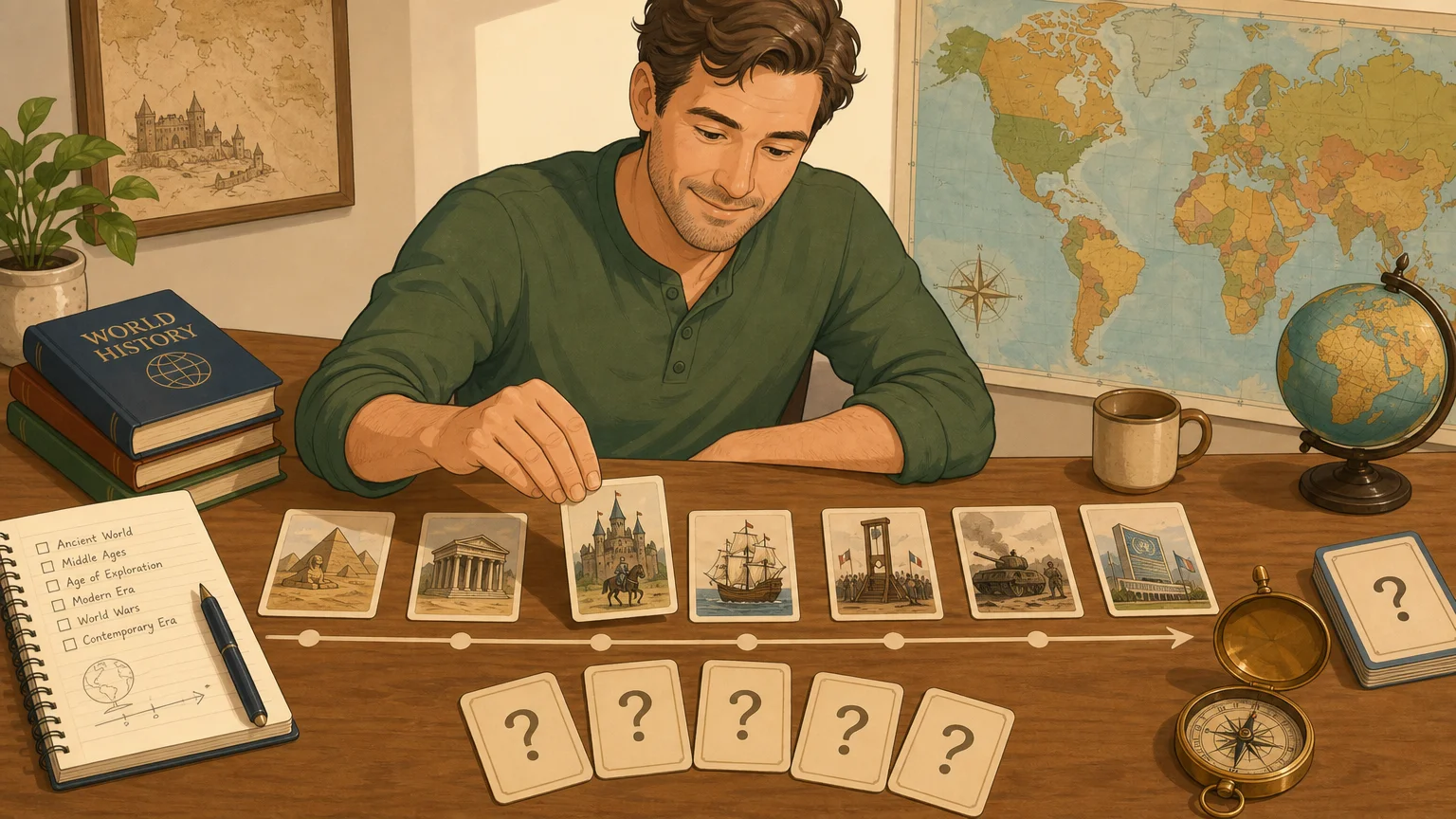

A good history quiz can turn a spare minute into a quick trip through empires, revolutions, discoveries, and famous people. If you want a simple starting point, our online quiz games bring short themed challenges into your browser, including history, geography, sport, and literature.
History learning is also more memorable when you actively retrieve information instead of only rereading it. A 2018 classroom case described by the American Historical Association used weekly content quizzes, recognition, and score tracking to encourage regular participation. That does not mean every quiz produces the same result, but it shows why format and consistency matter.
What makes a history quiz game useful for learning?
Should a history quiz feel like a test or a game? The most effective format usually sits between the two. It gives you a clear question, asks you to recall or reason, then offers enough feedback to help you understand the answer.
Start with historical coverage. A useful game may focus on one period, such as ancient history or the Cold War, or move across continents and centuries. Narrow quizzes help you revise a defined topic. Broad quizzes reveal gaps you might not notice when studying only familiar subjects.
Question design matters just as much. Multiple-choice questions are quick and accessible, but they can test recognition rather than full recall. Questions about dates, causes, locations, people, and consequences create more variety. A strong quiz also avoids relying only on obscure facts, because difficulty should encourage learning rather than simply reward specialist knowledge.
Feedback is another important difference. A score tells you how you performed, but an explanation tells you why an answer was correct. Even a short explanation can connect an event to its wider context, making the next question easier to understand.
Finally, look at the session length. A short daily round is easier to repeat than a long test that requires a free evening. Regular practice can help you notice patterns, especially when you review missed answers instead of treating the final score as the only result.
Which history quiz games match different interests?
Not every history quiz game serves the same purpose. Some are designed for quick daily practice, while others work better when you want to browse a large archive or focus on a particular school topic.
| Quiz or resource | Coverage and format | Useful for | What to consider |
|---|---|---|---|
| Flagdle History Quiz | Daily multiple-choice questions about treaties, empires, revolutions, world wars, decolonisation, historical figures, discoveries, and explorations. | Short browser sessions, general knowledge, and repeat practice. | History is one themed category within a wider geography and general-knowledge game. |
| Britannica History Quizzes | A broad collection covering historical figures, dates, wars, empires, regions, and events. | Topic browsing and traditional knowledge checks. | Quiz length, difficulty, and format vary from one activity to another. |
| History Guild Quizzes | Beginner, intermediate, advanced, and weekly history quizzes, with explanations available after completion. | Players who want visible difficulty levels and regular new questions. | The experience is centred on quiz sets rather than one compact daily routine. |
| Sporcle History Quizzes | A large category with many community-created history formats and subjects. | Exploring unusual topics and trying different question mechanics. | Length, difficulty, and consistency can differ between individual quizzes. |
| HISTORY Games | Content organised around U.S. history, world history, eras, culture, science, and major events. | Choosing a subject area before starting. | The collection includes different types of content, so the experience is not uniform. |
| PBS American History Quiz | A focused quiz about U.S. history, national symbols, presidents, and Independence Day topics, with immediate feedback. | American history revision and family learning. | Its scope is mainly U.S. history rather than global history. |
| WorldAtlas Modern World History Quiz | A general knowledge quiz focused mainly on modern world history. | Testing knowledge of more recent historical periods. | It is narrower than a full ancient-to-modern history course. |
| ProProfs History Quizzes | Collections covering political, economic, social, cultural, religious, scientific, and other historical themes. | Finding a quiz aligned with a specific theme. | Quality and purpose depend on the individual quiz selected. |
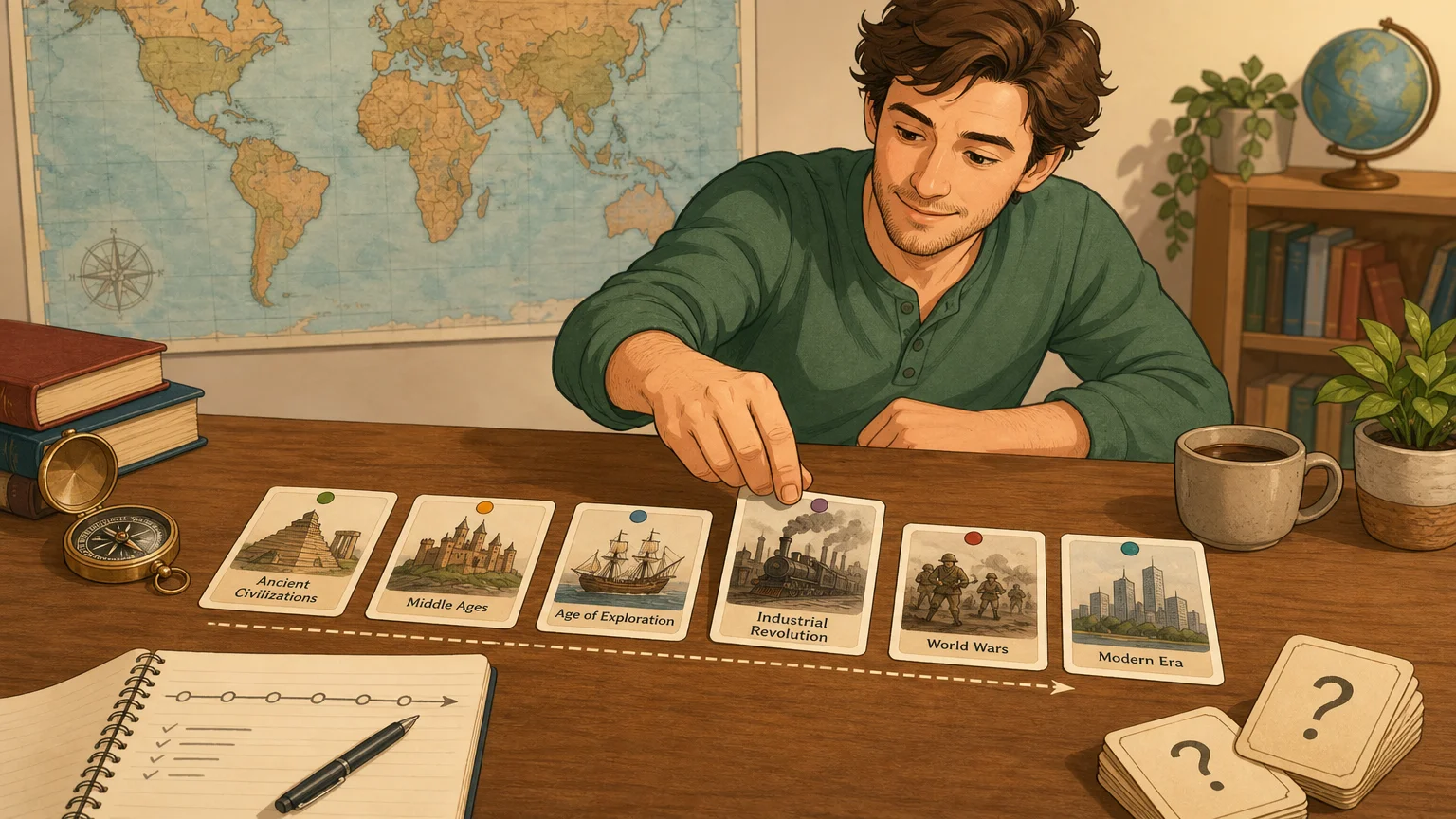
Our History Quiz is designed for the short-session category. It gives you 10 daily questions, with one minute per question, and places history beside other themed subjects. That makes it practical when you want a repeatable routine rather than an enormous archive to search.
How do you choose a history quiz for your goal?
What do you want to remember when the quiz ends? Your answer should guide the format you choose.
- For exam revision: choose a focused quiz about the period, region, or themes you need to review. Write down missed answers and revisit them later.
- For broad knowledge: use world history quizzes that move between ancient civilizations, major conflicts, political change, discoveries, and cultural developments.
- For quick daily practice: choose a short round with a clear limit. A consistent routine is easier to maintain than occasional marathon sessions.
- For classroom use: look for simple instructions, accessible questions, quick feedback, and no complicated setup. A teacher can use a short quiz as a warm-up, review activity, or discussion starter.
- For friendly competition: choose a shared daily puzzle, leaderboard, score recap, or multiplayer format. Competition can add motivation, but it should support learning rather than replace it.
Access conditions also matter. Browser-based quizzes are convenient when you want to start immediately, while apps may provide extra progression systems or offline features. If you prefer to avoid account creation, our guide to quiz games without signup can help you compare that specific requirement.
For international players, language support can make a real difference. Our game is available worldwide in English and French, covers 195 UN-recognised countries across its wider geography modes, and works directly in a responsive browser app. The history category is part of that broader learning environment, so you can switch between historical knowledge and geography practice without changing platforms.
Why does replay matter more than a single high score?
A single quiz can show what you know at one moment. Replay helps you find out whether the information stays available later.
The most useful replay loop is simple. Answer without looking anything up, note the questions you missed, check the explanation, then return to the topic after a delay. This approach turns mistakes into study prompts instead of treating them as failures.
A 2026 paper in the Journal of Statistics and Data Science Education described game-based activities that combined historical context, competition, collaboration, and real datasets. You should not treat that study as proof that every trivia quiz improves learning, but the 2026 education study supports a useful design principle: active participation gives you more to do than simply recognise the correct answer.
That principle applies to history quiz games in several ways. You can compare two possible causes, place events in sequence, connect a leader with a movement, or use a clue to eliminate unlikely answers. These small acts of reasoning make the activity more engaging than passive reading.
Replay also gives you a chance to widen your coverage. If you usually choose European history, try a quiz about Asian, African, Middle Eastern, or Latin American history. If you know major wars well, explore science, literature, social movements, or everyday life in the same period.
When you want to alternate history with other subjects, our online games collection lets you move between themed quizzes and geography modes. That variety can keep a daily learning habit fresh without making every session feel identical.
What should teachers and self-study players check first?
Popularity is not the same as educational fit. A 2026 report examining classroom game tools combined Google Trends data, feature audits, and public ecosystem metrics. Its 2026 classroom report is useful as a reminder that visibility can show interest, but it cannot by itself prove that a quiz is accurate, well designed, or suitable for your learners.
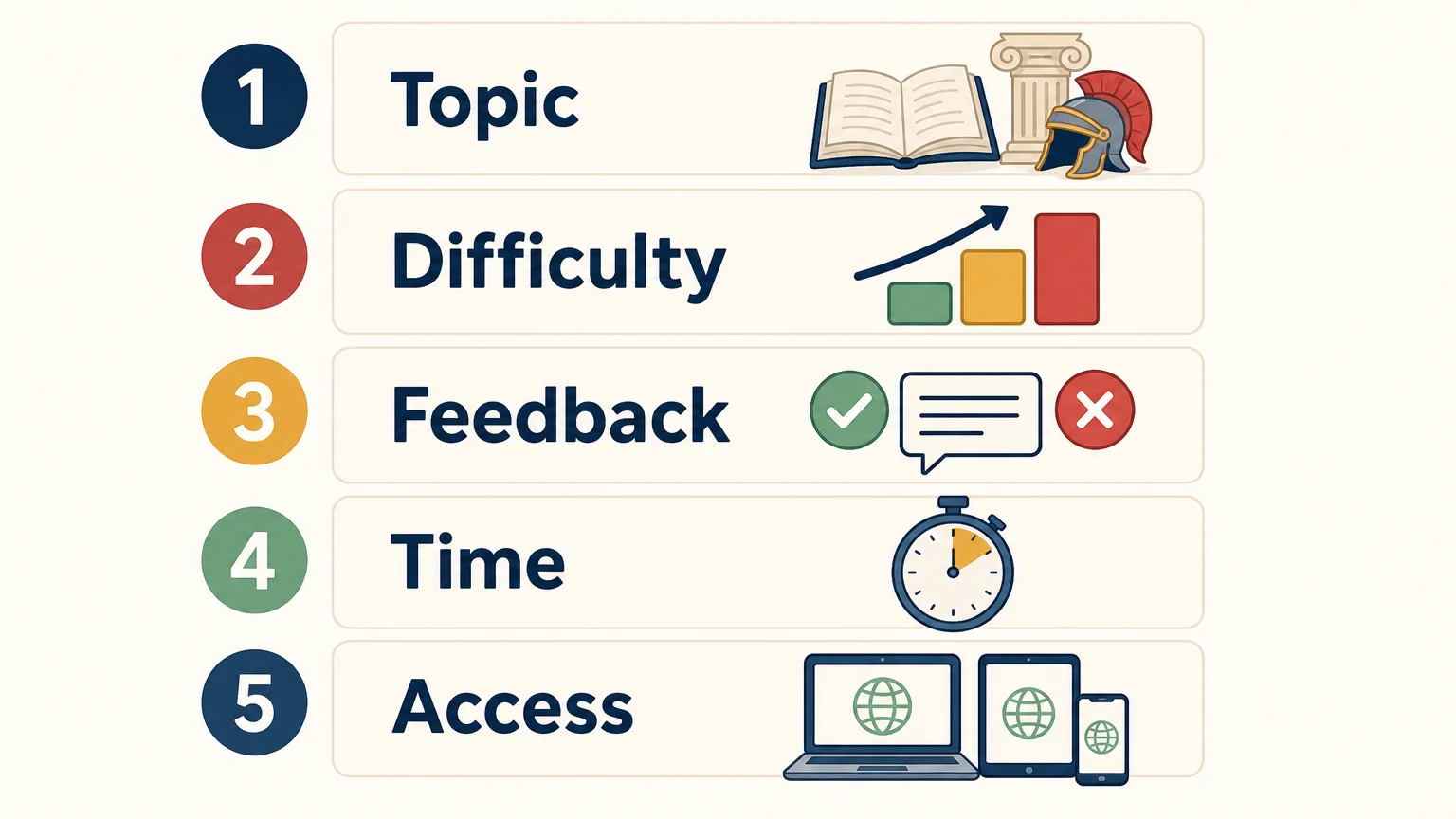
Before choosing a game, check five practical points:
- Topic clarity: Does the quiz cover the period or theme you need?
- Question quality: Are the questions understandable, balanced, and based on meaningful historical knowledge?
- Feedback: Does the game explain answers, or only display a score?
- Session length: Can you finish a round during a study break or classroom transition?
- Access: Can you play without an account, download, or payment if that matters to you?
Teachers should also consider whether the quiz creates space for discussion. A question about a treaty, revolution, or historical figure can become the starting point for asking why an event happened, who benefited, and how different groups experienced it.
For self-study, accuracy and transparency deserve attention. A quiz should not present a disputed interpretation as an unquestionable fact. When an answer seems surprising, use it as a prompt to consult a textbook, museum, archive, or reliable educational source.
Our game is intended for short practice and general knowledge, not formal assessment or educational accreditation. That distinction matters. It can support a five-minute classroom activity or personal revision, but it should complement, rather than replace, structured teaching and careful historical research.
How can you build a simple history quiz routine?
You do not need a complicated study system. Start with one short quiz session, then follow the same four steps each time.
- Answer from memory before checking notes.
- Record the questions you missed or guessed.
- Read a brief explanation and connect the fact to its wider context.
- Return to the same theme later, then try a different period or region.
Try to mix easy and difficult questions. Easy questions build confidence and speed, while harder ones expose gaps. A balanced session should leave you curious about at least one topic, not simply satisfied with a number.
You can also use history quiz games socially. Ask friends to explain an answer, compare reasoning, or create a follow-up question. In a classroom, let students defend an answer before revealing the result. The discussion often becomes more valuable than the score.
Choose the format that helps you return
The best history quiz games are not necessarily the longest or most difficult. They are the ones that give you clear questions, useful feedback, manageable sessions, and a reason to come back. Choose a focused quiz when you need revision, a broad world history format when you want exploration, and a daily game when consistency matters most.
Use scores as signals rather than final judgments. Review mistakes, vary the regions and eras you study, and give yourself time to connect isolated facts with larger historical stories. That is how history quiz practice becomes a lasting learning habit.
Try a Daily History Quiz
If you want a quick way to practise between lessons, during a study break, or whenever curiosity strikes, a daily browser quiz keeps the barrier low. You can make one short session part of your routine without preparing a worksheet or creating a complicated study plan.

Our History Quiz offers 10 daily multiple-choice questions across themes such as treaties, empires, revolutions, world wars, decolonisation, historical figures, discoveries, and explorations. It is free to play in the browser, requires no account, and sits alongside our geography, sport, and literature quizzes. Play our History Quiz and use the result as a starting point for deeper reading.
Frequently Asked Questions
What are history quiz games?
History quiz games are interactive activities that test your knowledge of events, people, places, dates, causes, and historical developments. They may use multiple-choice questions, timed rounds, clues, explanations, scores, or multiplayer features.
Are history quiz games useful for studying?
They can support studying by making you retrieve information and identify gaps in your knowledge. For the strongest results, combine quizzes with explanations, notes, textbooks, primary sources, or classroom discussion.
How long should a history quiz session last?
A short session is often enough to maintain a regular habit. Choose a length you can repeat consistently, then review missed questions instead of stopping at the final score.
Can you play a history quiz without signing up?
Many browser quizzes allow guest play, although account requirements vary by platform. Our History Quiz runs in the browser without an account, so you can start a daily round immediately.
Should you choose world history or U.S. history quizzes?
Choose U.S. history when you need focused revision or want to explore the development of one country. Choose world history when you want broader comparisons across regions, empires, conflicts, cultures, and time periods.