


Studying faster does not mean rushing through more pages. It means spending more of your time on activities that show what you can actually remember. If you are asking how can students study faster with quizzes, start with how quizzes can improve recall, then use that idea to build a smarter study routine.
Quizzes are useful because they make you pull information from memory instead of simply recognizing it on a page. However, not every quiz improves learning equally. A quiz that repeats familiar questions may create confidence without building flexible knowledge, while a well-designed quiz helps you identify weak areas, correct errors, and apply ideas in new situations.
Why quizzes can make studying faster
Imagine spending 30 minutes rereading a chapter. You may feel familiar with the material, but familiarity is not the same as recall. When you take a quiz without looking at your notes, you discover which facts and concepts are available in your memory and which ones still need work.
This process is called retrieval practice. It can include multiple-choice questions, short answers, flashcards, brain dumps, or practice problems. The important feature is that you attempt to remember before checking the answer. A Washington University guide describes retrieval practice as a way to strengthen memory connections and improve longer-term learning.
Quizzes also make your study time more selective. Instead of reviewing an entire chapter every time, you can separate material into three groups: answers you know, answers you partly know, and answers you cannot retrieve. The second and third groups deserve most of your attention.
That is why low-stakes quizzes work well for daily study. They are short enough to repeat, but informative enough to guide your next step. Their goal is not to punish mistakes. Their goal is to show you where another few minutes of focused practice will have the greatest value.
How do you know if a quiz is too easy?

A quiz may be too easy when you answer almost everything through recognition rather than recall. For example, you might see a definition and immediately recognize it, but struggle to explain the concept when the wording changes. That difference matters because exams often present information in unfamiliar formats.
Use these questions to check whether your quiz provides enough challenge:
- Can you answer without looking at notes or searching for clues?
- Can you explain why the answer is correct?
- Can you answer when the question is worded differently?
- Can you apply the idea to a new example?
- Can you still answer after waiting a day or two?
Your score can also be misleading if you have memorized the order of questions or the visual layout of a familiar quiz. Try shuffling the questions, changing the answer choices, and mixing old topics with new ones. If your score drops sharply on unfamiliar questions, you may remember the quiz pattern more than the subject.
A useful target is productive difficulty. The questions should require effort, but you should still retrieve some answers correctly. If you cannot answer anything, the quiz is too difficult for that stage of learning. If you answer everything instantly and cannot explain the answers, it is probably too easy.
Use a difficulty ladder instead of repeating the same quiz
The fastest study routine is not usually the one with the easiest questions. It is the one that gradually removes support. Start with a prompt that gives you a useful cue, then move toward questions that require fuller recall and application.
For example, when learning a biology concept, you could follow this sequence:
- Match key terms with their definitions.
- Answer a question with several possible choices.
- Complete a short answer without seeing the definition.
- Explain the concept in your own words.
- Use the concept to solve a new problem.
This progression helps you distinguish recognition from genuine understanding. A 2019 review on testing as a learning tool explains that retrieval practice can support later memory more effectively than simply restudying, although the benefit depends on factors such as feedback and task difficulty.
Change the question format when you can. Multiple-choice questions are efficient for checking broad coverage, but short answers and explanations reveal more about your thinking. In mathematics, include worked problems. In history, ask for causes and consequences. In literature, ask you to support an interpretation with evidence.
Spacing matters too. Take a short quiz soon after learning, then repeat selected questions later. You do not need to wait until you have forgotten everything. A little effort to reconstruct the answer is enough to make the next retrieval more meaningful.
Build a 20-minute quiz routine
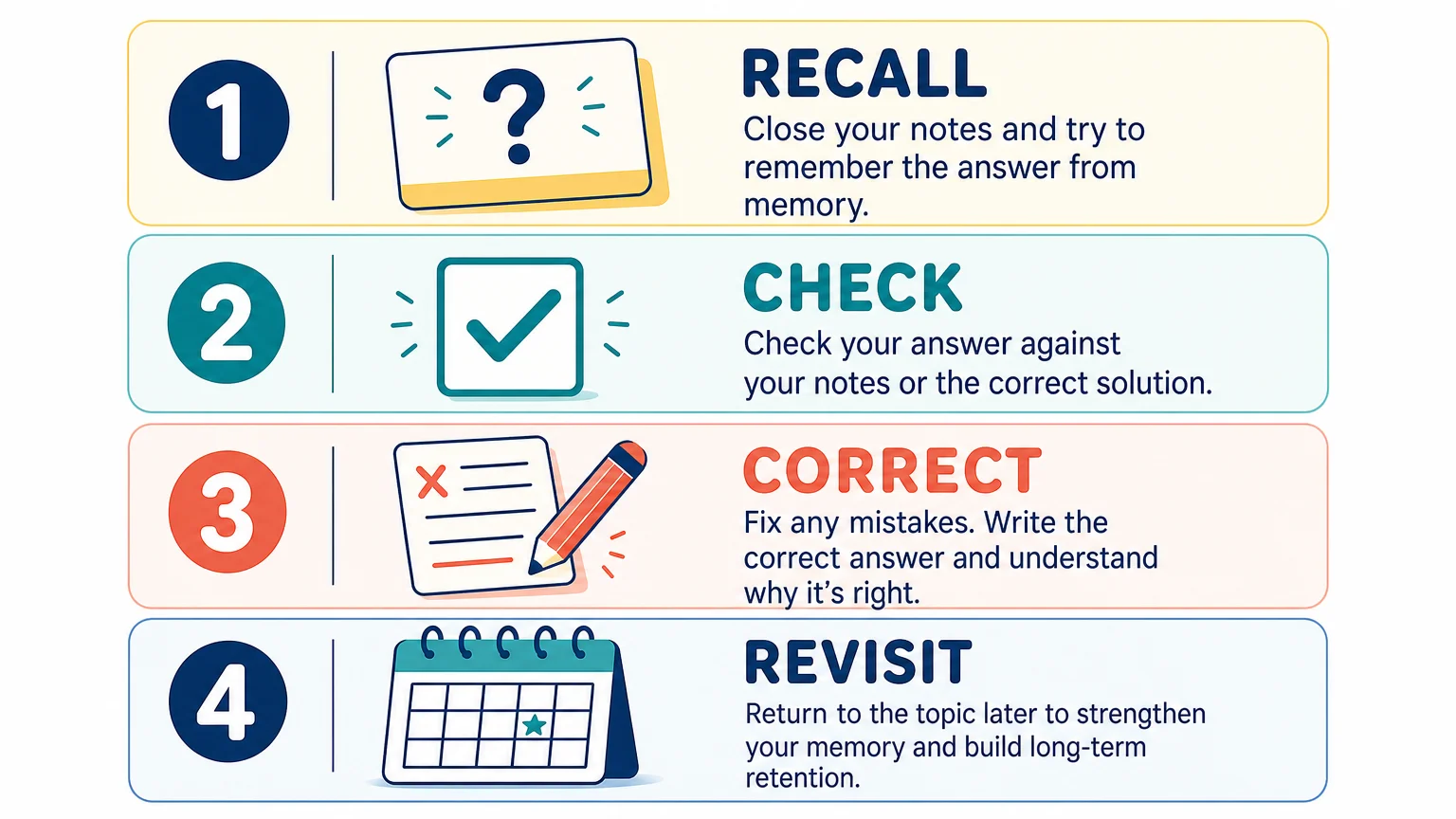
You can turn quiz practice into a repeatable routine without creating a complicated schedule. Set aside 20 minutes and use the following structure:
- Recall for 8 minutes. Answer questions without notes. Mark uncertain answers instead of guessing silently.
- Check for 4 minutes. Compare your answers with reliable notes, a textbook, or an answer key.
- Correct for 4 minutes. Write the correct answer and add one sentence explaining it.
- Revisit for 4 minutes. Choose the questions you missed and schedule them for another attempt.
This routine prevents a common mistake: taking a quiz, checking the percentage, and moving on. Your score is only the starting point. The learning happens when you inspect the errors and attempt the difficult items again.
Keep an error log with three columns: the question, what you answered, and why the correct answer works. This helps you notice patterns. Perhaps you confuse similar terms, skip a step in a calculation, misread command words, or remember a fact without understanding its context.
Use a timer when speed matters for your real assessment. However, do not time every practice session from the beginning. First build accurate recall, then gradually reduce the time available. Fast guessing is not the same as efficient thinking.
Use quiz results to choose what to study next
A quiz should change your next study decision. If you miss several questions about one topic, return to that topic briefly, then test it again. Avoid rereading the entire chapter unless your results show that the problem is broad.
Separate mistakes into categories:
- Knowledge gaps: you never learned or retained the information.
- Retrieval gaps: you studied it, but could not recall it without a cue.
- Reasoning errors: you remembered the facts but applied them incorrectly.
- Attention errors: you knew the answer but misread the question.
Each category needs a different response. Knowledge gaps require a short review. Retrieval gaps need more closed-book practice. Reasoning errors need worked examples and new applications. Attention errors may improve through slower reading and deliberate checking.
For geography, our flag lessons for students can support short recall sessions when you need to practise country and flag recognition. The same principle applies to any subject: focus on the areas that your answers show you have not mastered yet.
Use your score across several attempts rather than judging yourself from one result. A single low score may reflect fatigue or unfamiliar wording. Consistent improvement on mixed and newly worded questions is a stronger sign that your knowledge is becoming flexible.
Know when quizzes are not enough
Quizzes are powerful, but they cannot replace every kind of practice. If your exam requires a long essay, a lab procedure, a presentation, or a multi-step calculation, include those activities in your preparation. A multiple-choice score may show that you recognize the main idea, but it cannot always prove that you can produce a complete response.
Match your quiz to the assessment. For an exam based on factual recall, use short questions and flashcards. For an essay, practise planning arguments and supporting them with evidence. For mathematics or physics, solve problems without copying the worked example. For languages, combine vocabulary quizzes with writing and speaking practice.
Teachers can also turn quiz practice into a short classroom routine. Our guide to classroom geography activities can help you use brief geography challenges as a warm-up, exit activity, or collaborative review.
The best approach combines several forms of transfer practice. Retrieve the information, explain it, apply it, and use it in a context that looks different from the original lesson. That is how you move from knowing an answer to using knowledge under pressure.
Study faster by making every quiz useful
Students study faster with quizzes when each attempt produces a clear next action. Answer without notes, check your work, correct the mistake, and revisit the difficult questions after a short delay. If a quiz feels effortless, vary the wording or raise the level of application. If it feels impossible, add cues and build difficulty gradually. The goal is not to collect high scores on familiar questions, but to develop reliable recall that works in new situations.
Turn five minutes into daily recall practice
Short, repeatable practice is easier to maintain than a long revision session. When you want to review geography or general knowledge, we give you a simple browser-based way to answer questions, check your recall, and return for another challenge.

Our quiz hub includes daily challenges, flag and capital practice, country clues, silhouettes, and themed questions covering geography, history, sport, and literature. You can play without an account or paid plan, then compare your progress through local statistics and daily, weekly, or monthly scores. Try the online quiz hub when you have a few focused minutes to study.
Frequently Asked Questions
How can students study faster with quizzes?
Use quizzes to retrieve information without notes, identify mistakes, and focus your next review on weak areas. Spaced attempts and varied question formats help you retain more than repeatedly rereading the same material.
How do I know if a study quiz is too easy?
A quiz may be too easy if you answer through recognition, rely on familiar question order, or cannot explain your answers. Try new wording, remove hints, mix topics, and test yourself again later.
Should students time every quiz?
Timing is useful when speed matters in the final assessment, but accuracy should come first. Add time limits gradually after you can answer reliably without rushing.
What should I do after getting a quiz question wrong?
Write the correct answer and explain why it is correct. Then revisit the question later without looking at the solution, because the second retrieval attempt is part of the learning process.
Can Flagdle help with geography study?
Yes, our browser game provides short practice through flags, capitals, country clues, silhouettes, daily challenges, and themed quizzes. It can support geography recall sessions, especially when you want a quick activity between longer study tasks.