
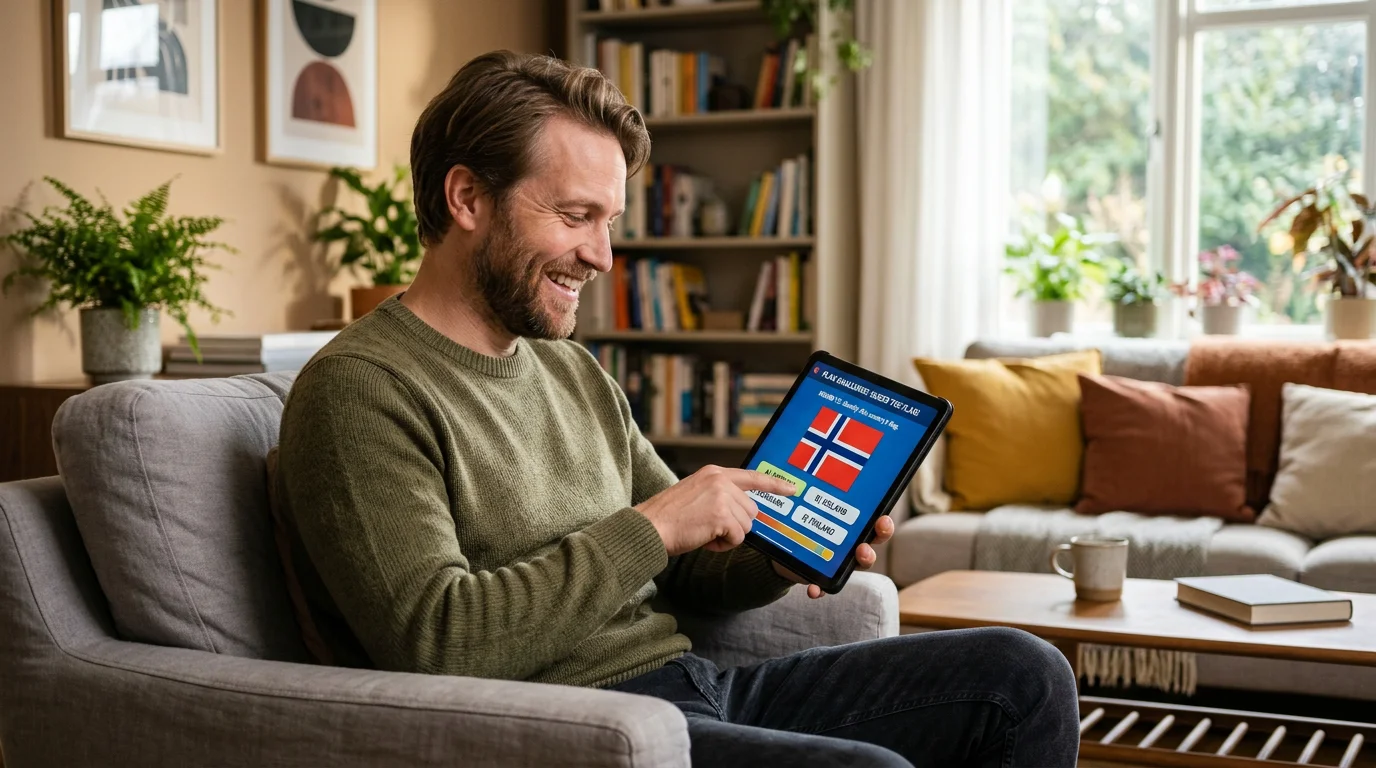

Ever stared at a flag and thought, "I know this one," only to blank completely? You're not alone. Recognizing the world's flags feels simple until a red, white and blue tricolor shows up and your brain freezes. That's exactly why a flag guessing game works so well: it turns that little moment of doubt into something you actually want to solve. Our daily flag guessing game builds the whole experience around that hook.
Daily guessing games have quietly become a global habit. According to Fast Company, the New York Times reported its puzzles were played 11.2 billion times in 2025. Flags tap into the same loop, except you walk away knowing real geography instead of a five letter word.
What a flag game actually is
Let's define it simply. A flag game shows you a national flag and asks you to name the country it belongs to. In French, this kind of puzzle is called a jeu de drapeaux, and the concept travels well across languages because flags are universal symbols.
Formats vary a lot. Some hide the flag behind tiles that reveal slowly. Others flash a flag and give you seconds to type the answer. A few use multiple choice, where you pick from four options. The core challenge stays the same: connect a piece of visual design to a place on the map.
The best versions cover every recognized nation. Our approach spans all 195 UN countries, so you're not just drilling the famous flags. You'll meet small island states and landlocked nations you might never think about otherwise.
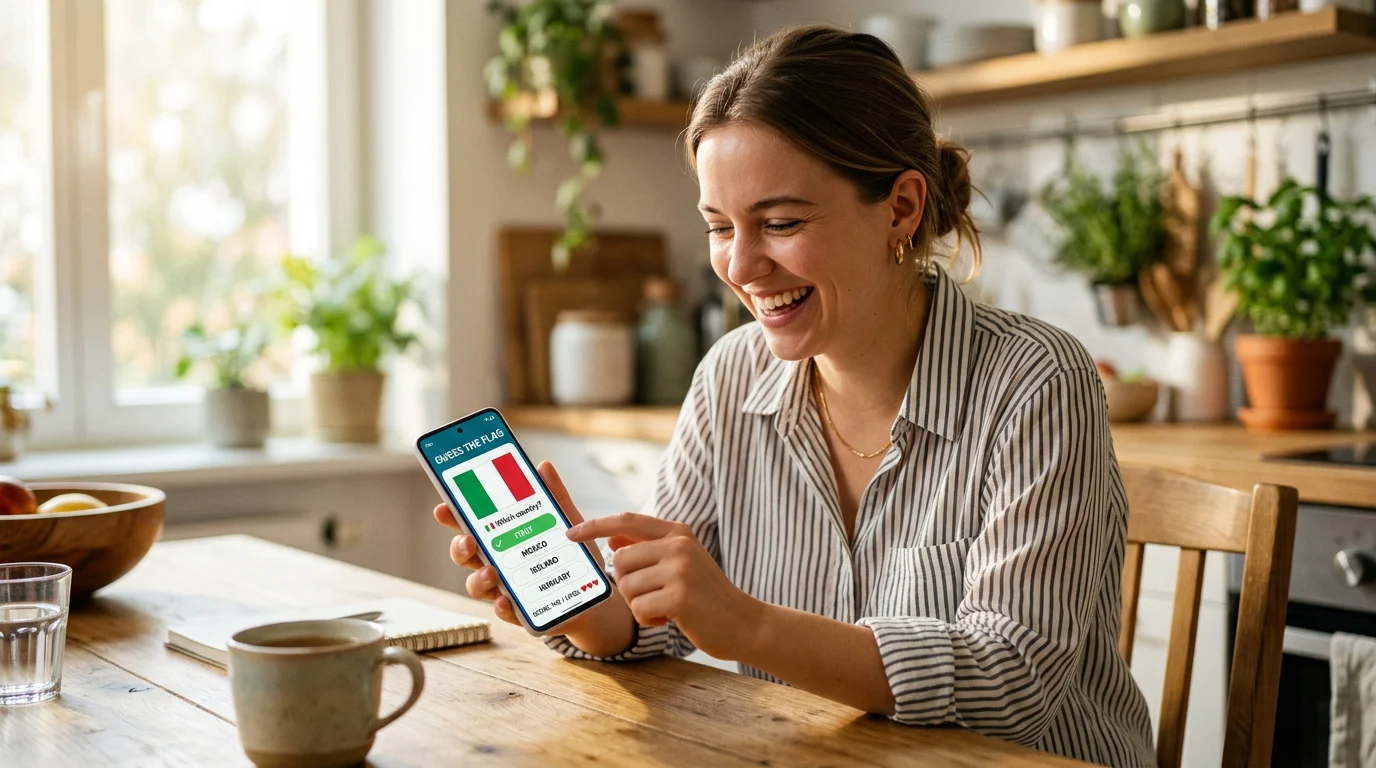
Why guessing flags every day sticks
Here's the thing about a daily challenge: it removes decisions. You don't scroll through options or pick a difficulty. One flag drops, everyone gets the same one, and you have a handful of tries. That constraint is oddly freeing.
The shared-challenge design also makes it social. When you and a friend both play the identical flag of the day, comparing scores becomes natural bragging material. That's a big part of why daily puzzle formats spread so fast on group chats.
We lean into this with a daily flag challenge that's identical for players worldwide, plus a leaderboard by day, week and month. If you like the geography angle beyond flags, our flag geography game mixes in capitals and progressive hints so no single mode gets stale.
The science behind learning flags this way
Why does a quick daily quiz beat cramming a flag chart for an hour? It comes down to how memory works. Pulling an answer out of your head, rather than just re-reading it, is called retrieval practice, and it's one of the most studied learning strategies out there.
A systematic review on spaced learning found that studying material over spaced intervals significantly improves long-term retention, even when total study time stays the same. A short daily flag round is basically that principle turned into a game.
Every guess forces active recall. You see the colors, search your memory, commit to an answer, and get instant feedback. That loop of active recall plus immediate correction is exactly what makes facts stick, and it's far more effective than passively flipping through images.
The different ways to play
Not every flag game is built the same, and the format changes what you actually learn. Some reward raw typing speed. Others reward careful recognition of tiny details, like the shade of blue or the position of a star.
Here's how the common formats stack up on the things that matter most for learning:
| Format | Countries covered | Tries per round | Account needed | Same daily challenge |
|---|---|---|---|---|
| Our daily flag game | 195 (UN members) | 3, with 9 tiles revealing | No | Yes, worldwide |
| Timed typing quizzes | Varies, often 190+ | Whole grid against a clock | Often no | Rarely |
| Multiple-choice apps | Varies by level | One pick from four | Sometimes | Rarely |
Typing quizzes are great if you already know your flags and want a speed run. Multiple-choice apps feel easier, but recognizing an answer isn't the same as recalling it. If your goal is genuinely memorizing flags, our flag memorization game is designed around recall rather than lucky clicks.
Turning it into a habit that lasts
Playing once is fun. Playing daily is where the geography actually lands. The trick is keeping the sessions short and consistent instead of marathoning once a month.
Research backs this up. A 2021 meta-analysis by Hattie and Donoghue, drawing on 242 studies and over 169,000 participants, concluded that distributed practice and practice testing are among the most effective learning techniques. Spreading effort across days beats one long block, and combining it with self-testing is stronger still.
That's why a five-minute flag round makes such a good ritual. Teachers use short daily warm-ups to get a class engaged. Students use them to keep revision ticking over. Travelers use them to prep for a trip. The format fits whatever slot you have.
Little and often beats rare and intense. A daily flag habit quietly compounds into real world knowledge.
Conclusion
A flag guessing game is more than a time-killer. It borrows from proven learning science, wrapping retrieval practice and spaced repetition inside something you genuinely look forward to. Remember, spaced daily practice can match hours of cramming while feeling like play, and covering all 195 countries means you eventually learn the obscure flags, not just the famous ones. The daily, identical-for-everyone format is what keeps it sticky, letting you compare scores and build a streak without ever making an account. Start small, keep it consistent, and watch how quickly the map fills in. Ready to test yourself across every nation on Earth? Try our full flag quiz and see how many you can name today.
Frequently Asked Questions
How many flags should I learn first?
Start with the ones you see most, like major economies and your own region. From there, a daily game naturally introduces the rarer flags over time, so you never have to face all 195 at once.
Is a flag game good for kids and classrooms?
Yes. A short daily round works well as a five-minute warm-up, and the instant feedback keeps younger players engaged. Our daily flag challenge needs no account, so a whole class can jump in from any browser.
Do I need to pay or install anything?
No. A good flag game runs right in your browser, free and without intrusive ads. Stats are stored locally on your device, so you can build a streak without signing up.