

Ever stared at a flag and drawn a total blank on the country? You're in good company. Even seasoned trivia fans miss dozens of the world's 195 flags on their first serious run. That's exactly why a daily flag guessing game like our daily flag quiz game has turned into such an addictive little habit for students, teachers, and travelers alike.
The idea couldn't be simpler. One hidden flag, a handful of guesses, and a brand new puzzle every single day. It feels casual, but there's real science underneath: according to a 2024 study, gamified mobile learning measurably lifts engagement, retention, and outcomes compared to plain study. In other words, playing beats cramming.
So, What Exactly Is a Flag Quiz Game?
At its core, it's a test of recognition. You see a national flag, and you type or pick the country it belongs to. In French you'll often see it called a jeu des drapeaux, and the concept travels beautifully across languages and borders.
Formats vary a lot, though. Some versions are timed typing sprints where you race to name every flag before the clock runs out. Others are multiple-choice apps that hand you four options per flag. And then there's the daily-reveal style, where a flag hides behind tiles that peel away with each attempt, nudging you toward the answer.
If you want the full landscape of formats before you dive in, our full flag rundown breaks down how each type plays and who it suits best.
Why the Daily Format Actually Sticks

Here's the thing about a once-a-day puzzle: it removes the pressure to "study" and replaces it with a tiny ritual. And rituals are where memory quietly compounds.
The research backs this up strongly. In a meta-analysis of 41 studies covering more than 5,000 learners, gamified instruction produced a large positive effect on learning outcomes. Even better for a daily habit, the same analysis found that longer-running "gameful" experiences outperformed short bursts, so showing up each day genuinely pays off.
Longevity matters elsewhere too. Researchers running a two-year study of 617 secondary and tertiary students found that well-designed game elements pushed knowledge retention above the usual benchmarks from educational literature. A quick flag round each morning isn't just fun; it's spaced repetition in disguise.
A shared daily challenge adds a social spark on top. When everyone in the world faces the same flag on the same day, comparing scores with friends becomes half the fun, and that friendly competition keeps you coming back.
Beyond Flags: The Modes That Keep It Fresh
Recognizing flags is the gateway, but geography is bigger than that. The best flag identification games layer in extra modes so you're not doing the exact same thing forever.
On Flagdle, for example, you get several ways to learn in short bursts:
- Flags mode: identify the country in 3 tries, with 9 tiles that reveal the flag bit by bit.
- Capitals mode: 6 attempts, with progressive hints on the continent, then the first letter.
- Worldle-style mode: guess the country from its silhouette in 6 tries.
- Themed quizzes: 10 fresh questions a day for broader general knowledge.
Mixing recognition with recall is smart. If you enjoy the pairing-things-up feel, our flag matching game is a gentle way to warm up before tackling the harder typing modes.
How to Memorize Every Flag Faster
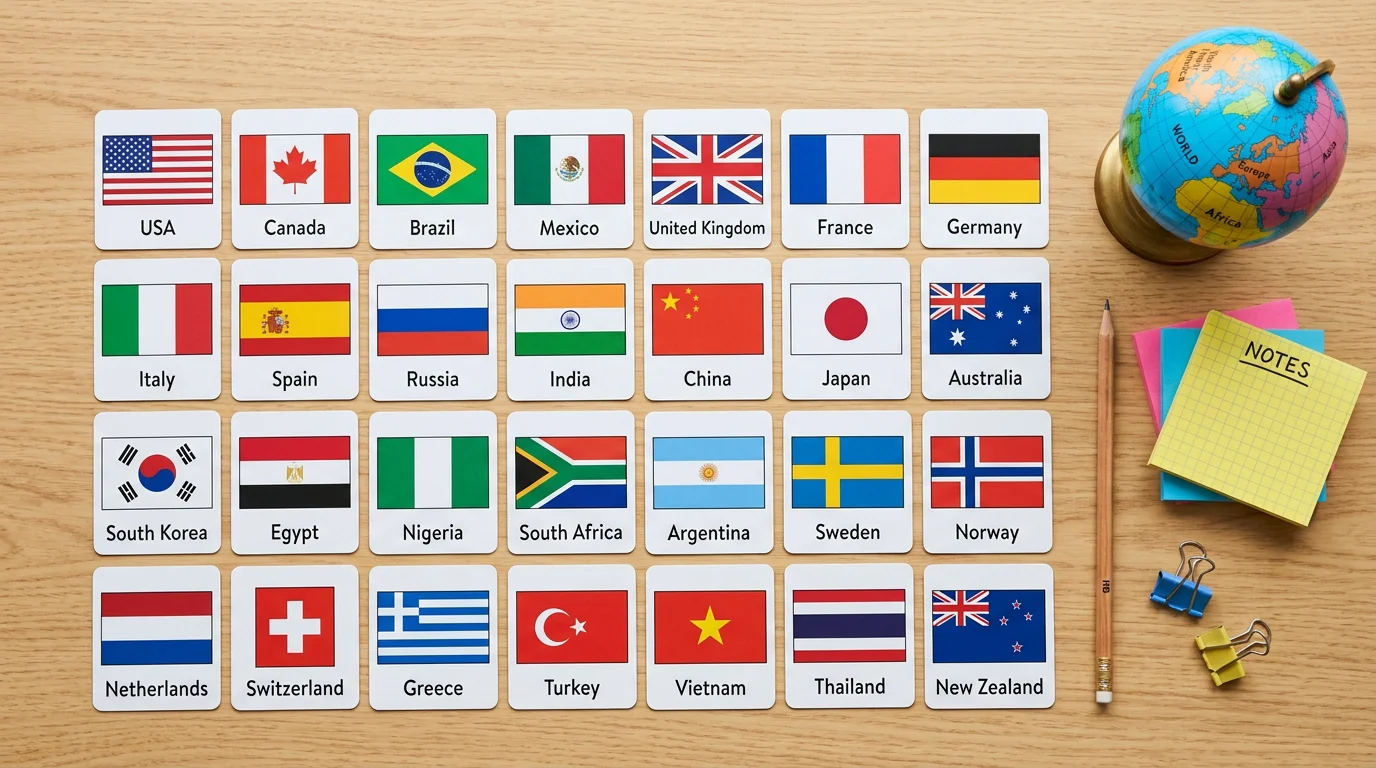
Want to go from "I know maybe 40" to a clean sweep? A few tactics do most of the heavy lifting.
- Work by continent. Learning Europe, then Africa, then the Americas in chunks beats trying to swallow all 195 at once.
- Hunt for patterns. Group similar-looking flags, like the Nordic crosses or the red-white-red trios, so you learn the differences on purpose.
- Use tiny daily reps. Five focused minutes a day builds sturdier memory links than one marathon session.
- Test recall, don't just review. Actively typing an answer forces retrieval, which is what makes it stick.
That last point is well supported. In a 2026 review of gamification in school geography, immediate feedback and repeated active engagement stood out as key drivers of stronger spatial and cognitive learning. A daily quiz gives you both automatically. When you're ready to drill for speed, our flag identification game is built around exactly this fast-recall loop.
Picking the Right Flag Game: A Quick Comparison
Not every flag game wants the same thing from you. Some chase speed, some chase completeness, some just want your ad impressions. Here's how the main styles stack up.
| Option | Format | Coverage | Account needed | Intrusive ads | Daily challenge |
|---|---|---|---|---|---|
| Flagdle (us) | Daily reveal, 3 tries with 9 tiles | 195 UN countries | No | No | Yes, same flag worldwide |
| Timed typing quiz | Race to type every flag | ~193 to 215 flags | No | Varies | Occasional |
| Multiple-choice app | Pick from 4 options | 197 to 200 flags | Often | Often | Varies |
Timed typing quizzes are great for speed drills, and multiple-choice apps offer easy on-ramps for beginners. The trade-off is that ad-heavy apps and account walls can interrupt the flow. A free, no-signup daily puzzle keeps friction low while still covering every recognized country.
The Takeaway
A flag guessing game isn't just a way to kill five minutes. Backed by that meta-analysis of 5,000+ learners, the daily, gamified approach genuinely helps facts stick, whether you're prepping for an exam, planning a trip, or just feeding your inner geography nerd. Start small, work continent by continent, and let the daily ritual do the compounding for you. The real advantage of a shared daily puzzle is that it stays free, needs no account, and gives everyone the same flag to compare, so learning feels social instead of solitary. Ready to test yourself? Jump into our flag quiz games and see how many you can name today.
Frequently Asked Questions
How many flags are there to learn?
Most serious flag games focus on the 195 countries recognized by the UN. Our Flags mode covers all 195, so you're always learning the full, up-to-date set.
Do flag quizzes actually help you learn geography?
Yes. Studies on gamified learning consistently show better engagement and knowledge retention, especially when you practice a little each day rather than cramming.
Do I need to create an account to play?
Not with Flagdle. You can play straight from your browser with no account, no intrusive ads, and your stats stored locally on your own device.