
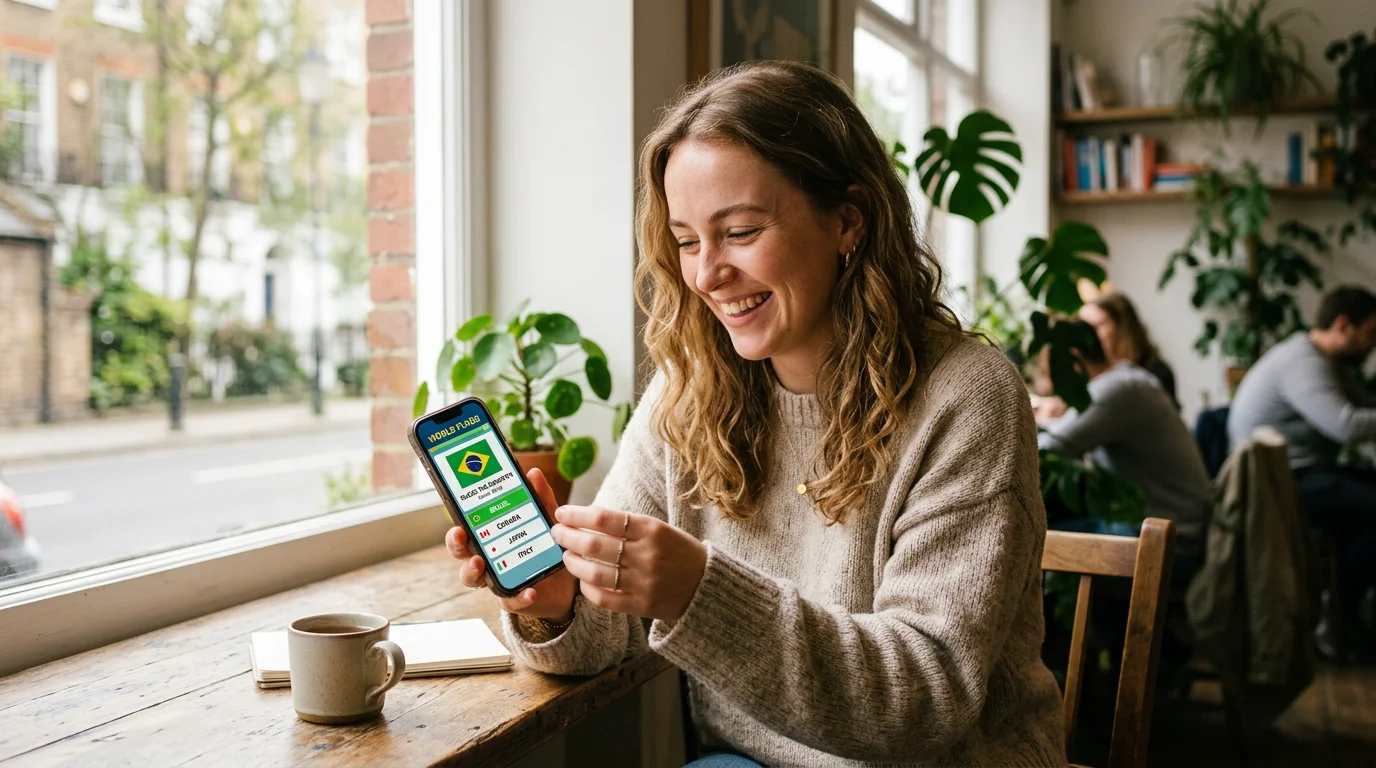

Here's a number that stings: most people can name maybe a dozen national flags on sight, out of nearly 200. That gap isn't about intelligence, it's about how we practice. Flashcards and wall posters feel productive, but staring at them rarely builds lasting recall. This is exactly where flag memory games change the equation, and why our flag memorization game leans on daily play instead of passive review.
When you flip a card, guess a country, or watch a masked flag reveal itself tile by tile, your brain works to retrieve the answer. That effort is the whole point. Decades of learning research show that this kind of active retrieval beats rereading every time, and it's the reason a five-minute game can outperform an hour of scrolling through a chart.
Why flag memory games actually work
The science behind flag games isn't complicated. Whether you call them flag matching games or jeux de mémoire drapeaux, they all share one trick: they make you pull an answer out of your head rather than recognize it on a page. Psychologists call this the "testing effect," and it's one of the most reliable findings in the field. In their classic paper on testing memory, Roediger and Karpicke showed that being tested on material produces stronger long-term retention than simply studying it again.
Flags are a perfect fit for this. They're visual, distinct, and often deceptively similar. When you're forced to tell Chad from Romania, or Indonesia from Monaco, you start noticing the tiny details that separate them. That's active recall and pattern recognition working together, which is far deeper than glancing at a poster.
What separates a good flag game from a forgettable one
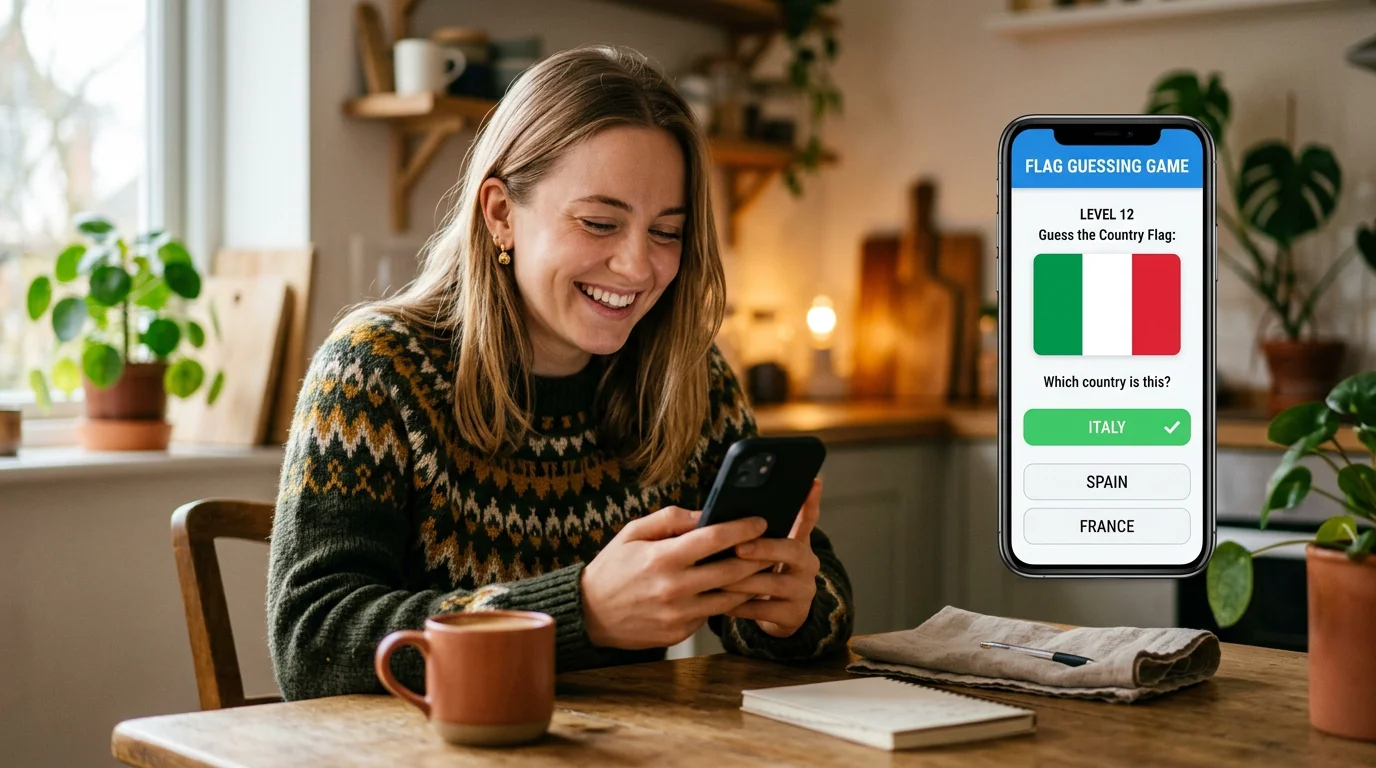
Not all flag games are built the same. Some show you 25 flags and call it a day. Others cover the full roster of countries and mix in capitals, silhouettes, and hints. If your goal is to genuinely recognize world flags, coverage matters, and so does variety.
A few things to look for when you pick one:
- Country coverage: aim for games spanning all 195 UN-recognized countries, not a handful of famous ones.
- Multiple modes: flags, capitals, map silhouettes, and quizzes hit different memory pathways.
- A daily habit loop: short, repeatable sessions beat rare marathon cramming.
- No friction: instant play in a browser, no account, no intrusive ads pulling you away.
If you want to branch out from pure recognition into place-on-the-map thinking, our Flag Geography mode connects each flag to where the country actually sits, which reinforces both skills at once.
The daily challenge: our differentiator
Here's where the format really shifts. Instead of an endless grid you play once and abandon, a daily challenge gives everyone the same flag on the same day. You get a limited number of tries, a masked flag that reveals itself as you guess, and a score you can compare with friends or a global leaderboard.
Why does this matter for memory? Because it spaces your practice out naturally. You come back tomorrow, then the next day, and each short session reinforces what came before. Our main mode gives you three tries to identify the country from a flag hidden behind nine tiles, while capitals and silhouette modes give you six. That built-in rhythm is a feature, not a limitation, and it's exactly the kind of "little and often" practice that memory research keeps recommending.
Flag games in the classroom and for exam prep
Teachers have quietly relied on flag matching for years, and there's good reason beyond keeping kids busy. A quick daily retrieval ritual builds knowledge without adding stress. In fact, according to Evidence Based Education, classroom research by Agarwal and colleagues found that regular low-stakes retrieval practice actually reduced exam anxiety and boosted student confidence.
That makes flag games a low-effort win for a five-minute warm-up. Students revising for geography, travelers prepping an itinerary, or trivia fans sharpening their edge all benefit from the same loop. If you'd rather test knowledge than just match pairs, our Flag Quiz mode serves up themed questions that push recall a step further.
How the main formats compare
Flag learning tools mostly fall into three buckets: quick browser games with a daily challenge, classic matching apps, and printable card sets. Here's how they stack up on the things that drive real memory gains.
| Feature | Flagdle (our approach) | Classic matching apps | Printable card sets |
|---|---|---|---|
| Country coverage | 195 UN-recognized countries | Often 25 to 50 flags | Usually around 50 |
| Daily challenge | Yes, same flag worldwide | Rarely | No |
| Modes | Flags, capitals, silhouette, quiz | Usually matching only | Matching only |
| Leaderboard | Daily, weekly, monthly | Sometimes | No |
| Access | Free, no account, no intrusive ads | Often ad-supported | Print and cut required |
Printable sets are great for screen-free family play, and classic apps offer casual fun. But if your priority is broad coverage plus a habit that sticks, a daily browser game covers more ground. For pure identification drills across every continent, our Flag Identification Games keep the challenge fresh.
Tips to memorize flags faster
Want to speed things up? Spacing your practice is the single biggest lever. Combining spaced review with retrieval practice compounds the effect: a 2025 review highlighted a meta-analysis by Pan and Rickard (2018) suggesting spaced retrieval improves outcomes by roughly 25% over using either strategy alone.
Beyond that, a few practical habits help:
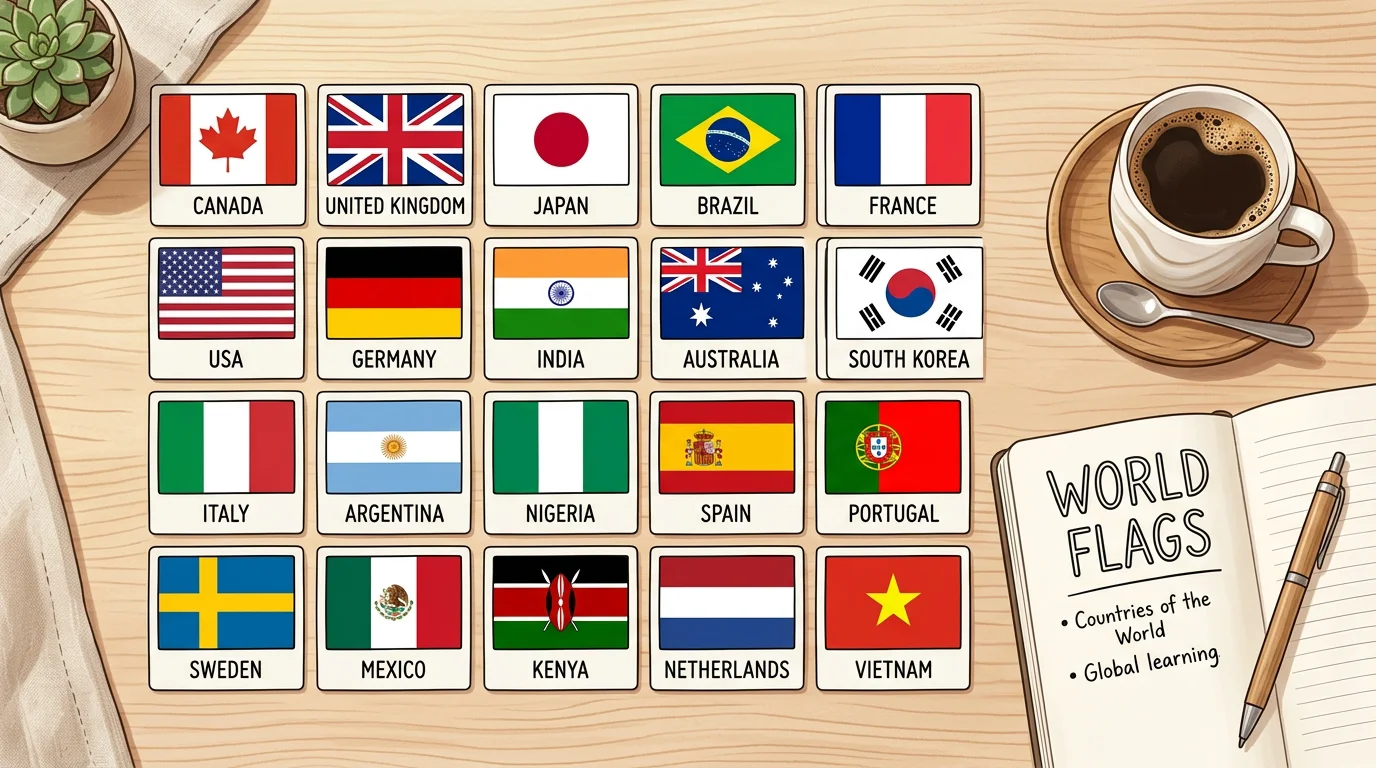
- Group flags by pattern: Nordic crosses, tricolors, star-and-crescent designs. Clusters are easier to remember than isolated facts.
- Link flag to capital: learning both together doubles the retrieval hooks in your brain.
- Play a little every day: short daily sessions beat one long cram, and the benefit holds across ages, as an NIH-published study found repeated spaced testing enhanced retention in both younger and older adults.
- Embrace near-misses: getting a flag wrong and then correcting it strengthens the memory more than an easy hit.
Turning flags into memories that stick
The best thing about flag memory games is that they hide real learning inside real fun. You're not grinding through a chart, you're guessing, comparing, and coming back for more, and that's precisely what your memory responds to. Start small: play once a day, focus on patterns, and pair each flag with its capital. Within a few weeks, countries you couldn't place will feel instantly familiar. Consistency, not intensity, is what carries you from a dozen flags to nearly two hundred.
Take action with Flagdle
Ready to stop staring at posters and start actually remembering flags? A quick daily game gives you the spaced, active practice that makes recognition automatic, and it takes about the length of a coffee break.
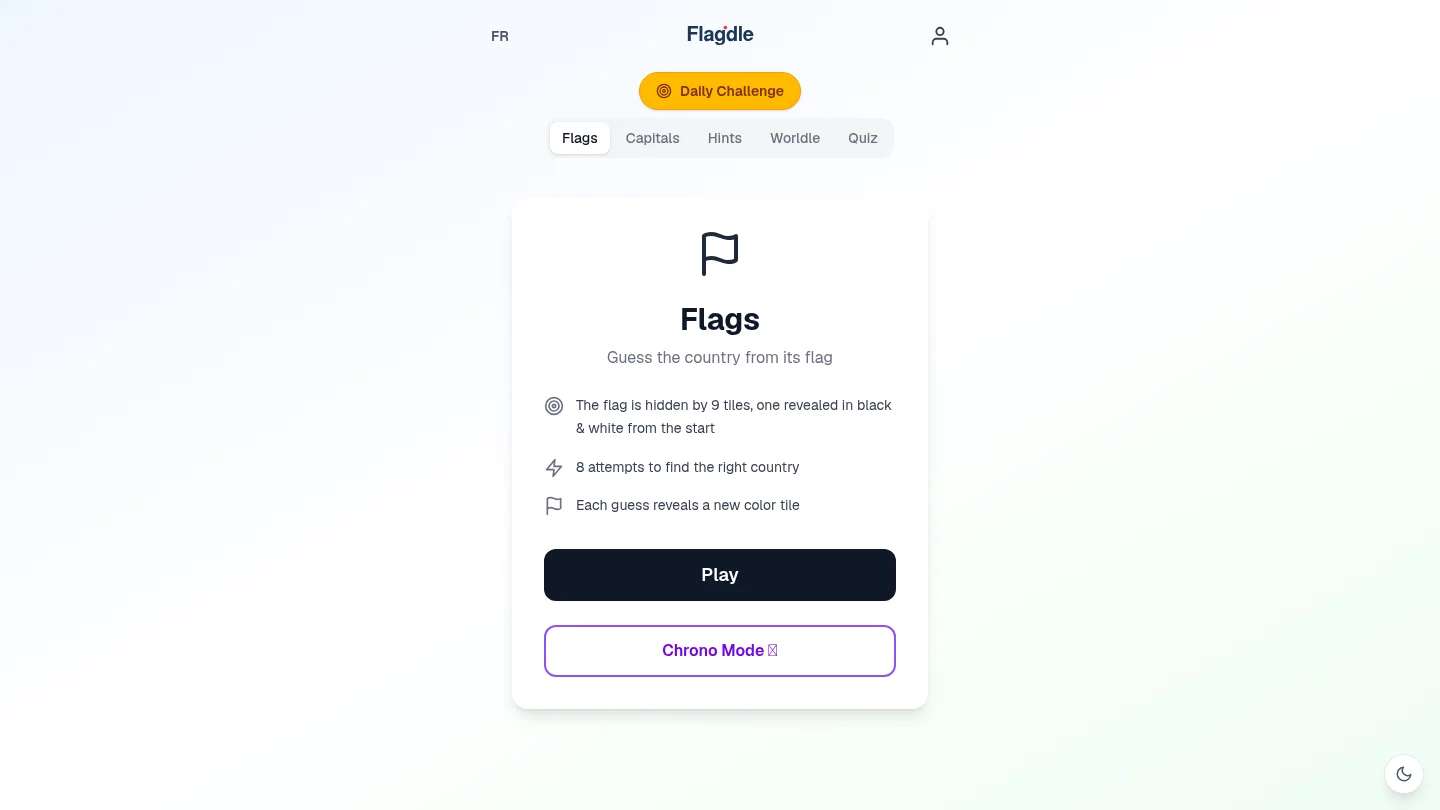
With our daily flag guessing game, you get one shared challenge for players worldwide, three tries to crack the flag behind nine tiles, plus capitals, silhouette, and quiz modes covering all 195 UN-recognized countries. It's free, needs no account, keeps your stats on your own device, and skips the intrusive ads. Come back each day, climb the daily, weekly, and monthly leaderboards, and watch your flag recall grow.
Frequently Asked Questions
Are flag memory games good for adults or just kids?
They work well for both. The active recall that makes them effective helps memory at any age, and adults often use them for trivia, travel prep, or general knowledge. Research on spaced retrieval shows retention benefits across younger and older learners alike.
How many flags can I realistically learn?
With short daily practice, most people can recognize the majority of the world's flags within a few weeks to a couple of months. The key is consistency, not marathon sessions. Playing a little every day beats occasional cramming.
What's the difference between a matching game and a guessing game?
A matching game asks you to find identical pairs, which trains visual memory and position recall. A guessing game asks you to name the country from the flag, which trains identification directly. Our modes let you do both, so you build recognition from multiple angles.
Do I need to download an app or create an account?
Not with a browser-based game. You can play instantly online, and our version stores your stats locally on your device without requiring sign-up. That means no friction and no data sent to a server just to have some fun.
How do flag games help with geography beyond flags?
Flags are a gateway. Once you link a flag to a country, adding its capital, location, and shape becomes much easier. Modes that combine flags with capitals or map silhouettes turn simple recognition into broader geography knowledge.