

Ever stared at a lonely country outline and thought, "I definitely should know this one"? You're not alone. Wordle proved that a tiny daily puzzle can hook millions, and in 2025 it still averaged around 4 million daily players. That same simple, share-your-score formula fueled a whole wave of spinoffs built around maps and flags.
A geography guessing game takes that addictive loop and points it at the planet. Instead of five letters, you're decoding shapes, colors, and capitals. It's quick, it's competitive, and it quietly makes you smarter about the world. If you're curious where to start, our Mapdle map guessing game is a friendly entry point.
Why a world guessing game is so hard to put down
The magic is in the constraint. You get a handful of guesses, a ticking sense of "can I nail it today?", and a result you can brag about. A world guessing game borrows the exact hooks that made word puzzles a habit rather than a fad.
Those hooks are surprisingly powerful. Wordle alone pulled in 12 million daily active users during Q2 2025, and players win their puzzles between 97% and 99% of the time. High win rates keep you coming back, because the game feels beatable but never boring. Swap letters for latitude and you get the same dopamine, plus a mental map of the globe.
The main types of geography guessing games
Not all of them work the same way, and that's the fun part. Depending on your mood, you can test your eye for flags, your sense of shapes, or your pub-quiz knowledge of capitals.
- Flag guessing games: you name the country behind a flag, sometimes partially hidden. If you want to get sharp here, our flag guessing game guide walks you through the tricky lookalikes.
- Silhouette games: you identify a country from its outline alone, using direction and distance clues to zero in.
- Capital and clue modes: you match cities to countries or piece together progressive hints.
- Street-level exploration: games that drop you into real-world imagery and ask "where am I?"
Each mode trains a different skill. Mixing them is the fastest way to build a full picture of the world, and our guide to guessing a country shows how flag, shape, and capital clues stack together.
The daily format that turns players into regulars
Here's the sneaky genius: one puzzle a day, the same for everyone. That single design choice is why these games retain people so well. There's scarcity (you can't binge), fairness (everyone gets the identical challenge), and a natural reason to compare scores with friends.
It's not a niche habit, either. Gaming has gone fully mainstream, and in the US roughly 78% of puzzle players reach for mobile devices first. A daily browser puzzle fits perfectly into a commute, a coffee break, or the five minutes before class. We built our daily challenge with a shared leaderboard so you can see exactly how you stack up against players worldwide.
How to actually get good at these games
Scenario: the outline looks like nothing you recognize. Don't panic. A few habits will bump your accuracy fast.
- Learn distinctive shapes first. Italy's boot, Chile's ribbon, and island chains are instant giveaways.
- Use direction and distance clues. Your first guess is really just a compass reading toward the target.
- Study flags in clusters. Nordic crosses, pan-African colors, and Gulf-state layouts repeat in patterns.
- Don't forget the small countries. Tiny territories are the ones people overlook and lose on.
- Play daily. Repetition beats cramming, and a short streak builds real recall.
If you want to turn casual play into steady improvement, our geography guessing games guide lays out drills to sharpen your world skills.
Comparing the popular formats at a glance
Different games make different trade-offs on guesses, clues, and cost. Here's how a few common formats line up, including ours.
| Format | Core challenge | Typical guesses | Cost |
|---|---|---|---|
| Flagdle (ours) | Flag, capital, silhouette, clues and daily quiz, all in one | 3 for flags, 6 for capitals and shapes | Free, no account, no intrusive ads |
| Silhouette game | Country shape with distance clues | 6 | Free daily, paid archive |
| Globe game | Mystery country by proximity on a globe | Unlimited | Free |
| Street-view game | Real-world location spotting | Limited free rounds | Subscription for full features |
The takeaway: if you want variety without juggling five different sites, a multi-mode option covers more ground in one place. We fold flags, capitals, silhouettes, progressive clues, and themed quizzes into a single free daily routine.
Why these games are a stealthy learning tool
Teachers noticed this early. A quick daily puzzle sneaks geography into a routine without feeling like homework. Students absorb country locations, shapes, and capitals while chasing a better score.
The momentum is real and measurable. The global mobile puzzle market was valued at about $6.1 billion in 2025, and analysts credit a good chunk of the growth to the "Wordle pipeline" of players branching into new themed puzzles. Geography guessing games ride that wave, turning idle minutes into a genuinely useful skill: knowing your way around the map.
The bottom line
A world guessing game is that rare thing: quick, addictive, and actually good for you. Pick a format that matches your mood, play it daily, and lean on the direction, shape, and flag clues instead of guessing blind. Within a few weeks you'll recognize outlines and flags you never thought you knew. Start small, keep your streak alive, and let curiosity do the rest.
Take action with Flagdle
Ready to turn "I should know this one" into "got it in three"? If a short, satisfying daily geography habit sounds like your thing, we've made it as easy as opening a browser tab.
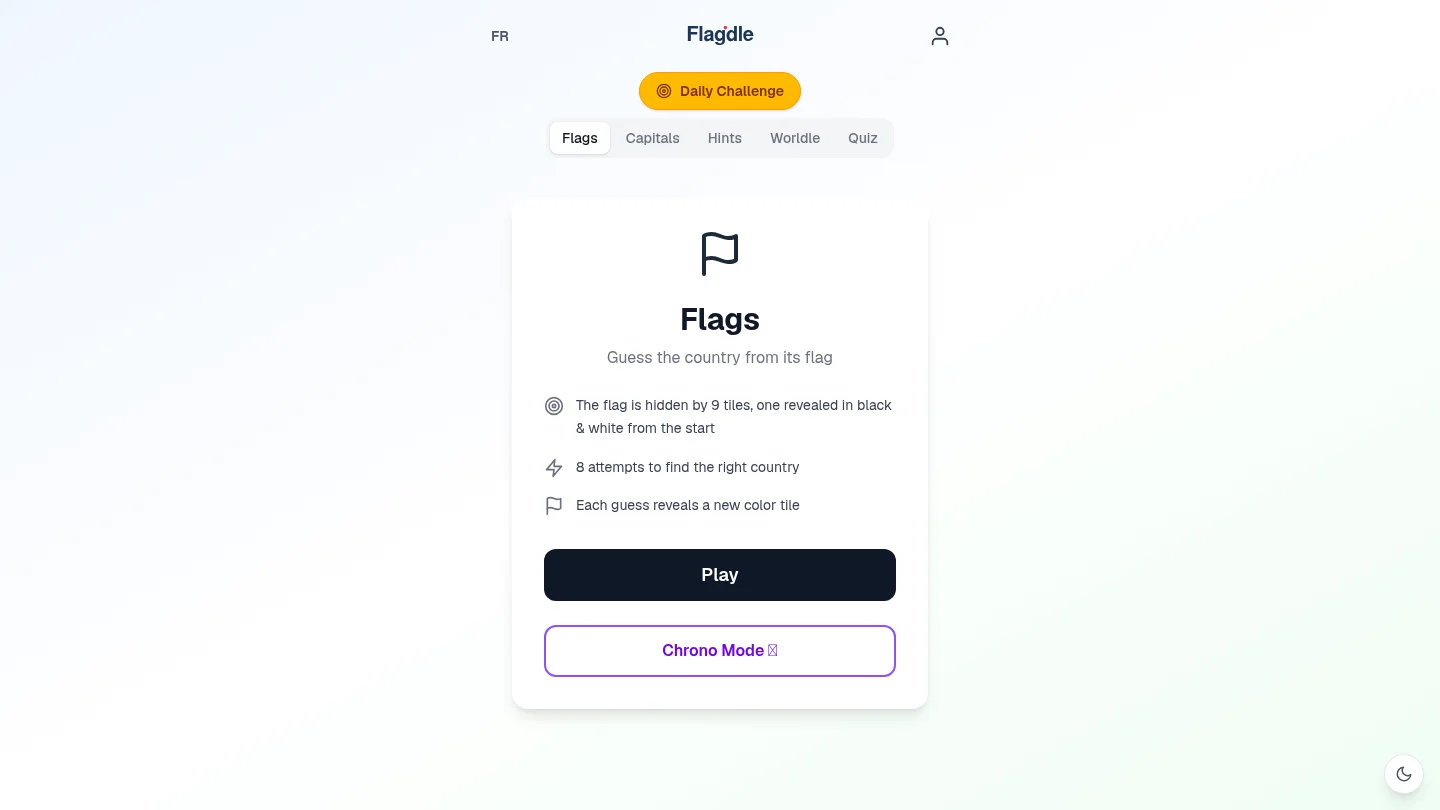
Play our free daily flag and geography guessing game covering all 195 UN countries, with flag, capital, silhouette, clue, and quiz modes plus daily, weekly, and monthly leaderboards. No account, no intrusive ads, stats kept right on your device. Jump in, guess today's flag in three tries, and compare your score with players around the world.
Frequently Asked Questions
What is a world guessing game?
It's a puzzle where you identify a country from clues like its flag, outline, or capital, usually within a limited number of tries. Most follow a daily format, so everyone gets the same challenge each day. They're quick to play and easy to share.
Are these games free to play?
Many are free for the daily puzzle, though some lock archives or extra modes behind subscriptions. Our version is fully free with no account and no intrusive ads. You can also install it as a web app on your phone.
Do geography guessing games actually help you learn?
Yes, the daily repetition builds real recall of flags, shapes, and capitals over time. Teachers use them as quick classroom warm-ups. Playing a few minutes a day beats cramming for retention.
How many guesses do you usually get?
It depends on the mode, but three to six is common. Flag rounds often give fewer tries, while silhouette and capital modes tend to allow six. Fewer guesses means each clue matters more.
What's the best way to improve quickly?
Learn distinctive country shapes and flag patterns, then use direction and distance clues to narrow things down. Play daily rather than in long bursts. A quick guide to drills and clue-reading speeds up the process a lot.