
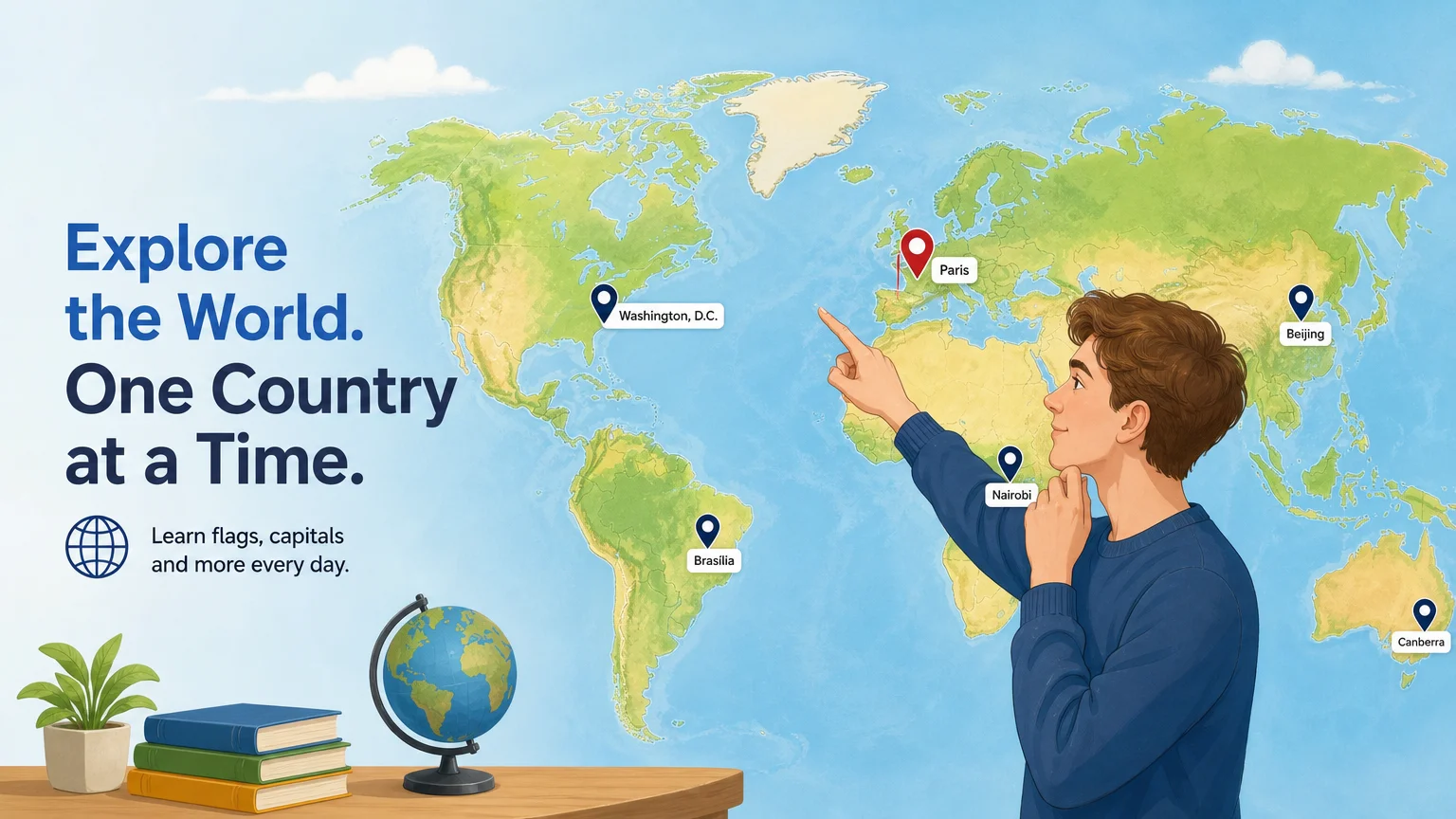

Can you name the capital of every country you recognize? A capitals of the world quiz game makes that challenge easier to repeat, especially when our country capital quiz game turns each answer into a small learning loop. You guess, see what you missed, and try again before the facts blur together. That feels more like a quick game than a study worksheet.
The catch is that not every quiz helps you learn in the same way. Some rely on multiple-choice recognition, while others ask you to recall the answer, use clues, beat a timer, or connect a capital to a country on a map. Your best choice depends on whether you want fast trivia, steady practice, classroom reinforcement, or travel preparation.
What makes a capitals quiz game worth your time?
A useful game does more than show you a list of city names. It asks you to retrieve an answer, responds to your mistake, and gives you another chance to use the information. That cycle is the heart of active recall, even when the experience feels casual.
Look for a format that keeps the question visible long enough for you to think. A capital should not appear immediately after every wrong guess, because that removes the useful effort of remembering. At the same time, the game should offer a clear correction, so you understand the difference between an uncertain answer and a genuine knowledge gap.
Games also work well when they keep each session manageable. A five-minute round is easier to repeat than a long study block, especially on a busy school day or before a trip. In a university teaching publication, geography students identified question-based games and interactive map games as possible classroom activities, which supports the value of combining recall with visual context.
That combination matters because capitals are abstract pairs. You need to connect a country, a city name, a location, and sometimes a spelling pattern. A good capital-city quiz helps you build those connections gradually instead of treating every answer as an isolated fact.
Imagine you only have five minutes
What can you realistically do in five minutes? You can complete a short multiple-choice round, review a small group of missed capitals, or test yourself on one region. That is enough to create momentum without making geography feel like another large task on your schedule.
Multiple-choice questions are a comfortable starting point. They reduce the pressure of spelling and help you distinguish between similar answers. However, recognition is not the same as recall. If you always choose from four options, you may remember the correct answer only when the other choices are visible.
Typed-answer quizzes create a stronger challenge. They ask you to produce the city name without relying on visual elimination. They can feel harder, but that difficulty is useful when you are preparing for an exam, trying to speak confidently, or checking whether a fact has really stuck.
Regional quizzes provide another practical option. You might focus on Africa, Europe, Asia, the Americas, or Oceania before moving to the full world set. This narrows the workload and lets you notice patterns, such as recurring language roots, neighboring countries, or capitals that are often confused.
A January 2026 Google Play listing for a world capitals quiz shows how varied these formats can be. It includes spelling, multiple-choice, timed play, map identification, flashcards, and continent-based study, illustrating why format choice matters as much as the question list.
Why do hints help more than a timer?
A timer can make a quiz exciting, but hints can make it more educational. The best clue systems reveal information progressively, giving you a chance to solve the question before showing the answer completely.
For example, a game might first reveal the continent, then the first letter, then a population or language clue. You still need to reason through the options, but you are not left staring at a blank screen. This creates a useful middle ground between guessing blindly and reading a flashcard.
Progressive clues also show you how your knowledge works. If you know the continent but not the city, your country knowledge may be stronger than your capital recall. If you recognize the city after seeing the first letter, spelling or retrieval speed may be the main obstacle.
To build a more consistent habit, our capitals quiz game for smarter daily geography explains how short challenges can connect memorization with broader country knowledge. That approach keeps capitals from becoming a disconnected list of names.
Try to use hints strategically. Give yourself a few seconds to answer first, then accept the clue when you are genuinely stuck. The goal is not to protect a perfect score at all costs. The goal is to make the next attempt more informed.
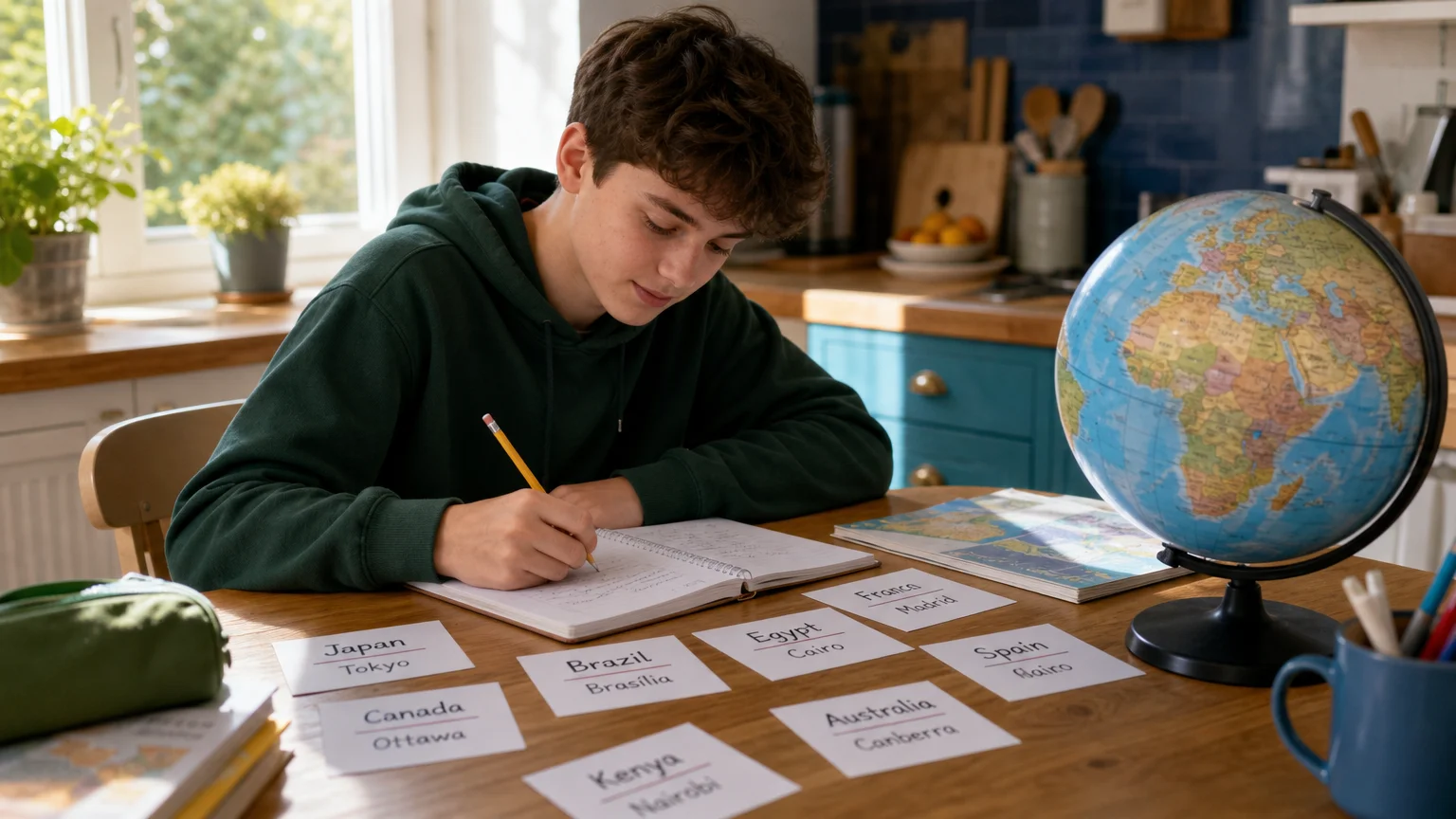
Five minutes can change the way you study capitals
Memorizing every capital in one sitting is an easy way to lose motivation. A better approach is spaced practice, where you return to the same material across separate sessions instead of cramming it once.
Start with a small target. You could attempt ten country and capital pairs, review the ones you missed, and stop while the activity still feels manageable. The next day, begin with those difficult pairs before adding new ones.
Daily play also gives you a simple measure of progress. You may answer more questions correctly, need fewer hints, or recognize a capital more quickly. These small improvements are easier to notice when each session has a similar length and structure.
One App Store example combines world and continent quizzes with a challenge mode and a list for reviewing capitals. That mix reflects a useful learning pattern: test yourself, identify weak spots, then return to the material with a different type of activity.
Keep your routine flexible. On a busy day, complete one short round. When you have more time, add a regional quiz or a map-based activity. Consistency matters more than forcing yourself through a large list.
One country can teach more than one answer
Suppose you are learning the capital of Kenya. You might remember Nairobi more easily when you connect it with Kenya’s flag, location, neighboring countries, languages, and physical geography. These extra details create more paths back to the same answer.
This is why a broader geography game can be more engaging than a capital-only drill. You are not just memorizing that one city belongs to one country. You are building a small mental map around it.
That approach is especially useful when several capitals feel interchangeable. Compare the countries by region, landscape, history, or language. Ask yourself what makes each pair distinct. The more meaningful the connection, the less likely the answer is to feel like a random fact.
Our own format brings several country-focused modes together, including capitals, flags, hints, silhouettes, and a multi-round Daily Challenge. You can approach the same mystery country through different clues, which adds variety without abandoning the central geography goal.
This also creates a natural progression. Begin with a flag or capital prompt, use a clue when needed, and then test yourself with a country silhouette. Each mode asks a slightly different question, so you practise recognition, recall, and geographic reasoning.
A practical routine for students, travelers, and teachers
Different learners need different levels of structure. A student preparing for a geography test may want focused repetition. A traveler may only need the capitals connected to an upcoming itinerary. A teacher may want a quick activity that works for the whole class.
For students, begin with a regional set and keep a short list of mistakes. Review that list before starting a new round. Once the answers feel familiar, switch from multiple choice to typed recall or timed play.
For travelers, study the countries on your route first. Add neighboring countries afterward, because border awareness makes the destination easier to place. You can also connect each capital with a landmark, local language, or regional fact.
For teachers, a short daily quiz can work as a warm-up, a transition activity, or a closing review. Keep the goal simple, such as learning three new capitals or correcting yesterday’s mistakes. Students are more likely to participate when the activity feels achievable.
If you want a repeatable routine, our guide to practice capitals daily offers a simple structure for turning quick rounds into regular review. You can adapt the same pattern for independent study or a classroom setting.
Most importantly, keep feedback visible. Ask learners to explain why an answer is correct, not only whether they selected it. That extra step turns a right answer into a stronger memory.
Before you choose, check these details
Not every game serves the same purpose, so compare the experience before committing to one. A few practical questions can help you find the right fit.
- What answer format does it use? Multiple choice is accessible, while typed answers test stronger recall.
- Can you practise by region? Regional sets are useful when the full world list feels too broad.
- Are hints progressive? Helpful clues should guide your thinking without revealing everything immediately.
- Can you review mistakes? A score is less valuable if you cannot revisit the answers you missed.
- Does it fit your device? Browser access can be more convenient than installing another app.
- Does it support repeat play? Daily puzzles create structure, while replay gives you extra practice.
- Can you track progress? Statistics, streaks, or leaderboards can make improvement easier to notice.
Privacy and access matter too. Check whether you need an account, whether your progress is stored locally, and whether the game includes intrusive advertising. If you are using it with students, also check the language options and whether the interface works comfortably on classroom devices.
Our browser-based experience is designed for short daily sessions, with no account required and statistics stored locally in the browser. It also supports replay practice, sharing, and multiple geography modes, so you can choose a challenge that matches your energy that day.
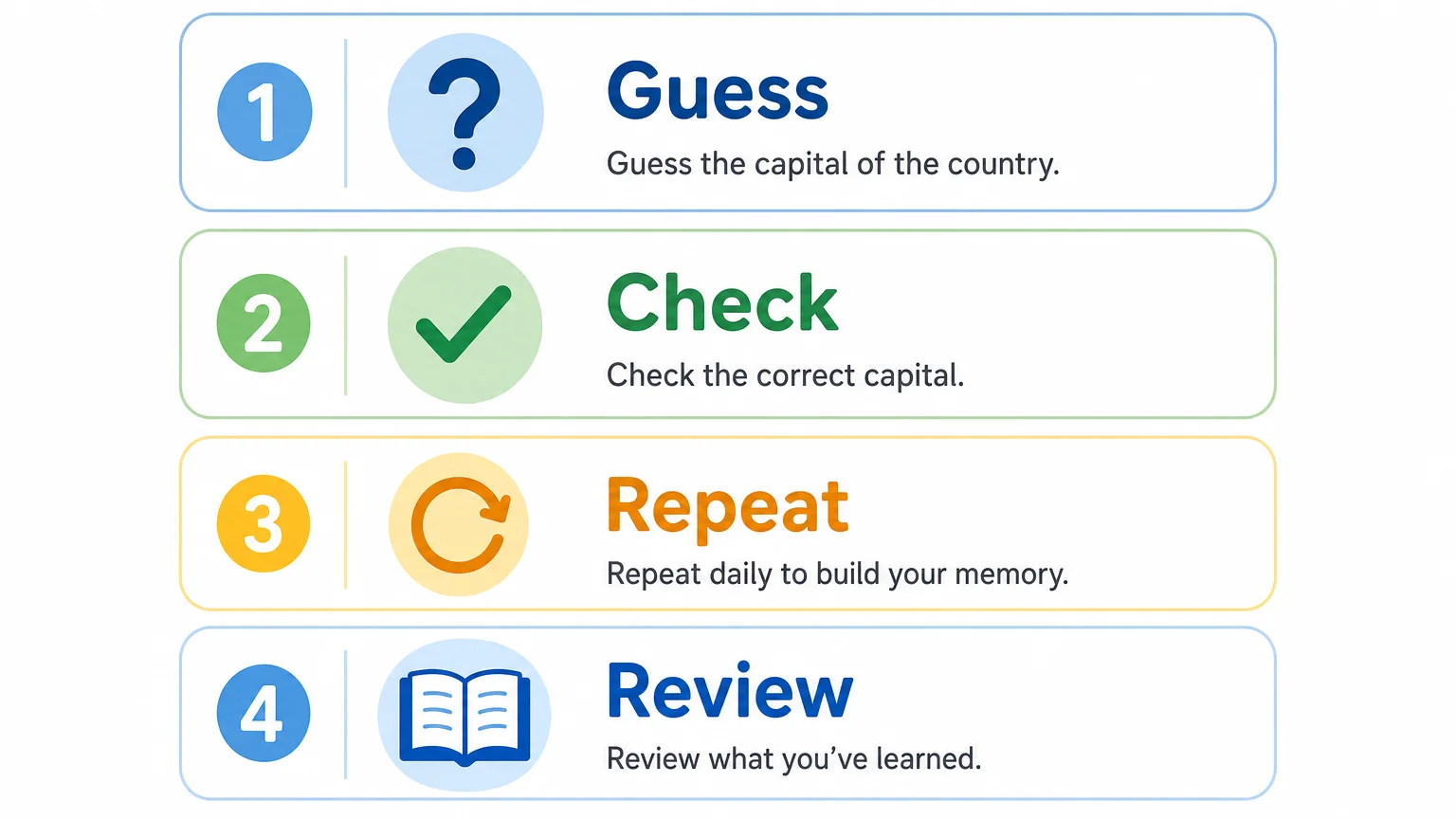
Make capital practice part of your routine
The best capitals of the world quiz game is the one you will actually return to. Choose short rounds, useful feedback, and a format that asks you to remember rather than simply recognize. Then review your mistakes, revisit difficult country and capital pairs, and gradually expand from one region to the whole world.
Take action with Flagdle
If you want a low-friction way to turn capital review into a daily ritual, we built Flagdle around short browser sessions. You can move from capitals to flags, clues, silhouettes, and themed quizzes without creating an account. That gives you variety when a straight list starts feeling stale.
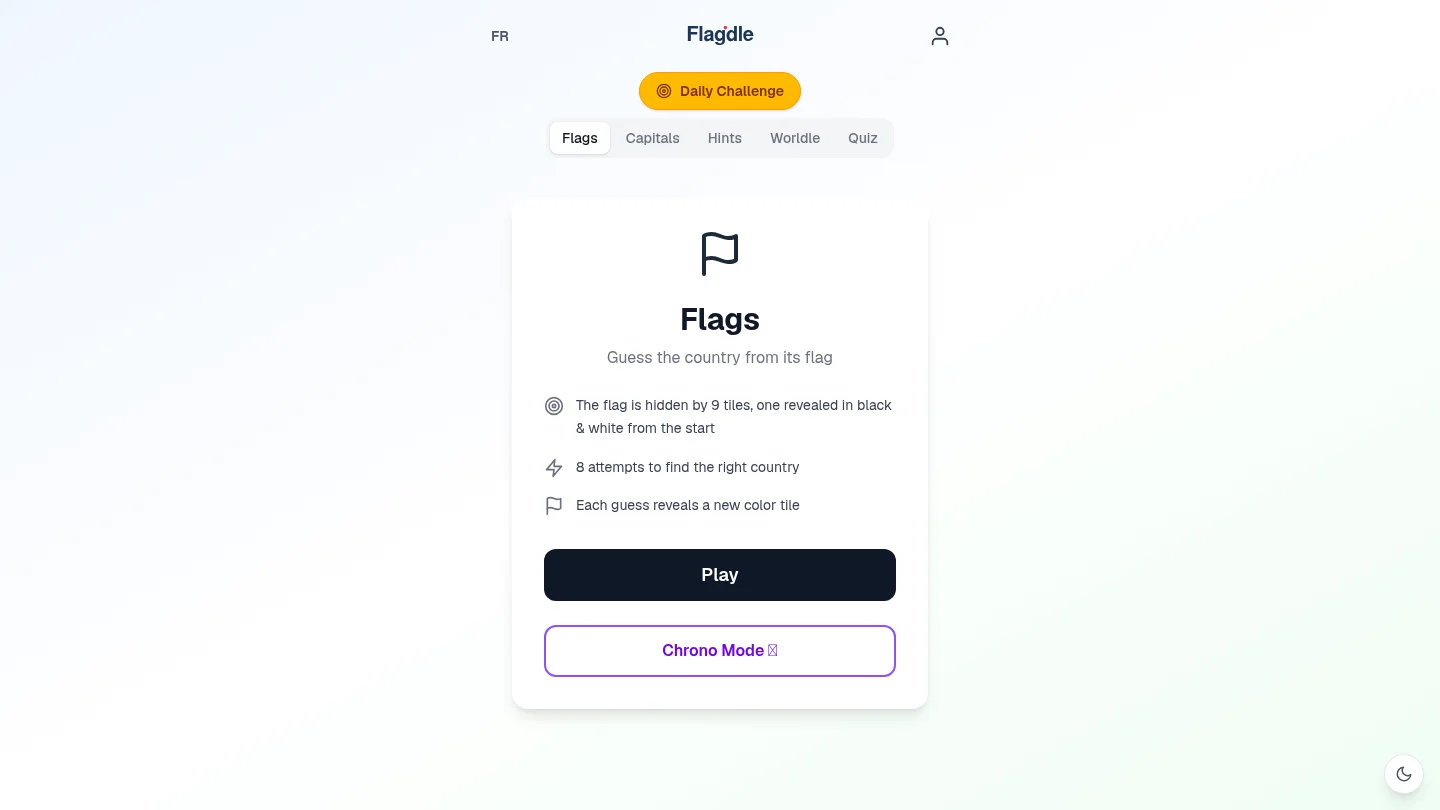
Use play the capitals quiz game to practise country and capital pairs through a focused daily challenge. When you want more variety, replay practice and connected geography modes help you keep learning without waiting for a long study session.
Frequently Asked Questions
What is a capitals of the world quiz game?
It is an interactive quiz that asks you to match countries with their capital cities. Depending on the format, you may choose from answers, type the city, use clues, or solve questions by region.
Is a quiz better than memorizing a list?
A quiz makes you retrieve the answer instead of only reading it. That gives you immediate feedback and shows which country and capital pairs need more practice.
How many capitals should I learn at once?
Start with a manageable group, such as ten capitals or one region. Add more only after you can recall most of the first group without relying heavily on hints.
Can I use a capital quiz before traveling?
Yes, you can focus on the countries in your itinerary and then add nearby countries for context. Learning capitals alongside flags, locations, and languages can make the preparation more useful.
Does Flagdle require an account to practise capitals?
No account is required to use our browser-based geography game. Our Capitals mode is part of a wider experience that also includes flags, hints, silhouettes, replay practice, and themed quizzes.