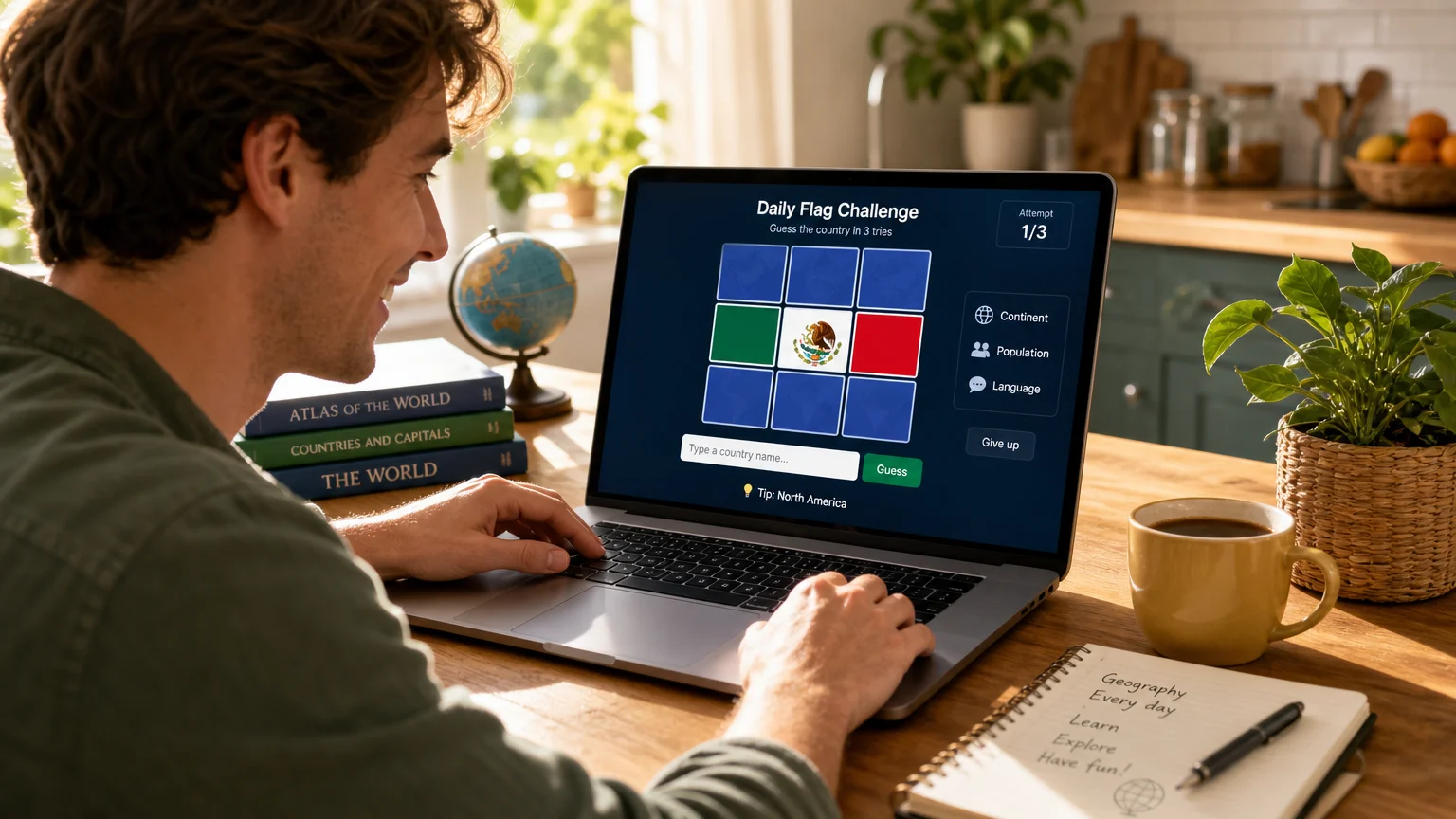


Here's something wild: there are 195 countries recognised by the United Nations, and most people can confidently name maybe a couple dozen capitals. That gap is exactly why a country capital quiz game works so well as a learning tool. Instead of staring at a list, you're prompted to produce an answer, and your brain treats that effort as something worth remembering. If you want a smarter daily routine, our capitals quiz game guide is a good place to start.
The science backs this up. Research on retrieval practice shows that active recall produces retention rates several times higher than passive review, which is why quiz mechanics beat rereading. Add a bit of time pressure and a daily habit, and you've got a low-effort way to actually memorise the map. Let's dig into how these games work and how to get the most out of them.
What makes a capital quiz game actually work
The magic isn't the trivia itself, it's the mechanic underneath it. When a country name appears and you have to type its capital, your brain shifts from lazy recognition ("I've seen this before") to genuine recall ("I need to know this now"). That effort is the whole point. According to a bibliometric review of gamified learning, studies repeatedly find that quiz-based gamification lifts student interest and measurable learning achievement compared with traditional instruction.
A good geography quiz game stacks a few ingredients on top of recall. You get immediate feedback, so you learn whether you were right within seconds instead of after a whole test. You get progressive hints, which nudge you toward the answer without handing it over. And you get a reason to come back tomorrow. If you want the broader picture across flags, maps and capitals, our country geography game: flags, capitals and maps breaks down how the pieces fit together.
Why daily play beats cramming
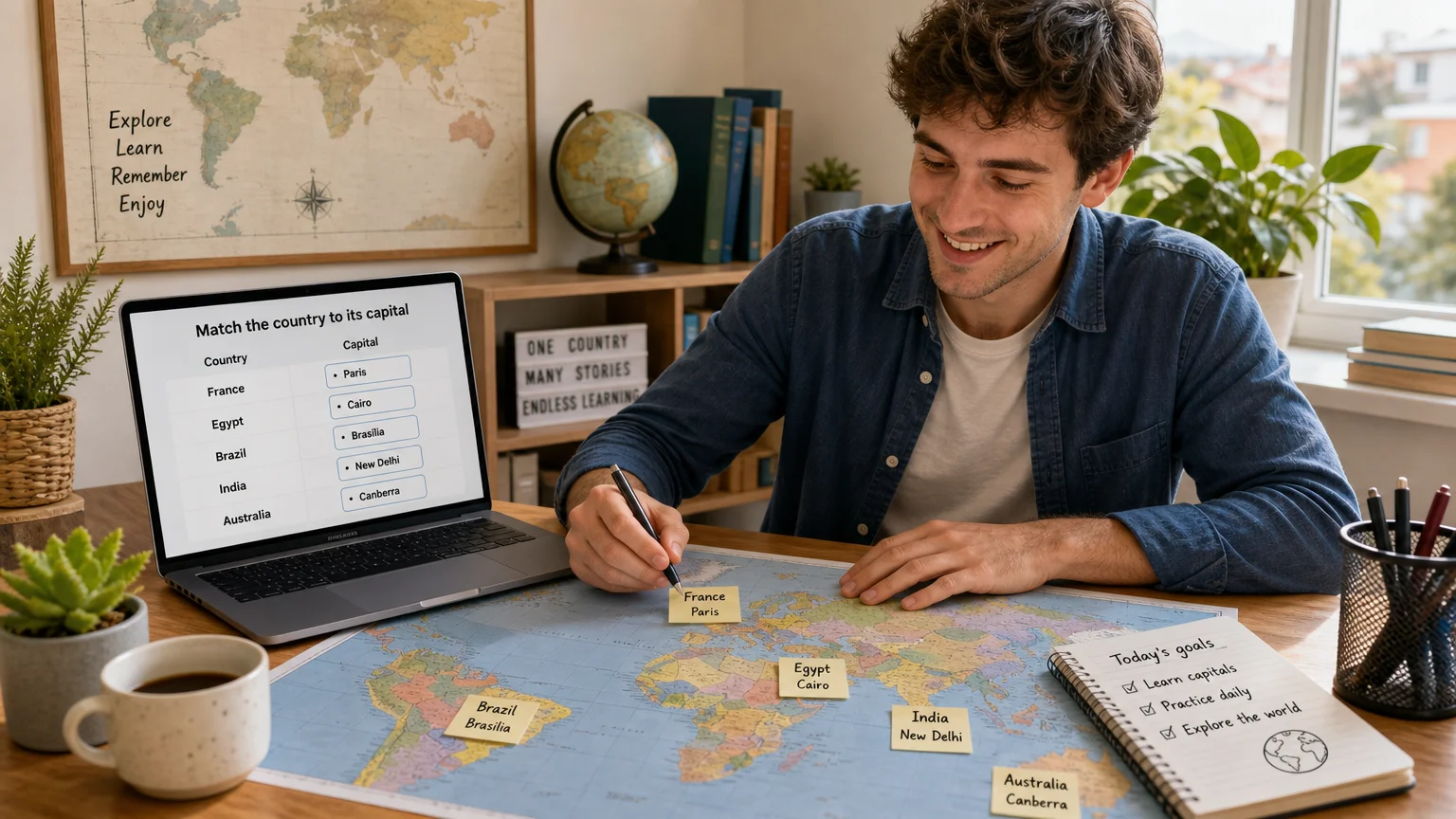
Ever crammed a list of capitals the night before a test, then forgotten half of them a week later? That's the failure mode of massed practice. Spacing your practice out, even five minutes a day, gives your memory repeated chances to reconsolidate what you've learned. A daily world capitals quiz turns that spacing into a habit you barely notice.
Time pressure plays a role too. The productive stress of a short countdown strengthens the neural pathways behind fast retrieval, the same reason timed drills feel annoying but work. In a clinical education trial on statistics learning, students in a gamified group that used points, levels, scoreboards and feedback showed better learning outcomes and attitudes than peers in a standard e-learning setup. The gamified structure did a lot of the heavy lifting. For a daily format built around one mystery country, our Guess the Country Daily approach shows how a single short round can compound over weeks.
The features worth looking for
Not every quiz is built the same, and a few design choices make a real difference in whether you keep playing and actually learn. When you're picking a capitals game, look for these:
- No sign-up friction. The best tools run instantly in a browser, no email required.
- Progressive hints. Continent, first letter, or region clues keep you thinking instead of giving up.
- Immediate feedback. Right or wrong within seconds, not buried at the end of a long quiz.
- Progress tracking. Knowing which capitals you miss lets you focus your practice where it counts.
- A daily refresh. A new puzzle every day builds the spacing habit automatically.
Watch out for the trade-offs, too. Some free sites don't save your progress or make it clear whether they work well on mobile, which limits their usefulness for a long-term study plan. A format that stores your stats locally and works on any screen sidesteps both problems.
Beyond capitals: connecting the whole map
Learning capitals in isolation is fine, but it sticks even better when you connect each one to something else about the country: its flag, its shape, its neighbours, its population. That web of associations gives your memory more hooks to grab onto. It's the difference between memorising "Canberra" as a random word and knowing it as the quiet inland capital of Australia, not the bigger, more famous Sydney.
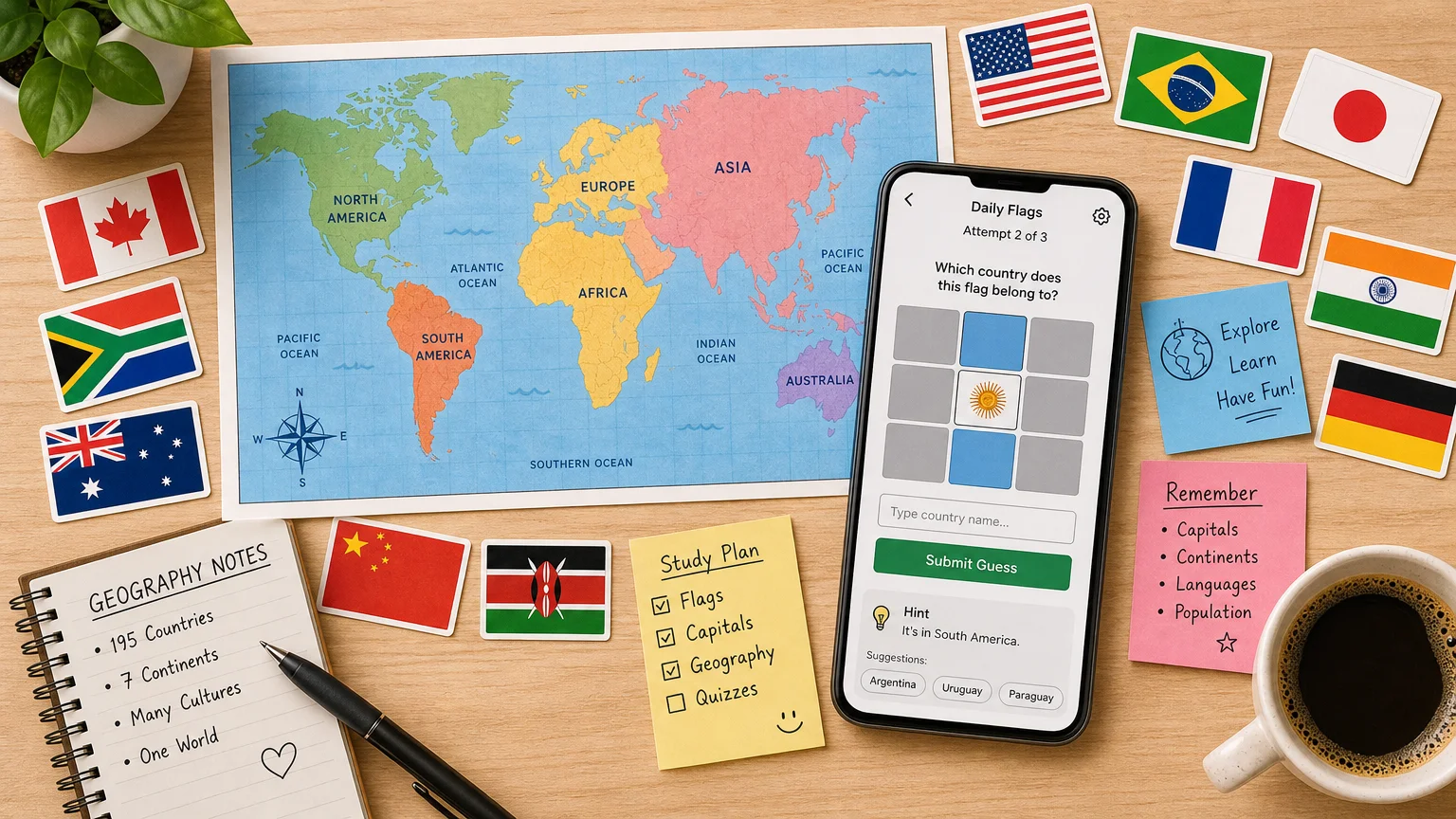
This is where multi-angle play shines. A challenge that chains a flag, a silhouette, a capital, and a few socioeconomic clues around one mystery country teaches geography as a connected system rather than a flashcard deck. It also keeps things fresh, which matters when you're playing every day. If you'd rather start from the country and work outward, our Geography Game to Guess the Country walks through that style of play.
How the popular formats compare
If you've searched around, you've probably seen a few different styles of capital and country quizzes. Some are giant one-shot lists, some are timed map games, and some are short daily puzzles. Here's how the common approaches stack up on the things that matter for actual learning.
| Format | Session length | Daily habit | Progressive hints | Multiple modes |
|---|---|---|---|---|
| Flagdle (our modes) | A few minutes | Yes, refreshes daily | Yes (continent, first letter) | Yes (six modes) |
| Big list quiz | Up to 20 minutes | No | No | No |
| Timed map quiz | Around 20 minutes | Varies | Limited | Sometimes |
The takeaway isn't that longer quizzes are bad; a big list is a great occasional stress test. But for building lasting memory, short repeatable rounds with hints and a daily reset tend to fit real life better. Our Capitals mode leans into that, adding continent and first-letter clues so you're always learning, even when you don't nail it on the first try.
The bottom line
Learning the world's capitals doesn't take a textbook or a marathon study session. A country capital quiz works because it makes you retrieve answers, gives instant feedback, and rewards showing up for a few minutes each day. Pick a format that's free, quick, and offers hints, then let the daily habit do the rest. Connect each capital to its flag, shape, and neighbours, and the map stops feeling like a list to memorise and starts feeling like a place you know.
Take action with Flagdle
Ready to turn five spare minutes into real geography knowledge? If the science of daily recall makes sense to you, the next step is simply to start playing, and to keep coming back tomorrow. That's where we come in.
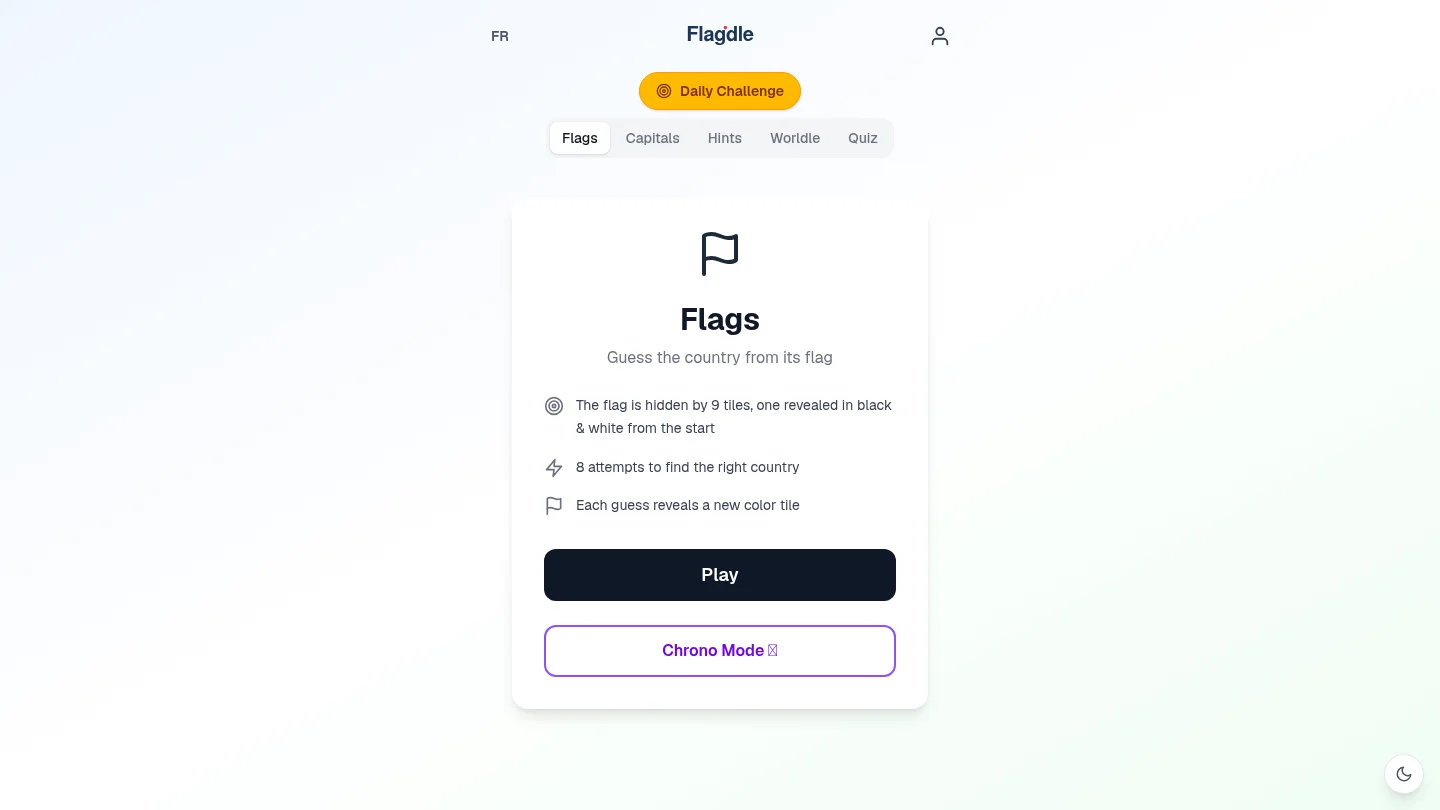
We built our free daily geography game around exactly these principles: no account, no intrusive ads, and a new puzzle every day at midnight in your timezone. You get six modes covering flags, capitals, clues, and country silhouettes, plus a multi-round Daily Challenge, replay practice, and daily, weekly and monthly leaderboards to compare with friends. Play it in your browser or install it to your home screen, across 195 UN-recognised countries in French or English.
Frequently Asked Questions
Is a country capital quiz game good for exam prep?
Yes, because it trains active recall, which builds stronger long-term memory than rereading notes. Short daily rounds spaced over weeks help capitals stick before an exam. Use the progress feedback to focus on the ones you keep missing.
How long should I play each day?
Five minutes a day is plenty to build the habit and benefit from spaced practice. Consistency matters far more than long sessions. A quick daily round keeps your memory refreshing the same facts repeatedly.
Do I need to create an account to play?
Not with every game. Our modes run right in your browser with no account, and your statistics are stored locally on your device. That means you can start instantly without any sign-up friction.
What if I confuse capitals like administrative versus constitutional ones?
Some countries genuinely have more than one capital, like Bolivia with La Paz and Sucre, or South Africa with three. A good quiz will accept the recognised answer and explain the nuance. Learning these edge cases is part of the fun.
Can teachers use a capital quiz in the classroom?
Absolutely, and many do. A five-minute daily quiz works well as a warm-up or a closing activity, and the shared daily puzzle lets a whole class compare results. It reinforces flags, capitals and world knowledge without much prep.