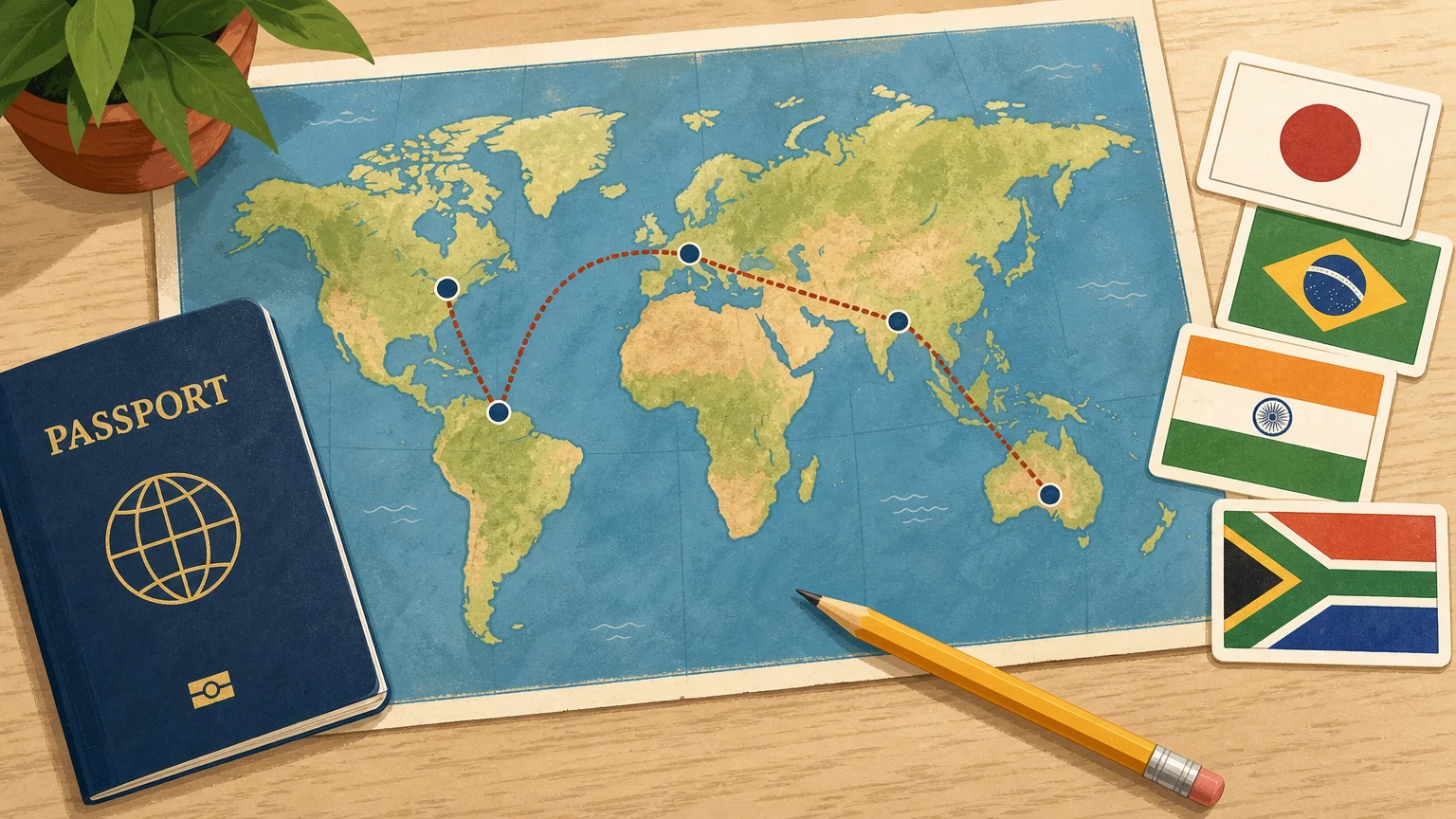

A useful geography game trains the skill you want to use, whether that’s recognizing flags, locating countries, or recalling capitals. For geography games for travelers, our strongest all-round starting point combines several kinds of practice. Our overview of country recognition games for travel also explains how to match practice to an itinerary.
You don’t need a long study session. A quick round that asks you to remember a country, then check your answer, gives you active practice rather than another country list to read. A systematic review of classroom research found retrieval practice benefited learning across varied subjects and study conditions, though it did not test travel games specifically. The classroom review offers useful context for choosing a practice style.
Which geography game fits your trip?
For broad country recognition, start with Flagdle: it pairs flag recognition with capitals, clues, silhouettes, and quizzes in a browser game covering 195 UN-recognised countries. If you want a narrower workout, choose a game built around maps, street scenes, country shapes, or routes. The comparison below focuses on each game’s practice format and access details.
| Rank | Game | Recognition practice | Format and access |
|---|---|---|---|
| 1 | Flagdle | Flags, capitals, country clues, silhouettes, quizzes | Daily games and replay; free browser access, no account; English and French |
| 2 | GeoGuessr | Recognizing real-world locations and surroundings | Free daily challenge with five locations; sign-up is presented. Broader map exploration is listed with a subscription |
| 3 | Seterra | Countries, flags, capitals, and regions on maps | Online map quizzes; other access terms aren’t stated here |
| 4 | Worldle | Country silhouettes, distance, and direction | Free daily browser puzzle; extra features depend on mode |
| 5 | Globle | Country guessing with distance feedback | Daily hot-or-cold format; access terms aren’t stated here |
| 6 | playGeography | Map placement for countries, flags, capitals, and regions | Free browser quizzes; no download or account required |
| 7 | MapTap | Placing world locations on a 3D globe | Daily puzzle with five locations and historical stories |
| 8 | Geograck geography games | Map, flag, shape, and capital recognition | Online quiz collection; access terms aren’t stated here |
| 9 | WhaleGames | City clues, routes, and place-based quizzes | Free account required to play; broader access includes a paid plan |
1. Flagdle
Best for: Travelers who want varied country recognition practice before visiting one or several destinations.
Our game covers 195 UN-recognised countries and supports English and French. The Daily Challenge links nine country-focused mini-games, while standalone modes let you practise flags, capitals, progressive clues, silhouettes, and themed quizzes. You can replay for additional practice, and the browser game doesn’t require an account or paid plan.
The variety is useful when you’re not sure which skill needs work. Try a flag round, then switch to play Worldle, our silhouette mode, to practise identifying a country by its outline and location clues. The game is available worldwide as a responsive web app, with an option to add it to your device’s home screen.
Pros
- Combines flags, capitals, clues, silhouettes, and quizzes instead of focusing on one recognition skill.
- Covers 195 UN-recognised countries and supports English and French.
- Free browser play without an account or paid plan.
Cons
- It’s a browser game rather than a native app-store download.
2. GeoGuessr
Best for: Travelers who enjoy reading visual clues in real-world street scenes.
GeoGuessr’s daily challenge presents five locations. You use what you see in each scene to work out where you are, making this a different kind of map awareness practice from a country-name or flag quiz. Its official free page also lists access to more than 1,000 official and community maps under a subscription.
Pros
- Builds observation skills through real-world location scenes.
- Offers a daily challenge and a large collection of maps to explore.
Cons
- Street-scene deduction doesn’t directly practise flags or capital recall.
- The broader map exploration is listed as a subscription feature, unlike our free, no-account browser game.
3. Seterra
Best for: Travelers who want direct practice locating countries or regions on a map.
Seterra’s map quizzes cover topics including countries, capitals, flags, and regions. Its map placement format suits learners who want to connect a name with a position, rather than infer a country from a street scene or a silhouette. Regional quizzes also let you focus on a part of the world that interests you.
Pros
- Map-based practice covers several familiar geography topics.
- Regional quizzes make it possible to focus on a particular area.
Cons
- Its described quizzes center on map identification, so choose another format for a broader mix of clues and country facts.
4. Worldle
Best for: Travelers who want a short puzzle about country shapes and relative location.
Worldle asks you to identify a country or territory from its silhouette. Guesses provide distance and direction clues, so the puzzle combines shape recognition with spatial reasoning. The daily browser game is a focused way to test your mental map, especially when you’re unfamiliar with a region’s outlines.
Pros
- Pairs country silhouettes with distance and direction feedback.
- Its daily puzzle provides a simple format for a short break.
Cons
- The silhouette format doesn’t directly test flags or capitals.
5. Globle
Best for: Travelers who like narrowing down a mystery country through distance feedback.
Globle’s described daily format gives you a country to identify and uses hot-or-cold feedback to guide later guesses. That makes it a different sort of location practice from quizzes that show a labeled map or a country outline. It’s worth considering if you like trying a broad guess, reading the feedback, and adjusting your next answer.
Pros
- Uses distance feedback to make each guess part of a geographic deduction.
- Daily play gives the puzzle a clear stopping point.
Cons
- Its described focus is country guessing, not a wider mix of flags, capitals, and quizzes.
6. playGeography
Best for: Travelers who prefer clicking on maps to identify countries, flags, capitals, or regions.
playGeography offers browser quizzes where you find places on a map. The collection includes world and regional country quizzes, flags, capitals, and subnational areas. World quizzes offer three difficulty levels, so you can start with a less demanding round and increase the challenge as you get familiar with a region.
Pros
- Provides map-based practice across world and regional topics.
- Free browser access without a download or sign-up.
- Difficulty levels let you build up from an easier quiz.
Cons
- The central activity is clicking on maps, which may not suit you if you prefer clues or free-form country guesses.
7. MapTap
Best for: Travelers who want a daily globe puzzle with location and history elements.
MapTap’s daily puzzle asks you to find five world locations on a 3D globe and connects them with historical stories. It offers a globe-based alternative to flat-map quizzes and flag recognition. Choose it when pinpointing places and exploring the story around a location sounds more appealing than memorising country details.
Pros
- Combines location guessing with historical stories.
- Uses a 3D globe and a daily puzzle format.
Cons
- The described activity centers on world locations and stories, rather than a broad set of country-recognition modes.
8. Geograck geography games
Best for: Travelers who want to choose among many map, flag, shape, and capital quizzes.
Geograck’s collection includes world and regional map games, flag quizzes, country shapes, capitals, and other geography challenges. That range makes it possible to select a topic that matches your itinerary or a skill you want to practise. It also includes quizzes about country landmarks and foods if you want to explore beyond map placement.
Pros
- Offers several geography formats, including maps, flags, silhouettes, and capitals.
- Includes regional quizzes as well as world-wide topics.
Cons
- The large collection asks you to choose a specific quiz, rather than follow one connected travel-preparation sequence.
9. WhaleGames
Best for: Travelers who enjoy short city clues, routes, and place-based puzzles.
WhaleGames describes a collection of five-minute games, including City Angle, City Route, and Country Guesser. Those formats focus on cities, directions, routes, and country identification, offering a different angle from capital drills or flag quizzes. The page says you need a free account to play and lists paid access for additional features.
Pros
- Offers multiple city and place-based puzzle formats.
- Games are presented as short sessions.
Cons
- A free account is required to play, and broader access includes a paid plan.
Match the practice to your journey
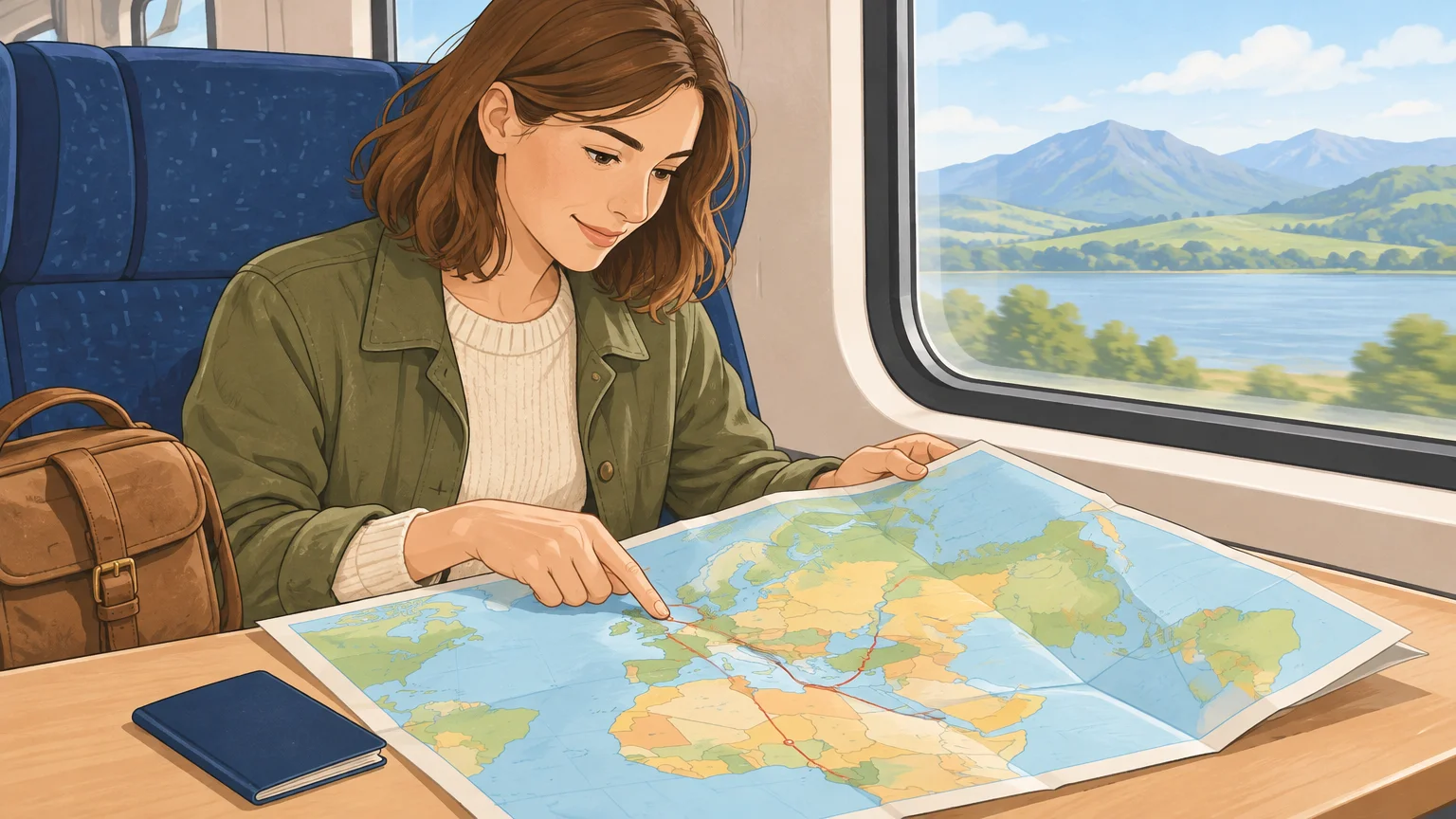
Which game should you choose? Start with the countries on your itinerary, then pick the kind of recognition you want to improve. For a trip through several countries, a map quiz or silhouette puzzle builds spatial familiarity. If flags are your weak spot, practise visual details; if you want broader country knowledge, use a mix of capitals and clues.
Different formats train different habits. A map quiz asks you to connect names with locations, while a silhouette puzzle asks you to recognize a shape. Street-scene games ask you to observe details such as signs and surroundings. Combining a few styles can keep your practice varied, but there’s no need to cover everything at once.
Retrieval practice is the act of bringing information to mind rather than simply rereading it. A review of this learning method describes how practising recall can support later remembering. That review covers learning research, not travel geography games, so treat it as context for how to practise, not as a result for any specific game. Read the review on retrieval practice.
Build a light practice routine before departure
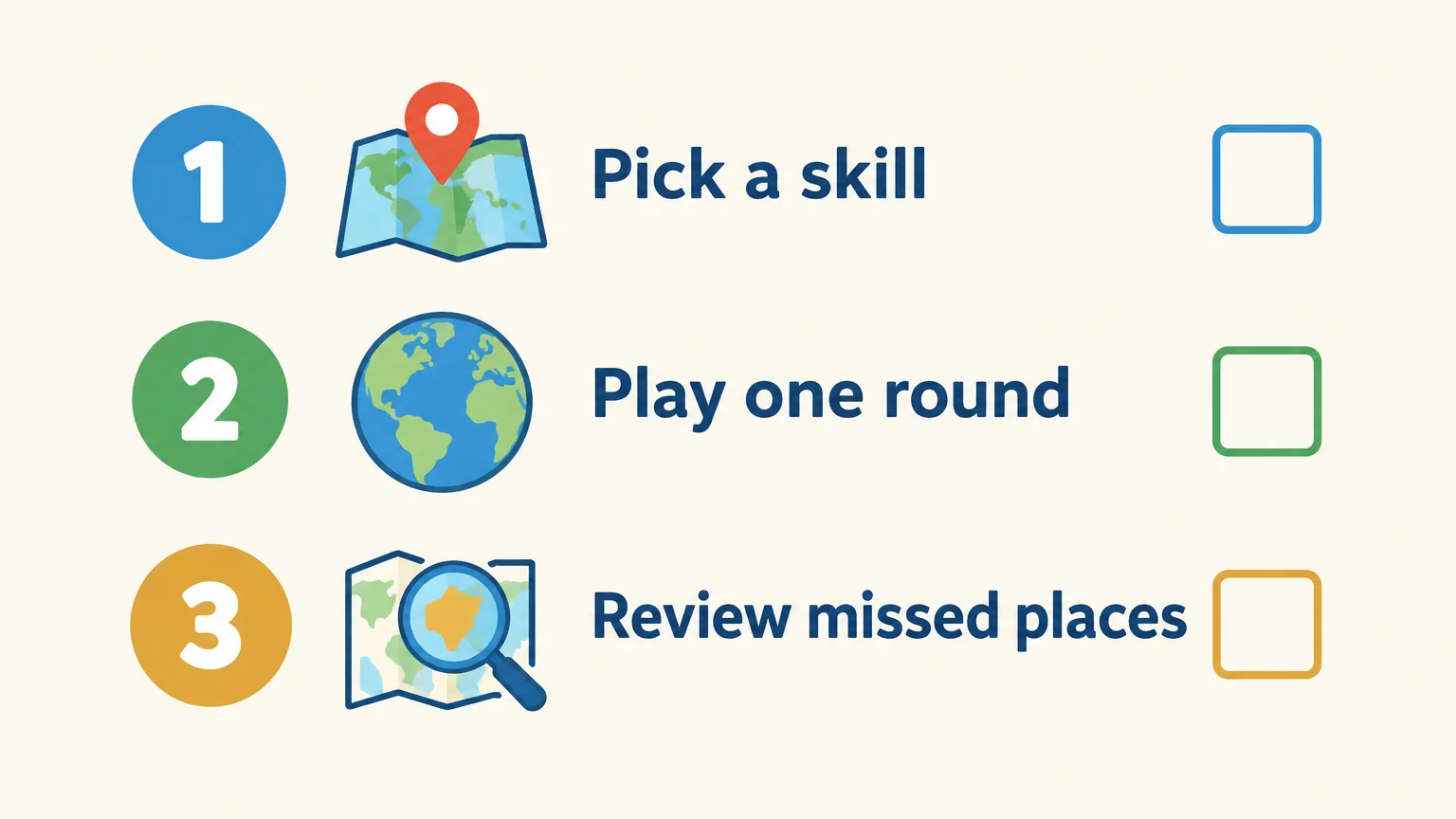
Short, repeatable practice is easier to fit around trip planning than a long cram session. Pick one skill, play a round, then revisit the countries you missed. A systematic review in health professions education found benefits from distributed practice and retrieval practice in many included experiments, while noting differences across study designs. It wasn’t a test of geography games, but it supports a practical habit: return to information over time instead of studying it only once. See the systematic review.
Try this simple routine:
- Choose one useful skill, such as flag recognition or map placement.
- Play a short round and note any countries you had trouble identifying.
- Review those places on a map, then test yourself again later.
You can also rotate formats. One day, practise capitals; the next, try a silhouette or a map quiz. A 2025 meta-analysis examined 44 studies comparing retrieval practice with elaborative study tasks, reinforcing that recall is a meaningful study approach to consider alongside other learning methods. Explore the 2025 review.
Keep the goal realistic: games can build recognition of countries, flags, capitals, and locations, but they don’t replace current travel information. Check official sources for entry rules, local transport, health advice, and other details that matter to your trip.
Choose a game that fits your itinerary
The best geography practice for travelers matches the skill you want to strengthen. Start with flags, capitals, maps, or country shapes, then add another format if your trip covers several places. A short round followed by a quick review gives you a practical routine without turning travel preparation into a study marathon.
Practise geography before your next trip
Want one browser game that brings several kinds of country recognition together? Our short, repeatable geography challenges let you practise on a break, while planning, or whenever you have a spare moment.

Explore flags, capitals, progressive country clues, silhouettes, and themed quizzes across 195 UN-recognised countries. Our game is free to play in your browser, requires no account or paid plan, and supports English and French. Choose geography games to play and find a format that fits your practice.
Frequently Asked Questions
Which geography game is best for a traveler who wants variety?
Flagdle combines flags, capitals, clues, silhouettes, and quizzes in one browser game. If you prefer to focus on a single skill, choose a map quiz or silhouette puzzle instead.
Can geography games help me recognize countries on a map?
Yes, map quizzes and silhouette games ask you to connect country names or shapes with locations. Repeat the countries you miss to make your practice more focused.
Are these games useful for preparing an itinerary?
They can help you practise recognizing destinations, flags, capitals, and neighboring countries. They don’t replace current travel guidance or practical research about your destination.
Can I play geography games in a browser without an account?
Some options are available in a browser without an account, including Flagdle and playGeography. Check each game’s access details, since some features or other games require sign-up or paid access.
What should I practise first before a trip?
Start with the skill most relevant to your itinerary, such as locating countries on a map or recognizing their flags. Add capitals or country clues if you want a broader review.