
Short practice can make your travel preparation more active than simply reading a country list. Our browser-based option combines flags, capitals, clues, silhouettes, and quizzes, so you can train different types of recognition in one place. If you want a quick starting point, try our geography game to guess the country, then choose the practice style that fits your itinerary.
What should you practise before a trip: flags, locations, capitals, or border routes? The answer depends on your destination and your confidence level. Retrieval practice tends to support longer-term retention better than rereading alone, although the design of the activity still matters, as explained in this systematic review of retrieval practice.
Which country recognition game fits your trip?
For most travelers, the best starting point is a game that mixes visual recognition, factual clues, and quick replay. Flagdle takes that broad approach, while the other options below focus more narrowly on silhouettes, borders, flags, maps, timed rounds, or mobile trivia.
Choose a focused alternative when you already know your main weakness. Travle is useful for border geography, Worldle develops silhouette and location awareness, and Flagle concentrates on flags. If you prefer a broad mobile quiz or short browser rounds, Travel Quiz and Stampie offer wider travel-themed practice.
| Rank | Game | Recognition focus | Practice format | Access and social features |
|---|---|---|---|---|
| 1 | Flagdle | Flags, capitals, clues, silhouettes, quizzes | Daily challenges and replay practice | Browser-based, no account, English and French, score sharing and leaderboards |
| 2 | Worldle | Country silhouettes, distance, direction | Daily puzzles and additional practice options | Browser-based daily play, with extra features depending on mode |
| 3 | Travle | Bordering countries and travel routes | Daily routes, practice, and challenges | Browser-based route puzzles with score comparison |
| 4 | Flagle | Progressively revealed national flags | Daily flag guessing and extra rounds | Browser-based play with archive and account features described on its site |
| 5 | MapGame | Hidden countries, map position, directional clues | Daily, practice, and ranked modes | Interactive map play with local browser statistics |
| 6 | Stampie free travel games | Flags, capitals, country naming | Short timed rounds and full-country challenges | Browser-based, no account required, score sharing |
| 7 | Travel Quiz, Trivia game | Countries, cities, flags, cuisine, trivia | Mobile quiz modes and tournaments | App-based access with offline play described in store listings |
1. Flagdle
Best for: Travelers who want one flexible geography game for flags, capitals, country facts, silhouettes, and general knowledge.
Flagdle is the strongest all-round choice because it covers several recognition mechanics without requiring an account or a paid plan. Its Daily Challenge links nine country-focused mini-games around one mystery country, while separate modes let you practise flags, capitals, progressive hints, silhouettes, and themed quizzes.
The format suits a short session before planning an itinerary. You can start with visual recognition, use clues when you get stuck, and then switch to replay practice. Coverage includes 195 UN-recognised countries, with English and French support. Daily, weekly, and monthly leaderboards also give you a reason to return without making competition the only goal.
Pros
- Combines flag recognition, capital recall, clues, silhouettes, and quizzes.
- Runs in a browser without an account, subscription, or stated fee.
- Supports English and French, with worldwide browser access.
- Uses shared daily challenges, local statistics, emoji sharing, and leaderboards.
Cons
- It is browser-based rather than a native app-store download, so offline play is not its main use case.
- Local statistics can be reset when you clear browser data, change browsers, or use private browsing.
2. Worldle
Best for: Travelers who want to recognize countries from their shapes and improve broad map awareness.
Worldle centers on a country or territory silhouette. Each guess gives distance and direction feedback, helping you narrow the answer through spatial reasoning rather than flag details. This makes it useful when you want to recognize where a country is located, not only what its flag looks like.
The game is particularly helpful for destinations with unfamiliar outlines or regions you have not studied closely. It also makes you think about relative position and scale. However, silhouette practice is narrower than a multi-mode platform, so you may need another tool for capitals, flags, or cultural facts.
Pros
- Builds map awareness through silhouettes, distance, and direction.
- Encourages you to compare neighboring regions and relative positions.
- Works well as a quick daily geography challenge.
Cons
- Silhouette recognition does not directly train flag or capital recall.
- Some extra practice and archive features may depend on the selected mode.
3. Travle
Best for: Travelers who want to understand how countries connect through land borders, bridges, and routes.
Travle turns geography into a route-building challenge. You receive a starting country and a destination, then name bordering countries until you reach the goal. The central skill is not simply recognizing a country, but understanding which nations form a plausible path between two places.
This is useful if your trip crosses several countries or if you want to build stronger regional knowledge. It also creates a practical connection between geography and travel planning. The trade-off is that it focuses on country relationships rather than flags, capitals, or visual clues.
Pros
- Develops border knowledge and regional connections.
- Offers daily routes alongside practice challenges.
- Rewards efficient thinking and recognition of geographic gateways.
Cons
- It is less suitable if your main goal is memorizing flags or capitals.
- Route puzzles can feel demanding when you have limited border knowledge.
4. Flagle
Best for: Travelers who want focused practice identifying national flags through progressive visual reveals.
Flagle keeps its mechanic simple. You guess a hidden flag, then receive more visual information after each attempt. This creates a focused way to study colors, symbols, stripes, and layouts, especially when you are preparing for countries with flags that look similar.
It works well as a lightweight daily habit. You can use it to build visual familiarity before moving to a broader game that asks for capitals, map locations, or country facts. Because the mechanic is specialized, it is best treated as a flag tool rather than a complete travel preparation system.
Pros
- Provides direct, repeated flag recognition practice.
- Progressive reveals give you support without showing the full answer immediately.
- Short rounds are easy to fit into a break or commute.
Cons
- It concentrates on flags and offers less practice with routes, capitals, or silhouettes.
- Visual similarities between flags can make early rounds frustrating for beginners.
5. MapGame
Best for: Players who prefer clicking on an interactive map and using directional hints to identify a country.
MapGame combines a hidden-country format with map interaction. You receive hints after guesses, then use the map to test possible locations. Daily, practice, and ranked modes provide different levels of pressure, from relaxed learning to score comparison.
This format is helpful when you want to connect a country name with its approximate location. It also makes a good supplement to flag practice because you are required to think spatially. The main limitation is that map clicking may feel less convenient on small screens than a simple search field.
Pros
- Strengthens map placement and directional reasoning.
- Offers daily play, unlimited practice, and ranked sessions.
- Provides hints that help you learn from near misses.
Cons
- The interactive map can demand more screen space than a text-based quiz.
- Local progress may not carry over when you change browsers or devices.
6. Stampie free travel games
Best for: Travelers who want very short browser games for flags, capitals, country naming, and road-trip entertainment.
Stampie groups several lightweight travel games in one browser collection. You can choose short flag or capital rounds, name countries against a timer, identify all 50 U.S. states, or use travel-themed activities during a road trip.
The collection is convenient when you want to choose the activity based on your available time. A 10-question round feels different from a full-country challenge, which makes the format approachable for casual practice. It is less focused on deeper clue systems or connected country knowledge.
Pros
- Offers simple short replay formats with several difficulty options.
- Runs in the browser without requiring an account.
- Works well for families, road trips, and quick travel breaks.
Cons
- The collection is divided into separate games rather than one connected learning journey.
- Timed naming rounds may favor speed over careful learning.
7. Travel Quiz, Trivia game
Best for: Travelers who prefer a mobile quiz covering countries, cities, flags, cuisine, and cultural trivia.
Travel Quiz takes a broader trivia approach than the browser-first games above. Its described modes include country photos, city and capital questions, flag identification, world cuisines, geography questions, and a travel-focused test about customs and traditions.
This variety can make the experience engaging when you want more than map exercises. It also suits people who prefer multiple-choice questions and mobile play. Before choosing it, check the current store listing, supported device, advertising, and purchase details because those conditions can change between platforms and regions.
Pros
- Combines travel trivia with country, city, flag, and cuisine questions.
- Offers a broader cultural angle than a flag-only or silhouette-only game.
- Mobile access can suit travelers who prefer an installed quiz experience.
Cons
- Its emphasis is broader trivia rather than a dedicated country-recognition routine.
- Store availability and app conditions may vary by device and region.
What should you practise before a trip?
Start with the recognition skill most likely to help during your journey. If you are visiting several countries, practise flags and capitals first because they support quick recognition at airports, border crossings, museums, and news displays. If you are planning a road trip, border routes and map placement may be more useful.
For visual learners, progressive clues offer a useful middle ground. You still make the decision, but the game gives you a continent, first letter, distance, direction, or factual hint when needed. Flagdle uses several of these approaches, while our distance and direction geography game content explains how spatial clues can guide country recognition.
It also helps to separate recognition from cultural preparation. A game can help you remember a country, capital, flag, or location, but it cannot replace learning local customs, language basics, transport rules, or safety information. Education can support intercultural understanding and the ability to navigate differences, as discussed by UNESCO on intercultural dialogue.
How should you compare game mechanics?
Ask what you want your memory to do. A flag game asks you to recognize visual patterns. A capital quiz asks you to retrieve a city name. A silhouette game asks you to connect shape with location. A route game asks you to build a geographic relationship step by step.
Capital recall is useful when your itinerary includes major cities or when you want stronger general knowledge. Map awareness matters more when you need to understand neighboring countries, regional distances, or a route across several borders. Broader quizzes are useful when you want to connect geography with food, history, language, and culture.
Do not assume that the most difficult format is always the best one. Multiple-choice questions can help you build familiarity, while typed answers and timed rounds test stronger recall. A good routine moves gradually from support to independence rather than making every session feel like an exam.
If your main goal is map placement, our Mapdle country recognition game article can help you think about map-based practice. If you want a wider mix of formats, our guide to world guessing games covers broader ways to practise country knowledge.
How can you build a travel geography routine?
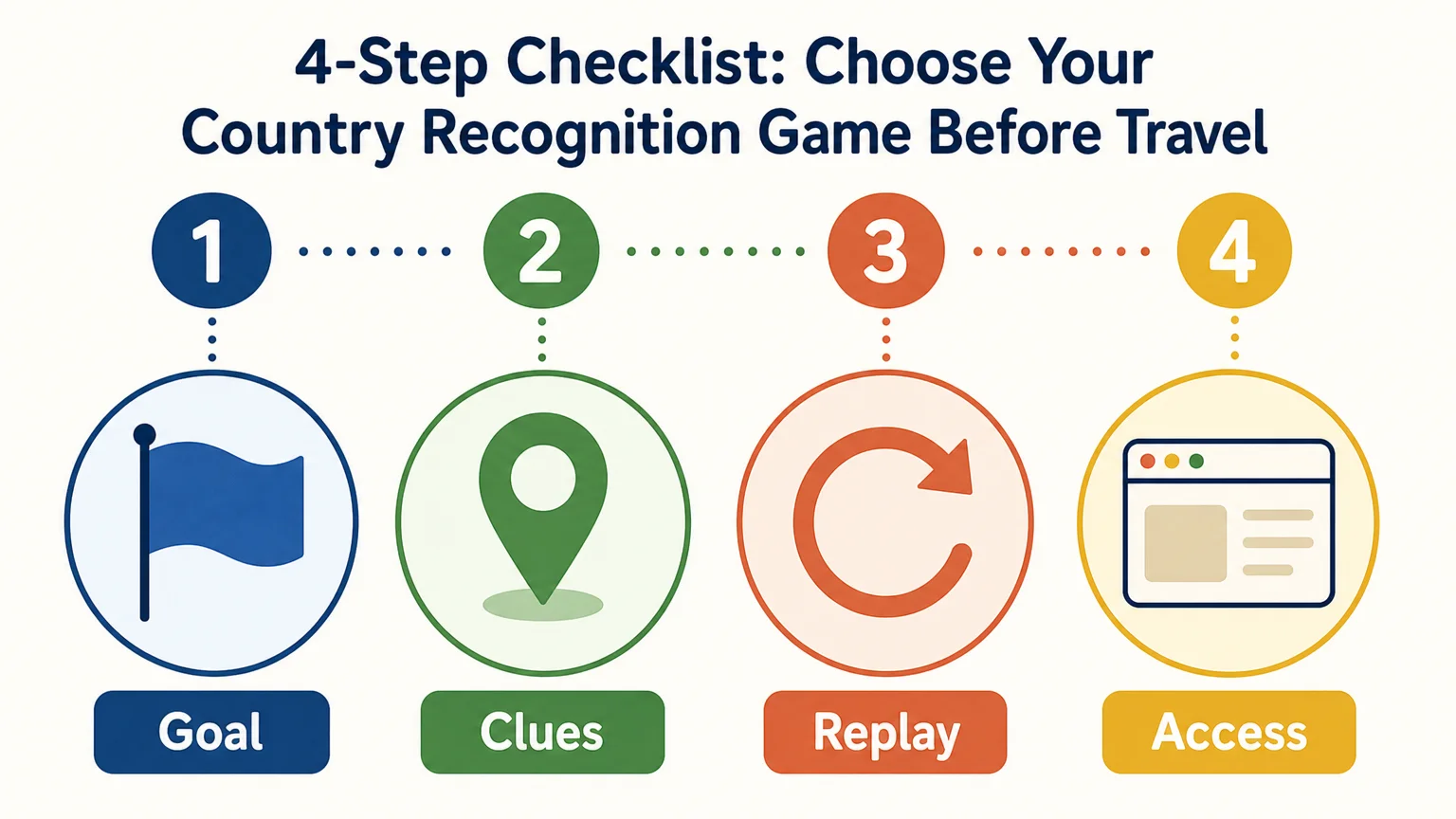
A practical routine does not need to be long. Choose one short round before breakfast, during a commute, or while planning the next part of your itinerary. Then review the countries you missed instead of immediately starting another random game.
- Set a goal. Choose flags, capitals, silhouettes, routes, or broader trivia.
- Start with support. Use clues or multiple-choice questions if the topic is unfamiliar.
- Review mistakes. Look at a map, repeat the answer later, and connect it with a flag or capital.
- Increase variety. Mix visual, factual, and spatial challenges once recognition improves.
Shared challenges can also make practice easier to maintain. Comparing scores with friends gives you a social reason to return, while a daily puzzle creates a natural rhythm. Keep the competition light, and measure progress by the countries you recognize more quickly, not only by your rank.
Flagdle is particularly suited to this routine because its Daily Challenge brings several country-focused tasks together. You can use one short session to test a flag, capital, clue, silhouette, language, currency, or other country fact, then return later for replay practice.
What are the main trade-offs?
Browser games are usually the easiest option when you want to start immediately on a phone, tablet, or laptop. They avoid app-store searches and can work well for classroom activities or shared travel planning. Their limitation is that offline access may be unavailable, and local progress can depend on the browser you use.
Mobile apps can be more convenient when you want dedicated installation or offline features. However, you should check current store conditions, supported devices, advertising, purchases, and privacy details before relying on one during a trip.
Daily games are good for consistency because they create a small recurring task. Unlimited modes are better when you want to focus on a destination or repeat a weak topic. The strongest choice is often a combination: one daily challenge for variety and one replay mode for targeted improvement.
Choose the game that matches your journey
The best country recognition games for travel are not identical, and that is useful. Choose flags when visual recognition matters, silhouettes and maps when location is your weak point, routes when you are crossing borders, and broad quizzes when you want cultural variety. For one flexible starting point, Flagdle combines these approaches in short browser sessions, while focused alternatives can strengthen a specific skill.
Make geography practice part of your travel routine
If you want a simple way to prepare for an itinerary, start with one short recognition session and return to the countries you find difficult. A varied routine can help you connect flags, capitals, locations, and country facts without turning preparation into a long study block.

With our free browser geography game, you can play a Daily Challenge built around one country, switch between flags, capitals, hints, silhouettes, and themed quizzes, and practise in English or French. No account or paid plan is required, and you can install the responsive web app on your device home screen for convenient access.
Frequently Asked Questions
Are country recognition games useful before travel?
Yes, they can help you practise recognizing flags, capitals, silhouettes, locations, and neighboring countries. Use them as a supplement to practical travel research about customs, transport, safety, and local language.
Which game is best for learning country flags?
Flagle is designed around progressively revealed flags, while Flagdle combines flag practice with capitals, clues, silhouettes, and quizzes. Choose a focused flag game when visual recall is your main goal, or a multi-mode game when you want broader preparation.
What is the best game for learning country locations?
Worldle and MapGame emphasize silhouettes, maps, distance, direction, or location hints. Travle is better when you want to understand how countries connect through borders and routes.
Can I play geography games on my phone without downloading an app?
Many browser-based geography games work on phones and tablets without a native download. Some can also be added to your home screen, while mobile apps may offer different access, offline options, or store conditions.
How long should a travel geography practice session last?
A short daily session is often easier to maintain than occasional cramming. Start with one round, review mistakes, and repeat difficult countries later using a different clue or recognition format.