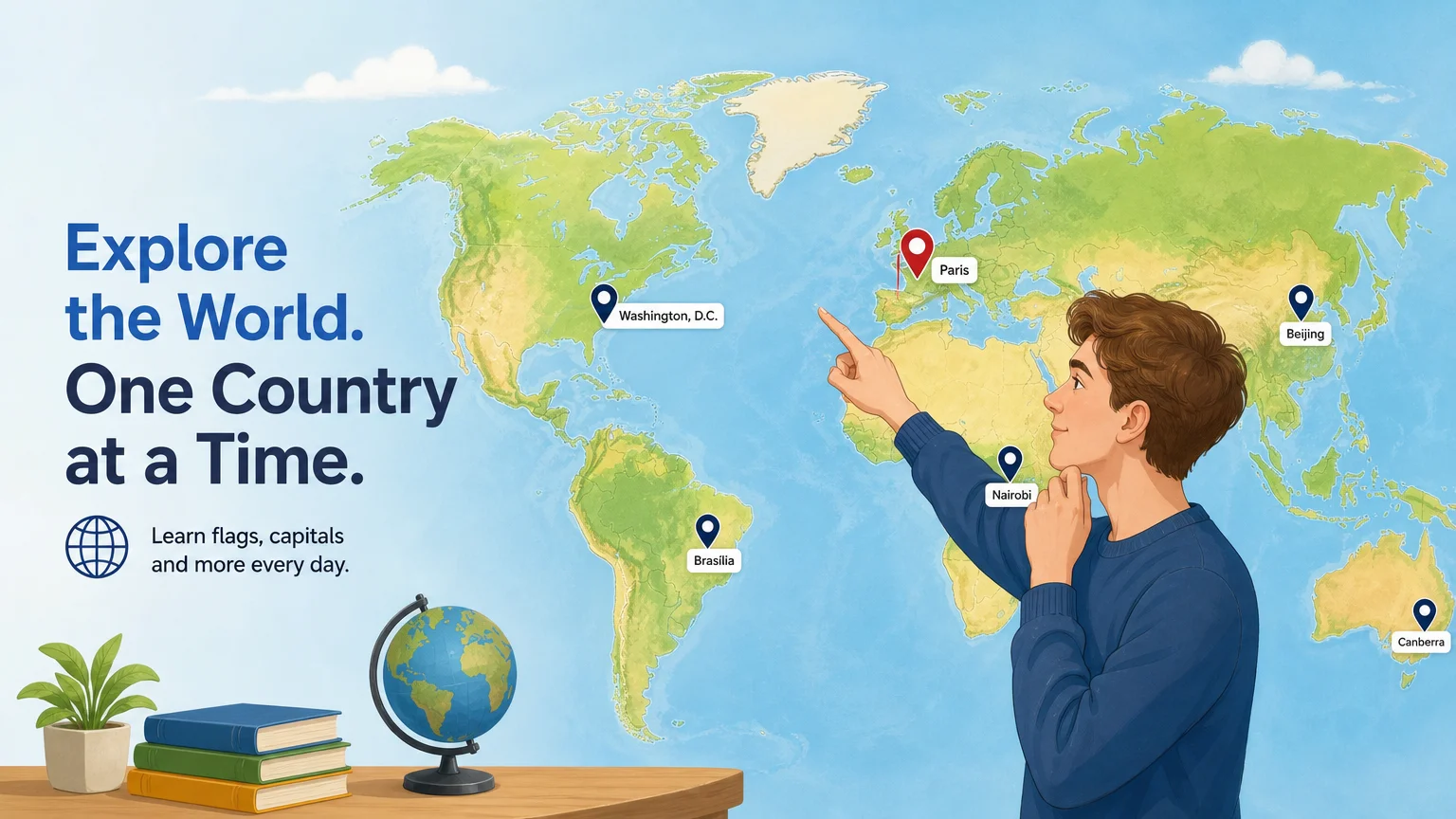
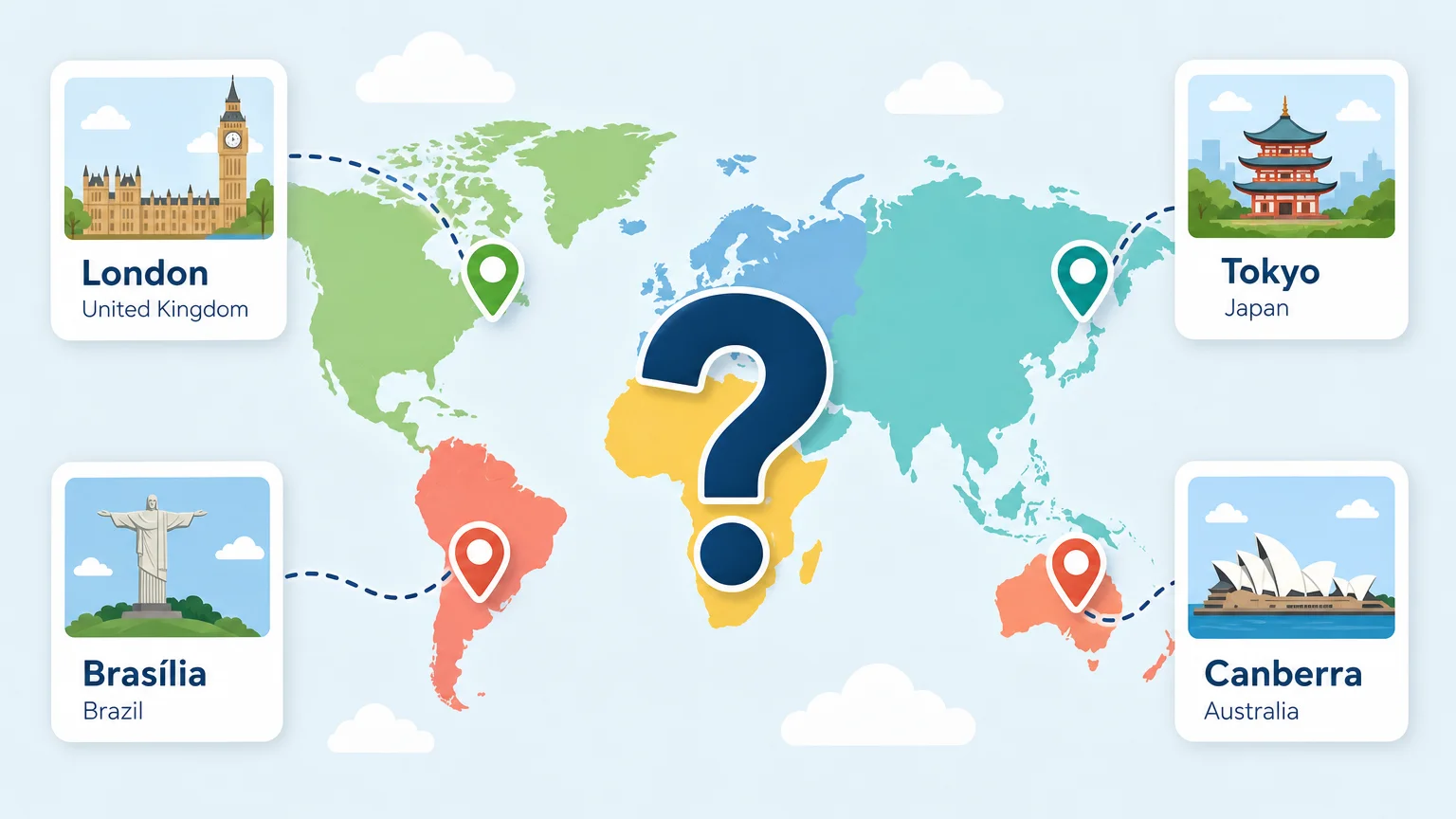

How many capitals could you name without a map, a search bar, or a lucky multiple-choice guess? A good country capitals test turns that question into active practice. If you like learning through short rounds, our capitals of the world quiz game gives you a playful way to connect countries and cities.
The trick isn’t chasing a perfect score on your first attempt. It’s noticing which answers feel uncertain, testing them again later, and linking each capital to a region, language, landmark, or neighboring country. That approach makes the names easier to retrieve when a quiz, classroom exercise, trip, or conversation puts you on the spot.
What does a country capitals test really measure?
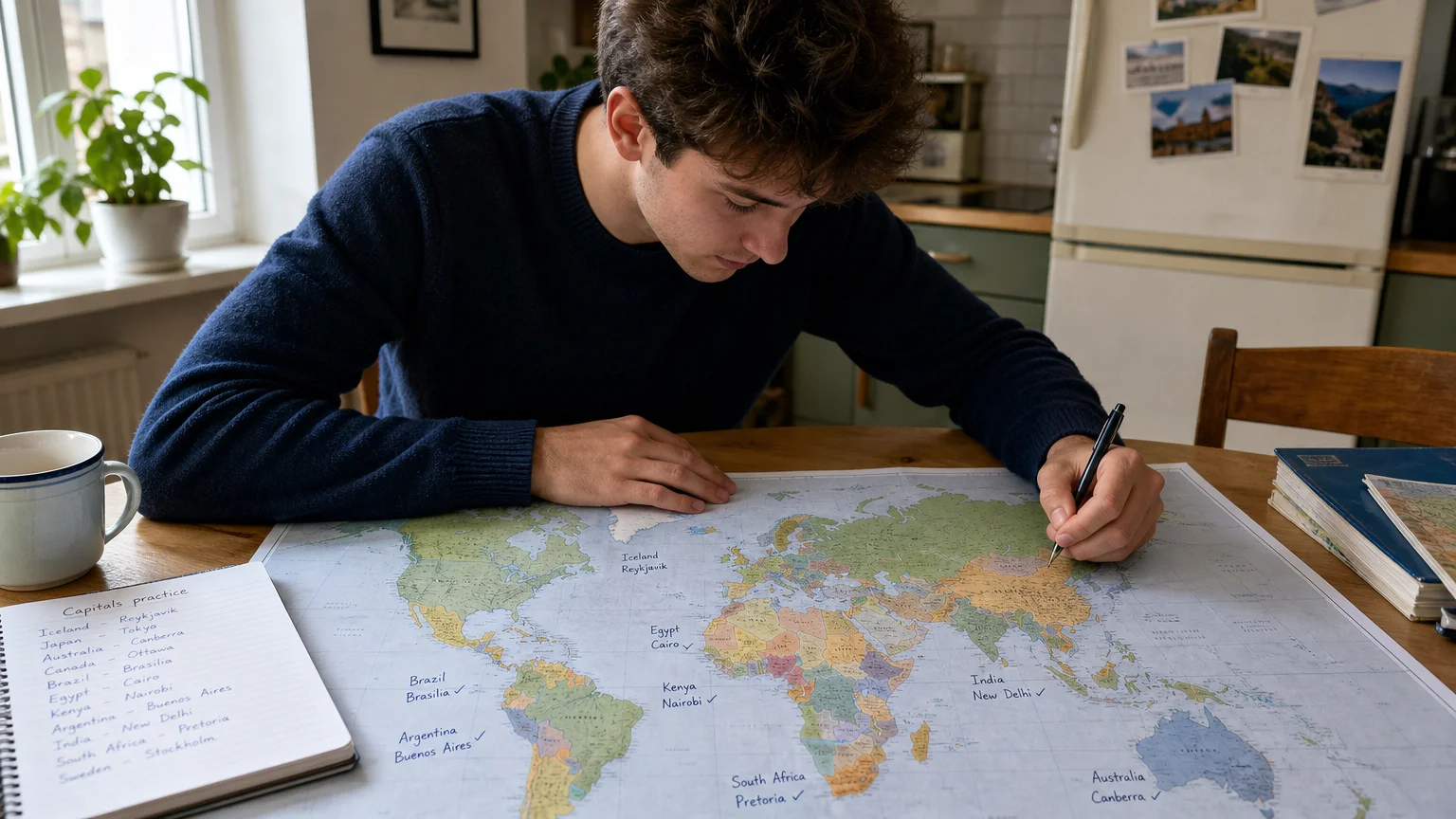
At first glance, a capitals quiz seems to test simple memory. You see a country, then produce its capital. That is useful, but it measures only one layer of geographic knowledge.
A stronger test also checks active recall, spelling, recognition speed, and the ability to work in both directions. Country-to-capital questions ask for retrieval. Capital-to-country questions test whether the connection works in reverse. Map questions add location, distance, and regional context.
The distinction matters because formal geography assessment covers more than remembering names. The NAEP geography framework separates knowing, understanding, and applying. In practical terms, you should know that a city is a capital, understand where it sits, and apply that knowledge to a map or real-world situation.
So, a country capitals test is a starting point rather than a complete measure of geography skill. A high score shows strong recall of the tested list. It doesn’t automatically mean you can locate every country, explain its regional relationships, or understand why its capital developed where it did.
How should you prepare before taking the test?
Imagine you have thirty minutes before a quiz. Reading a giant alphabetical list from start to finish may feel productive, but it often creates shallow familiarity. You recognize the names on the page without being able to produce them independently.
Use a simple three-step cycle instead:
- Group by region: Study a manageable set from Europe, Africa, Asia, the Americas, or Oceania.
- Hide the answers: Look at the country and say or type the capital before checking.
- Review misses: Write down wrong answers and test them again after a short break.
Start with countries you already recognize. Familiar examples create useful anchors, such as linking Portugal with Lisbon, Japan with Tokyo, or Kenya with Nairobi. Then add less familiar pairs and place them beside regional clues.
It also helps to vary the question direction. If you only practise “country to capital,” you may know the answer when prompted but fail when you hear the city first. A country capital quiz game can make this variation easier because each round gives you a clear prompt, an immediate result, and a reason to try again.
For a more focused session, use our country capital quiz game when you want practice that feels more like a challenge than a worksheet.
Can you take a quick country capitals test now?
Try these ten questions without checking a list. Give yourself one point for each correct answer, but mark guesses separately. A guessed answer may deserve review even if it happens to be right.
- What is the capital of Canada?
- What is the capital of France?
- What is the capital of Japan?
- What is the capital of Ghana?
- What is the capital of Peru?
- What is the capital of Bhutan?
- What is the capital of Morocco?
- What is the capital of Australia?
- What is the capital of Portugal?
- What is the capital of Kenya?
Answer key: 1. Ottawa, 2. Paris, 3. Tokyo, 4. Accra, 5. Lima, 6. Thimphu, 7. Rabat, 8. Canberra, 9. Lisbon, 10. Nairobi.
A score of 8 out of 10 is a solid start, but your error pattern tells you more than the number alone. Missing several African capitals suggests a regional review. Confusing Canberra with another city suggests you need a stronger association, not simply more exposure.
Now reverse the exercise. Look at the answers only and name their countries. This second pass checks whether you’ve built two-way recall instead of memorizing a one-directional list.
How can you turn mistakes into stronger memory?
A wrong answer is more useful when you do something with it. Instead of copying the correct capital ten times, connect it to one extra fact. For example, you might place the country on a map, identify its neighbors, or note the continent and language family.
This creates a small network around the capital. The city is no longer an isolated word. It becomes part of a geographic association that gives your memory several routes back to the answer.
Short review intervals work well for this kind of practice. Test yourself now, return to the missed pairs later, and test them again the next day. You don’t need a complicated system. You need enough spacing to prevent the answer from feeling permanently familiar.
The 2026 2026 GEM Report examines education access and equity across different countries and contexts. That broader perspective is useful here because a quiz score should be interpreted in context. Your result can show what to practise next, but it shouldn’t define your overall geographic ability.
Try keeping a small error log with three columns: country, capital, and memory clue. Keep the clues short. “High-altitude Himalayan kingdom” may help you recall Thimphu, while “southern African executive capital” can separate Pretoria from other South African cities.
Which quiz format fits your learning goal?
Different formats create different kinds of pressure. The right choice depends on whether you want a fast warm-up, spelling practice, deeper recall, or broader geographic context.
- Multiple choice: Useful when you’re learning the basic country and capital connection. It supports recognition, but incorrect options can sometimes give away the answer.
- Typed answers: Better for retrieval and spelling. They feel harder because you must produce the capital without visual support.
- Timed rounds: Helpful for building speed. They can also encourage guessing, so review uncertain answers afterward.
- Map-based quizzes: Valuable when you want to connect capitals with location, neighbors, and regional patterns.
- Daily mixed practice: A strong fit when you want a repeatable habit that combines recall with variety.
Online education dashboards often combine results from different assessments, but the World Bank dashboard warns that data may not be comparable across years, countries, or assessment systems. The same caution applies to personal quiz scores. Use them to track your own progress within the same format, rather than treating every score as a universal ranking.
For most learners, the best routine combines two formats. Use typed answers to check recall, then use maps or clues to add context. That combination helps you remember the capital and understand where it belongs.
How do you build a five-minute daily routine?
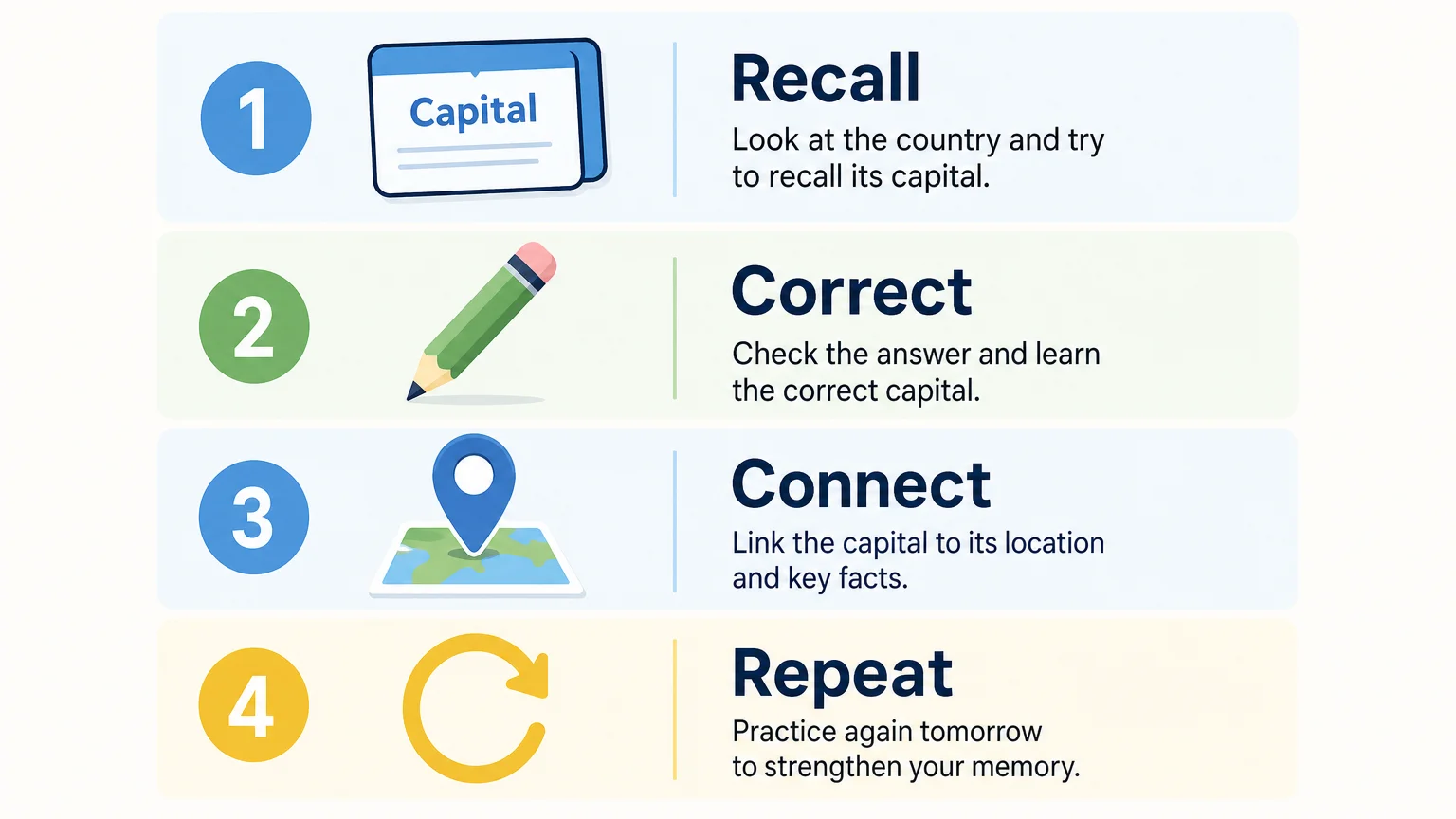
Five minutes is enough to create momentum if you use the time deliberately. The goal isn’t to finish every country in one sitting. The goal is to return often enough that recall becomes familiar.
- Minute one, warm up: Answer three easy country-to-capital questions.
- Minutes two and three, stretch: Try unfamiliar countries or reverse capital-to-country prompts.
- Minute four, correct: Review every mistake and every uncertain guess.
- Minute five, connect: Place one difficult country on a map or attach one useful clue.
Keep the routine small enough to repeat. A daily puzzle can become a classroom warm-up, a travel preparation habit, or a quick break between larger tasks. If you want a ready-made rhythm, our practice country capitals daily guide can help you turn scattered review into a consistent habit.
Once the routine feels easy, add a weekly check. Test only the capitals you missed during the week, then compare your result with the previous week. This gives you a more meaningful progress signal than taking a completely different quiz every time.
You can also make the habit social. Ask a friend to give you five capitals, trade questions, or compare results without turning the activity into a competition. A little accountability can make the routine easier to maintain.
Make every capital answer useful
A strong country capitals test does more than count correct answers. It shows which names you can recall, which ones need another review, and where your geographic connections remain weak. Practise in both directions, mix regions, add map context, and revisit mistakes after a pause. When you keep sessions short and regular, memorization becomes a practical skill rather than a one-time cram exercise.
Take action with Flagdle
If you want to turn capital study into a habit, a short browser game can make the next practice session easier to start. You can play from a computer or mobile browser, take on a daily challenge, and keep learning without setting up an account.
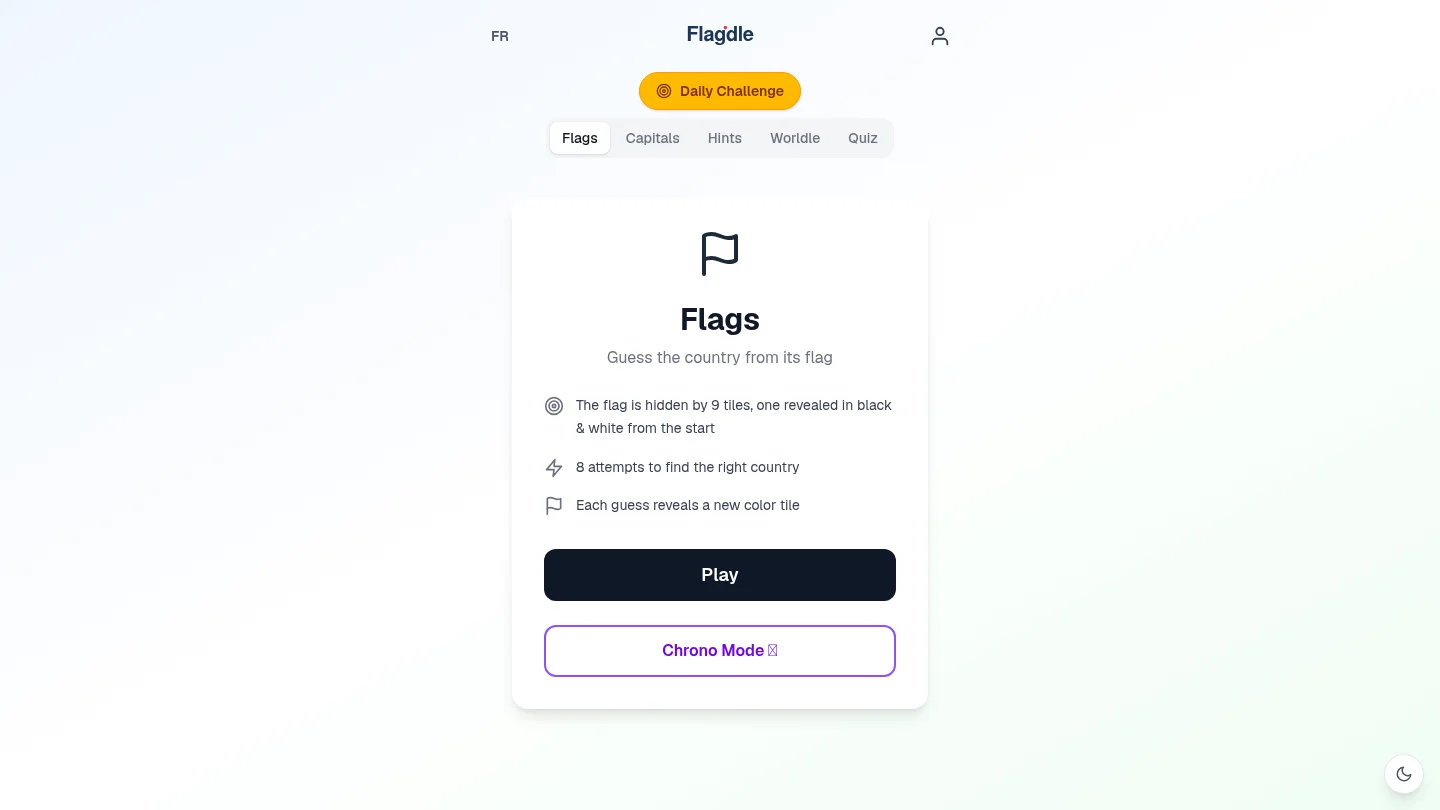
At Flagdle, we bring country identification, capitals, clues, silhouettes, and themed quizzes into one free geography experience. You can test your recall, practise again, compare results, and explore countries through different types of prompts. Start with our country capitals game when you’re ready to make geography part of your daily routine.
Frequently Asked Questions
What is the best way to study country capitals?
Use active recall instead of only rereading a list. Test yourself, review mistakes, and connect each difficult capital to a region, map location, or memorable clue.
Should I study capitals by continent?
Yes, grouping capitals by continent can make the list easier to organize. Mix regional study with occasional worldwide quizzes so you don’t depend only on the order of your notes.
Is a timed country capitals test useful?
Timed tests are useful for building speed and confidence. They should be combined with untimed review because speed alone doesn’t show whether you truly understand the country and capital connection.
Should I practise country-to-capital or capital-to-country questions?
Practise both directions. Country-to-capital questions build the most common recall path, while capital-to-country questions reveal whether the association works in reverse.
Can I practise capitals with Flagdle?
Yes, our Capitals mode is designed for short geography practice in the browser. You can use it as a daily activity, then reinforce difficult answers with replay and other geography modes.