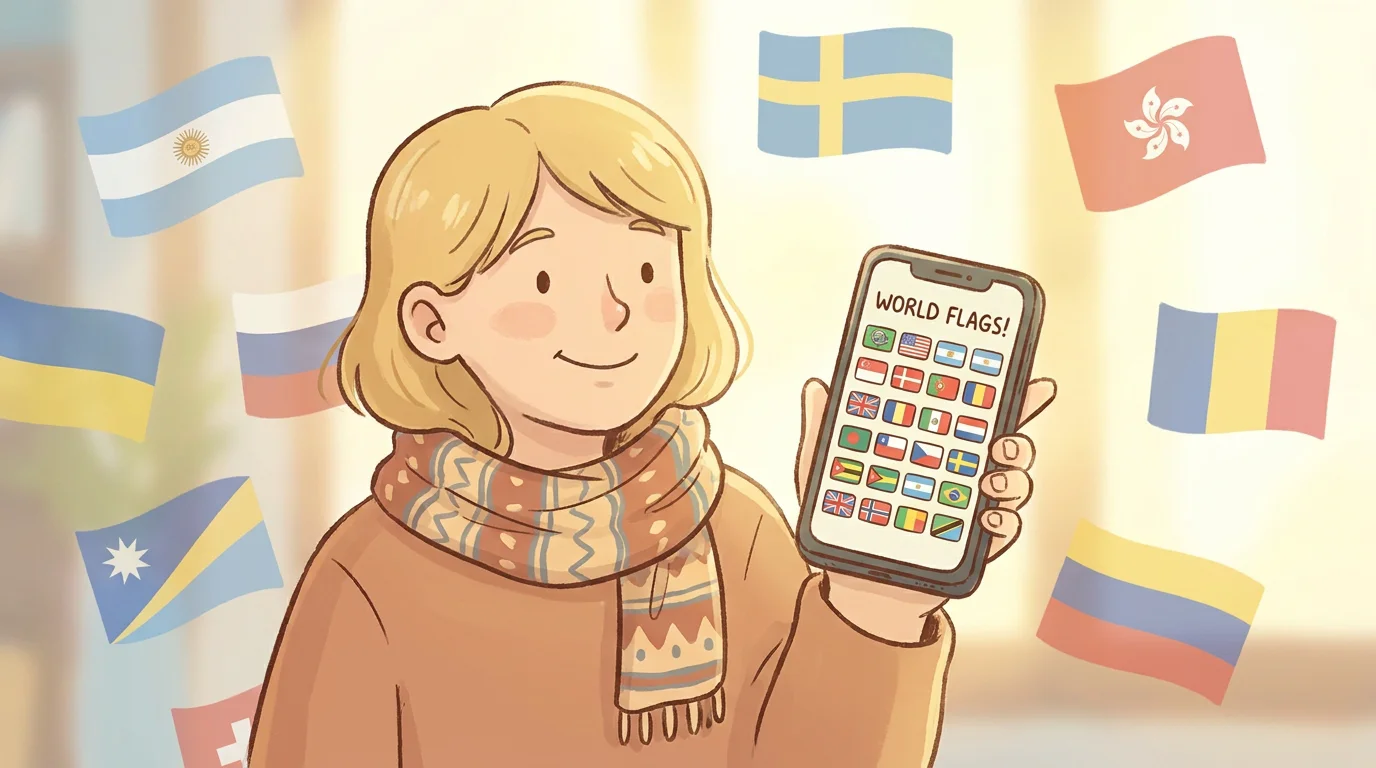


Can you tell Chad's flag from Romania's? What about Indonesia and Monaco? You're not alone if you mix them up. Flag quiz games have exploded in popularity as one of the most addictive ways to learn world geography without cracking open a textbook. Whether you're a trivia buff, a student cramming for exams, or just someone who loves a daily brain teaser, there's a good chance you've already stumbled across our flag quiz or something similar.
The appeal is simple: you see a flag, you guess the country. But behind that simplicity is a surprisingly effective learning method. Research on retrieval practice consistently shows that active recall produces retention rates three to eight times higher than passive review. That means every time you play a quick round, your brain is doing serious work. Let's break down what makes these games tick, how to get better at them, and why 2026 might just be the golden age for geography quizzes.
What Exactly Is a Flag Quiz Game?
At its core, a flag quiz game shows you a national flag and asks you to identify the country it belongs to. Some versions give you multiple choice options. Others make you type your answer. And then there are daily challenge formats where you get a limited number of attempts to nail it.
The concept covers everything from quick five-minute rounds to marathon sessions spanning all 197 sovereign states. Sporcle's popular world flags quiz, for example, features 197 questions and was last updated in February 2026. Other platforms break things down by continent or difficulty level, letting you ease into the challenge.
What sets the best flag quizzes apart is how they keep you coming back. Progressive hint systems, daily challenges, and score tracking all tap into our natural competitive instincts. It's not just about right or wrong; it's about improving your streak.

Why Flag Quizzes Are More Than Just Fun
You might think flag quizzes are pure entertainment. They are, sure, but they're also backed by real science. Quiz-based games are among the most effective retention tools available because answering a question under time pressure is itself a powerful memory consolidation event.
A 2026 roundup of gamification statistics by Engageli highlights that game-based learning has moved well beyond early adoption into mainstream deployment across education and enterprise, with growth rates that significantly outpace the broader EdTech sector as of 2025 and 2026.
A study published in Computers and Education (Legaki et al., 2020) found that students in gamified conditions significantly outperformed peers in traditional lecture-based instruction. So every round you play genuinely makes you sharper.
The Progressive Reveal: A Smarter Way to Learn Flags
Not every quiz works the same way, and that matters more than you'd think. The most effective format for actually learning flags (not just testing yourself) is progressive revelation. Instead of showing you the full flag and asking you to guess, the image is partially hidden and reveals itself step by step with each attempt.
This is exactly how our countries flag quiz works. The flag starts masked by tiles, and each guess you make uncovers a new section. It forces your brain to work with partial information, building stronger visual memory connections.
Think of it like a jigsaw puzzle meets a geography test. You start noticing color patterns, stripe orientations, and emblem placements much faster than you would by staring at a complete flag. After a few sessions, you'll surprise yourself by recognizing flags from just a sliver of color.
Flags That Trip Everyone Up
Some flags are dead giveaways. Japan's red circle, Canada's maple leaf, Brazil's green and yellow diamond. But others? They're sneaky.
Flags with complex designs, intricate patterns, and uncommon colors tend to be the most challenging. People generally remember flags that include red, blue, white, or green, while flags with less common colors like orange, mustard, or dark green are the most commonly forgotten. That's according to a 2024 Preply study that asked participants to draw flags from memory.
Sri Lanka's flag stood out as one of the most difficult, with only 5 out of 23 people guessing its mustard, green, burgundy, and orange color palette correctly. It was also ranked as the least memorable flag in terms of color.
Here's a quick cheat sheet of commonly confused flag pairs:
| Flag Pair | Why They're Confusing | Key Difference |
|---|---|---|
| Chad & Romania | Nearly identical tricolors | Chad's blue is slightly darker |
| Indonesia & Monaco | Same red and white bands | Different proportions |
| Ireland & Ivory Coast | Green, white, orange tricolors | Reversed stripe order |
| Luxembourg & Netherlands | Red, white, blue tricolors | Luxembourg uses a lighter blue |
Knowing these tricky pairs is half the battle. The other half? Practice. That's where a daily flag guessing game really pays off.
How to Get Better at Flag Quizzes (Fast)
You don't need to be a geography professor to crush a flag quiz. Here are practical strategies that actually work:
- Group by color pattern. Most flags use red, white, and blue. Learn the exceptions first (Bhutan's orange dragon, Jamaica's gold X) and you'll eliminate confusion quickly.
- Focus on emblems and symbols. A crescent means one thing, a cedar tree means another. Symbols are your fastest shortcut to identification.
- Play daily. Consistency beats marathon sessions. A single daily challenge keeps flags fresh in your memory without burnout.
- Start by continent. Don't tackle all 195+ countries at once. Master Africa, then move to Asia, then Europe. Chunk it up.
- Use progressive formats. Quizzes that reveal flags gradually train your brain to recognize partial patterns, which is much harder (and more effective) than multiple choice.
Competitive game formats that might seem stressful in theory actually appear to reduce test anxiety in practice by normalizing frequent, low-stakes assessment and making evaluation feel like play rather than judgment. So don't stress about wrong answers. They're part of the process.
Daily Challenges vs. Infinite Mode: Which Is Better?
Most flag quiz platforms offer two main formats: a daily challenge (one puzzle per day, same for everyone) and an unlimited or infinite mode where you can keep playing. Both have their place.
Daily challenges are great for building a habit. You log in, you play your round, you're done. The shared experience is part of the fun, too. Everyone gets the same flag, so you can compare results with friends. It's the Wordle effect applied to geography.
Infinite and timed modes are better for dedicated study sessions. If you're prepping for a geography exam or just want to speed-run all the world's flags, unlimited play is the way to go. You can also use timed modes to push your reaction speed and build instinctive recognition.
We offer both on our platform, plus geography quizzes that go beyond flags into capitals, borders, currencies, and more. Mixing it up keeps things fresh and reinforces the connections between a country's flag and its other characteristics.
Comparing Popular Flag Quiz Formats in 2026
There are a lot of options out there, and they're not all created equal. Here's how the major formats stack up:
| Feature | Flagdle (Us) | Traditional Multiple Choice | Type-the-Answer |
|---|---|---|---|
| Progressive flag reveal | Yes (9-tile system) | No | No |
| Daily challenge | Yes | Varies | Varies |
| Number of countries | 195 | Typically 197 | Typically 197 |
| Bonus geography content | Capitals, currencies, GDP, neighbors | Flags only | Flags only |
| Free to play | Yes | Usually | Usually |
| Learning effectiveness | High (active recall + progressive hints) | Moderate | High (recall-based) |
According to Mordor Intelligence's February 2026 market report, game-based learning is among the fastest-growing segments of the broader education technology market. Expect even more innovation in how geography quiz games are designed over the coming years.
Beyond Flags: Expanding Your Geography Knowledge
Once you've nailed the flags, there's a whole world of geography trivia waiting for you. Capitals, coat of arms, country silhouettes, neighboring countries, official languages; each one adds a layer of understanding that makes the flags stick even better.
Gamification creates intrinsic motivation: learners want to finish because finishing means winning, progressing, or outscoring a colleague. That's why expanding into related quizzes doesn't feel like extra homework. It feels like leveling up.
If you've been enjoying flag challenges, try branching out into our full geography content. From capitals to currencies to country shapes, there's always a new way to test yourself.
The Rise of Geography Games in EdTech
Flag quizzes aren't just casual games anymore. They're part of a larger shift in how people learn. The growth of the game-based learning market reflects the convergence of research evidence, institutional adoption, and technological capability.
Teachers are using flag quizzes in classrooms. Parents are putting them on tablets for road trips. And adults are using them as daily brain training exercises. A study published in Education and Information Technologies in 2024 from the Polytechnic University of Madrid tracked students across 14-week semesters over five academic years, using gamified quiz tools for formative assessment. The results confirmed what casual players already know: quizzes work.
The mobile gaming space has responded, too, with dedicated flag quiz apps earning strong user ratings on both Android and iOS in 2026.
Flag quiz games sit perfectly at the intersection of entertainment and education. They don't require a subscription, a textbook, or even a lot of time. Just a curious mind and a few minutes a day. Whether you're here because you want to finally tell Monaco from Indonesia apart, or because you want to impress people at trivia night, the path forward is the same: play more, learn more, and have fun doing it.
With progressive flag reveals, daily challenges across 195 countries, and bonus quizzes on everything from capitals to currencies, we've built a geography experience that keeps you coming back. Ready to see how many flags you actually know? Play our daily quiz and find out.
Frequently Asked Questions
How many country flags are there in the world?
There are 195 internationally recognized sovereign states, each with its own flag. Some quizzes include territories and dependencies, pushing the total closer to 200 or beyond. Our daily challenge covers all 195 UN-recognized countries.
What's the hardest flag to identify in a quiz?
Flags with uncommon color palettes and intricate designs tend to be the trickiest. Sri Lanka, Bhutan, and Turkmenistan are notorious for stumping players. Look-alike pairs like Chad and Romania are also tricky because the color difference is extremely subtle.
Can playing flag quizzes actually improve my geography knowledge?
Absolutely. Research shows that active recall through quizzes is far more effective than passive study. Playing a daily round on Flagdle reinforces your visual memory and builds connections between flags, countries, capitals, and more. It's one of the best low-effort ways to learn geography.