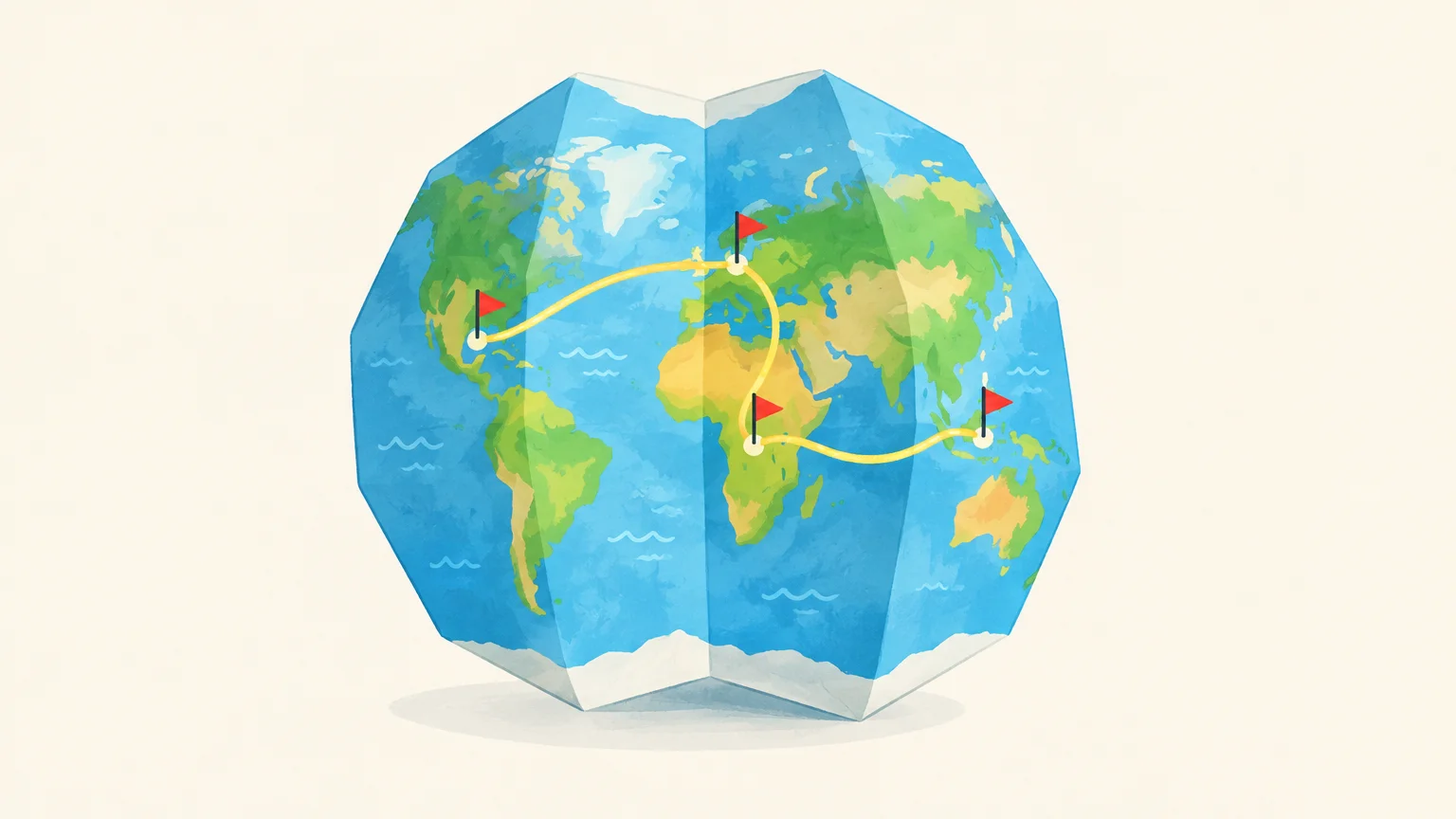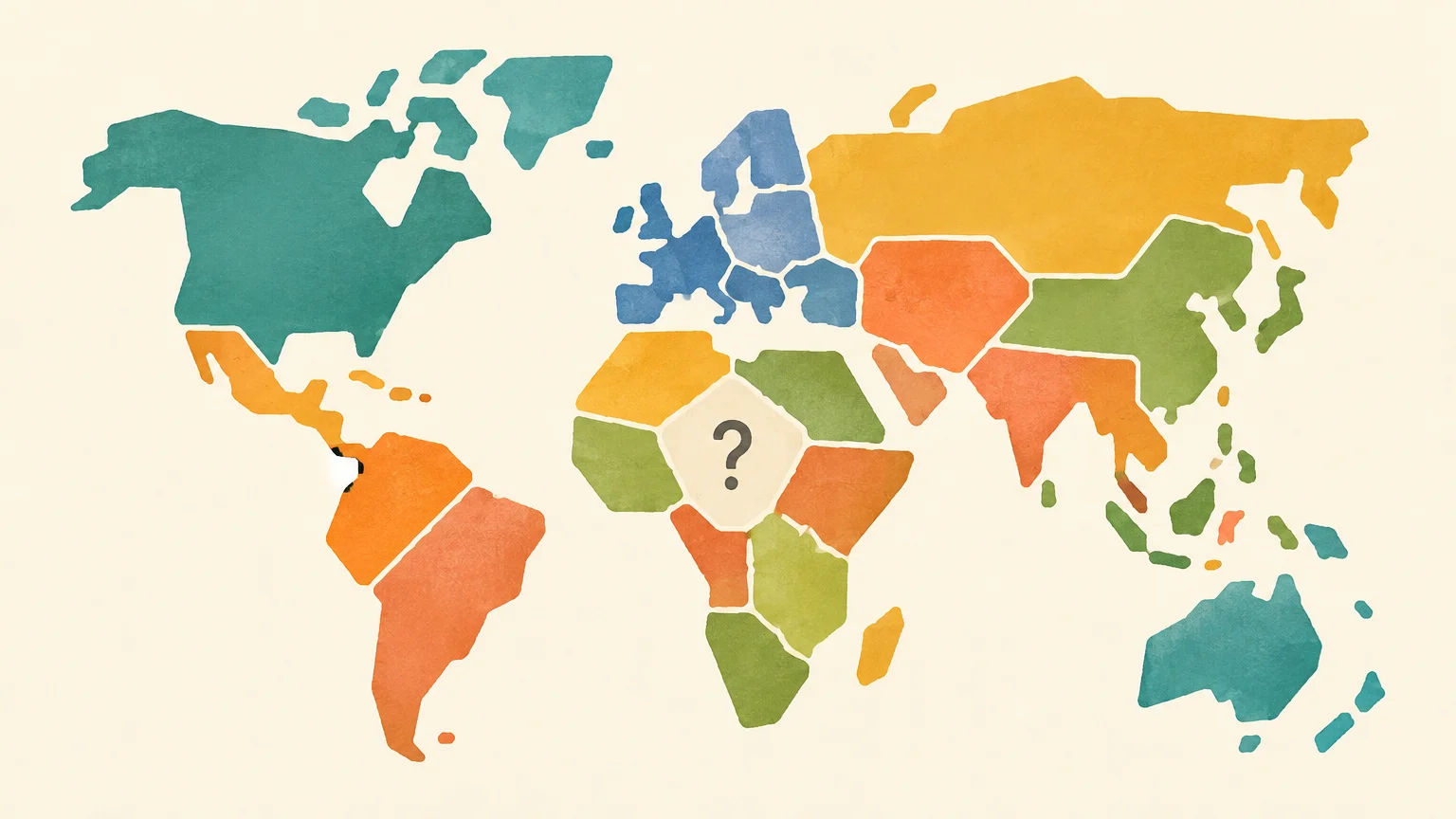
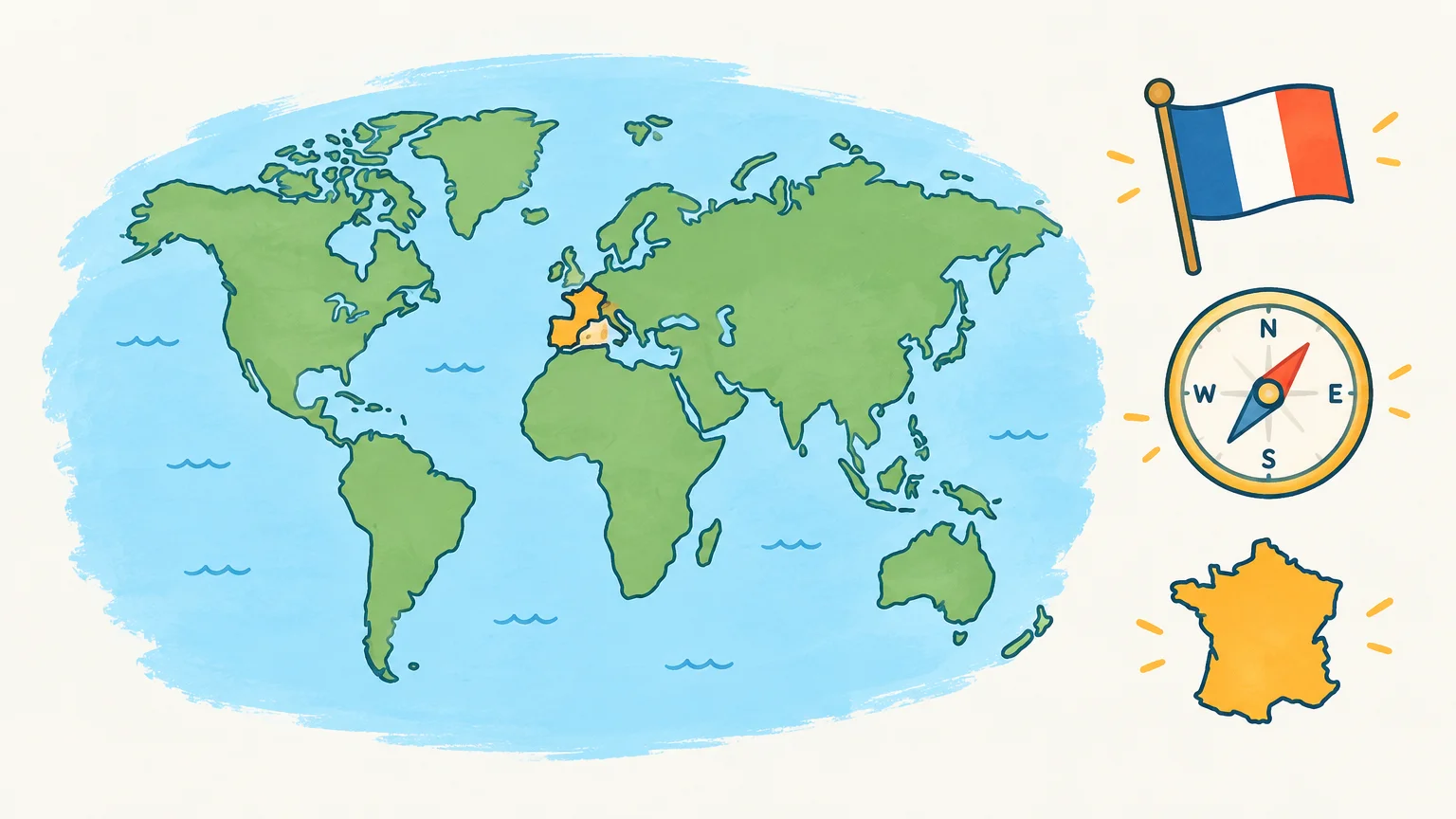

A map quiz should do more than test whether you remember a country’s name. It should give you a reason to notice, think, and learn. If you want to explore different formats, geography games for learning and play offers ideas for turning map practice into an activity you’ll want to revisit.
The question of what makes a good geography quiz game comes down to how well its questions, clues, and scoring work together. A 2026 systematic review of school geography games found that learning activities often target skills such as spatial reasoning and map reading, rather than adding game features without a learning purpose. (frontiersin.org)
Do the questions test geography clearly?
Start with the question itself. A fair quiz asks one understandable thing at a time, uses a precise map or clue, and makes it clear what kind of answer counts. “Which country borders Kenya to the north?” is more focused than “What do you know about Kenya?”
Accuracy matters just as much as wording. Check that country names, capitals, borders, and map labels are current and consistent. If two answers could reasonably fit, revise the question or explain the intended distinction after the guess.
Good questions also match the player’s knowledge. A beginner might identify a continent from a highlighted region, while an experienced player might use neighboring countries to narrow down a location. Both questions can be challenging if the game signals what it expects and avoids relying on obscure trivia alone.
Do the clues teach the skill you want?
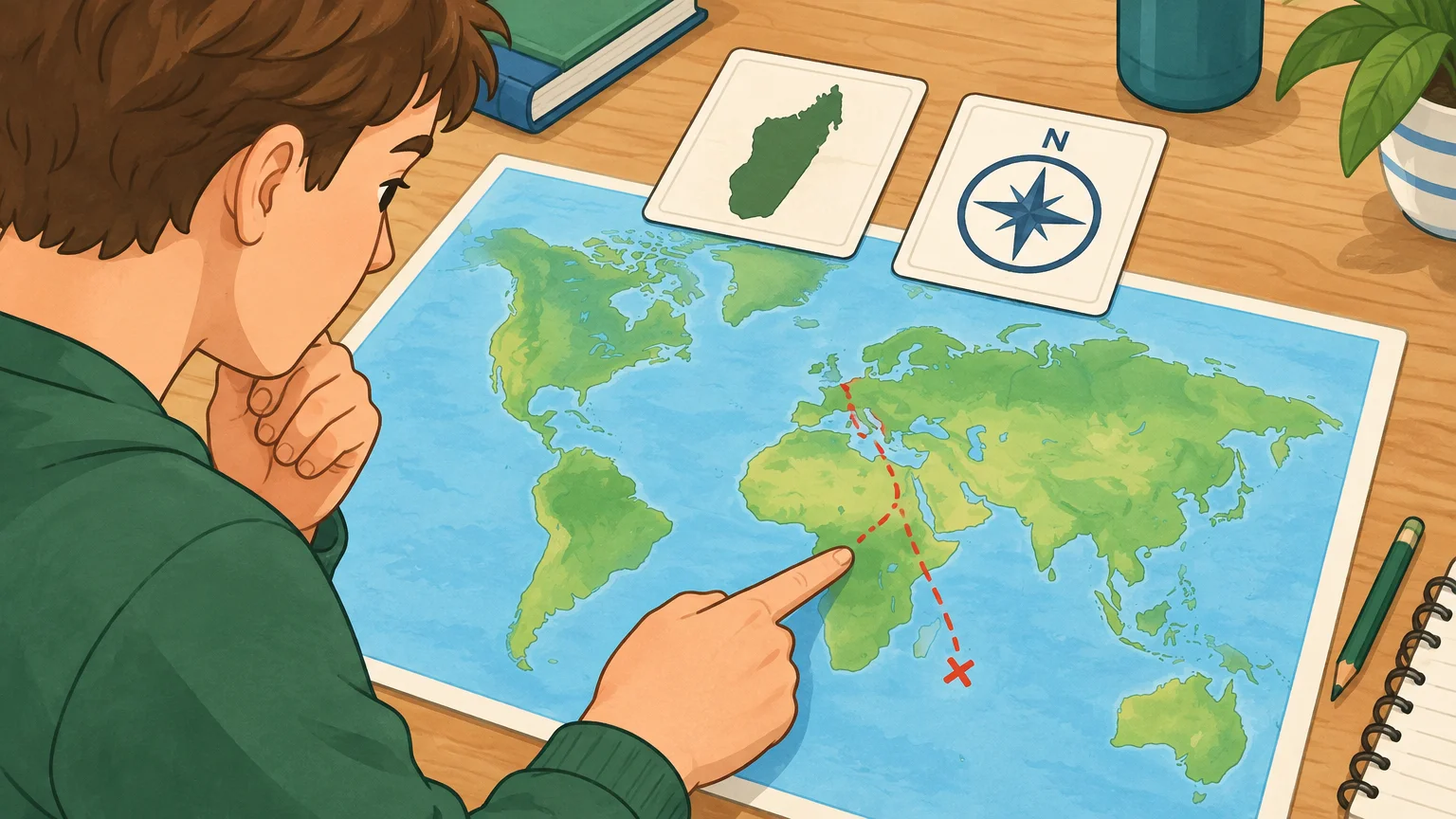
A clue should help you reason, not simply reveal the answer. For example, a silhouette-based round could give you a distance or direction after each guess. A flag round could reveal more of the image after a wrong answer. Each mechanic teaches a different way to recognize places.
Progressive clues make challenge feel fair. A first hint might name a continent, followed by a language or neighboring-country clue. That sequence gives you room to think before the answer becomes obvious. It also shows how each new clue changes the range of possible answers.
Match the mechanic to the learning goal. A map-selection task suits location practice; a capital question suits recall; a country-fact clue can prompt you to connect language, population, or region. The same mystery country can even appear across several clue types, helping you build a richer picture instead of remembering one isolated fact.
Our daily geography quiz formats and clues explores how clue styles shape a daily challenge. In our Daily Challenge, nine linked mini-games explore one country from different angles, including its flag, shape, capital, and other country facts.
Does feedback help you understand mistakes?
When you get an answer wrong, useful feedback tells you more than “incorrect.” It might show the right location, explain why a clue points there, or let you try again with another hint. That turns a missed answer into a chance to adjust your thinking.
Consider a question about a country’s neighbors. If your guess is wrong, a helpful game could explain which border clue you overlooked. A score alone tells you how you performed; a short explanation can also show what to check next time.
In a 2022 article on geography teaching, instructors described using quiz software to engage students and check their understanding. The authors also noted that repeating one format can lose its appeal and that quizzes have limits for complex questions. The teaching example supports a practical rule: vary question types, and make room for discussion when a short answer cannot explain a complex topic.
For self-study, look for a way to review what a question was testing, not only whether you scored a point. For classrooms, consider whether players can answer without being singled out and whether the result gives you something useful to discuss together.
Does the game represent places and topics broadly?
A quiz focused only on familiar countries can leave large parts of the map out of practice. Check whether it covers a mix of continents, regions, and geographic features, and whether its questions go beyond capitals and flags. Depending on your goal, useful topics might include borders, landforms, languages, or population.
Coverage should be easy to understand. Does the game say which countries or topics it includes? Can you choose a region when you want focused practice, or does the game mix places from across the world? A focused quiz is useful for studying a specific unit, while wider coverage helps you notice what you still need to learn.
Map design matters too. Clear outlines, labels, and contrast make locations easier to interpret. If the question depends on a small island or a close border, the map should let you see enough detail to make a reasonable choice.
For a map-based approach, our article on an educational geography game discusses how play can support learning about world maps. Our browser game covers 195 UN-recognised countries, with country names available in French and English.
Is it easy to play, and worth coming back to?
A good game should let you start without puzzling over the controls. Check that instructions explain how to answer, how clues work, and how scoring works. The game should also be comfortable on the device you plan to use, with text and map details that remain readable on a smaller screen.
Replay value comes from more than a new daily answer. Short rounds, different question styles, and practice options give you a reason to return without making every session feel the same. A daily puzzle can create a simple routine; random practice can help you revisit topics you find difficult.
Competition can add a social reason to play, but it should not be the only measure of learning. Compare scores if that’s fun for you, while also noticing which questions you can now answer and which clues helped you get there.
A 2026 exploratory study in one German upper-secondary geography class found that average scores on selected tasks rose from 11.63 to 15.78 out of 70 during a six-lesson sequence. The researchers could not isolate a game effect or establish retention, so the findings are a useful reminder to pair play with reflection. The case study does not show that a quiz alone caused the change.
How can you assess a game before playing?
Try a short round and use a few practical checks. You don’t need a long feature list to see whether the game suits your purpose.
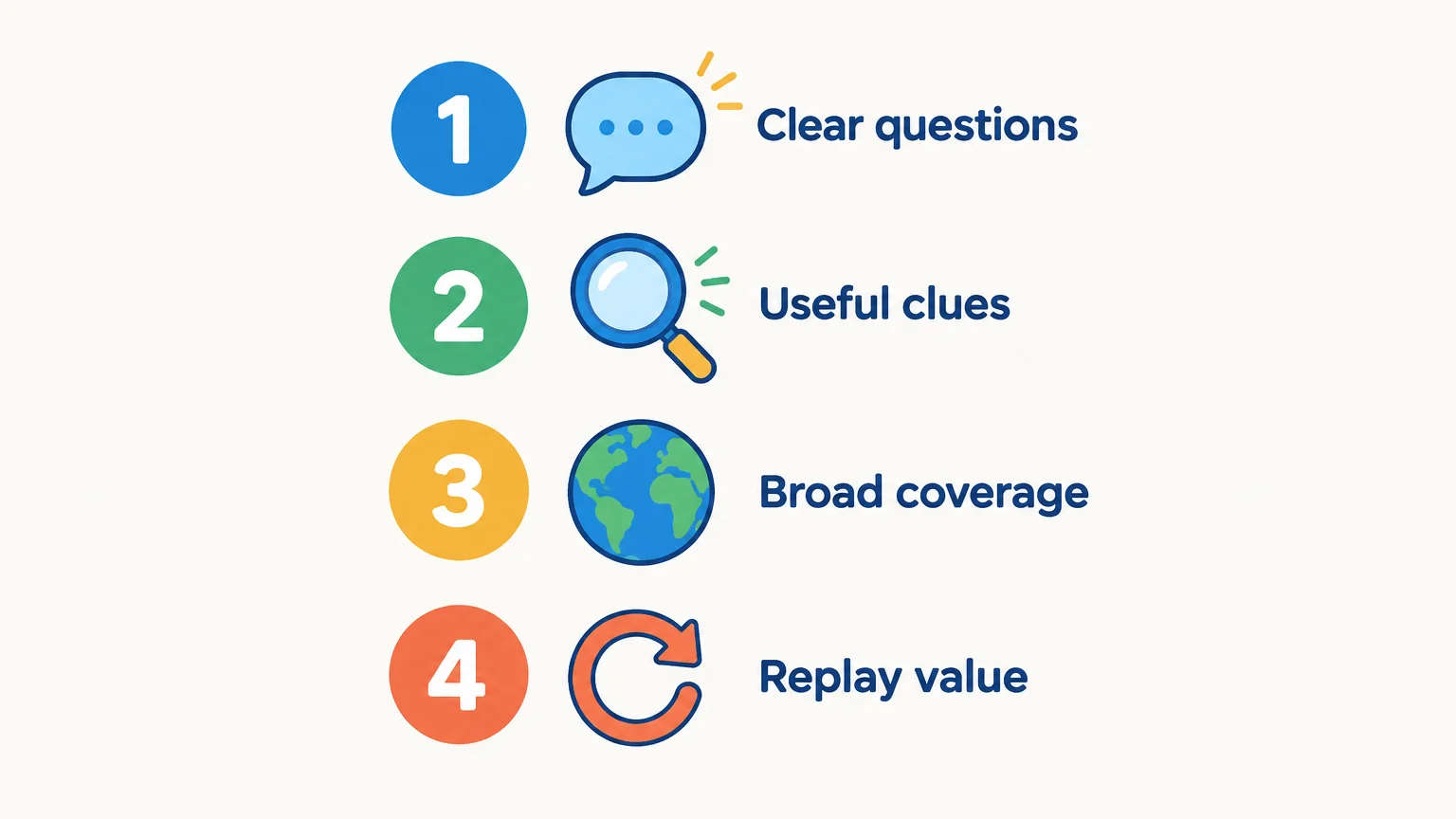
- Question clarity: Can you tell what each question asks and what counts as a correct answer?
- Clue quality: Does each hint help you reason, or simply give away the answer?
- Useful feedback: After a wrong guess, do you learn what to reconsider?
- Balanced coverage: Are countries, regions, and topics broad enough for your goal?
- Usability: Can you play comfortably on your device and understand the rules?
- Replay value: Is there a reason to practice again beyond chasing a higher score?
Your answers depend on how you plan to use the game. For exam practice, favor clear questions and repeated review. For a group activity, easy instructions and discussion-friendly feedback matter more. For casual play, short rounds and varied clues may be what keep you interested.
Choose a quiz that makes you think
A worthwhile geography quiz combines accurate questions, clues that reward reasoning, useful feedback, and coverage that suits your learning goals. Before you commit, try a round and notice whether you understand why an answer is right, not just whether you earned a point. The best fit is the one that makes geography practice meaningful and gives you a clear reason to return.
Put Your Geography Quiz Criteria Into Practice
If you want to try these ideas in a short round, start with a game that lets you identify places through more than one kind of clue. Our browser game is built for quick geography practice, whether you’re studying independently, using a brief classroom activity, or comparing results with friends.

Our free, responsive browser game requires no account and covers 195 UN-recognised countries. Try flags, capitals, progressive country hints, silhouette clues, themed quizzes, or a Daily Challenge linking nine mini-games around one country. It supports French and English, has no intrusive ads, and can be added to your device’s home screen from your browser. Play the geography quiz and see which clues help you learn.
Frequently Asked Questions
What should a geography quiz game teach?
It should help you practice skills such as locating places, recognizing countries, or connecting geographic clues. The questions and feedback should make those skills clear.
Are map quizzes better than trivia questions?
They practice different things. Map quizzes focus on location, while trivia questions can cover facts about places, people, and geographic features.
How can clues make a quiz fairer?
Progressive clues give you a chance to reason before revealing too much. Good hints narrow down the possibilities without making the answer obvious straight away.
Can teachers use a short geography quiz in class?
Yes. Our Daily Challenge is designed as a five-minute classroom activity, and linked questions can give students several ways to explore one country.
Does a high score prove that I learned the material?
A score shows how you did on that round, but it doesn’t explain what you understand or remember later. Review the clues and answers to see what you can apply next time.