
Can you really recognize every flag on the planet? Most people can name maybe 30 or 40 off the top of their head, but beyond the obvious ones (looking at you, Japan and Canada), things get tricky fast. There are 196 countries with unique flags to learn, and an all countries flag quiz is one of the most addictive ways to get there. If you're ready to dive in right now, our countries flag quiz lets you start testing yourself immediately with a progressive reveal mechanic that keeps things interesting.
Whether you're a geography nerd, a casual trivia fan, or a student cramming for a test, flag quizzes have exploded in popularity over the past few years. A world flag quiz is more than a game; it's a global journey that educates and entertains, and it's perfect for all ages. Let's break down everything you need to know to go from "Is that Chad or Romania?" to getting a perfect score.
Why Flag Quizzes Are More Popular Than Ever
Geography games have carved out a serious niche in the online learning world. The challenge of identifying flags of all 193 United Nations member countries is more than just a geographical test; it's a window into the diverse and colorful tapestry of global cultures and histories. That mix of education and entertainment is exactly what keeps people coming back.
On platforms like JetPunk, the all country flags quiz has been taken over 3.7 million times, and that's just one site. The appetite for this kind of challenge is massive, spanning students, travelers, trivia players, and people who just want a quick brain workout during lunch. Research on learning techniques shows that flashcard and quiz systems leverage two of the most evidence-based approaches: active recall (retrieving information from memory) and spaced repetition (reviewing information at increasing intervals).
The bottom line? You're not just killing time when you play a flag quiz. You're genuinely training your brain.
How Many Flags Are There, Anyway?
This depends on who's counting. Some quizzes test you on all 193 United Nations member countries. Others, like JetPunk's popular quiz, include 196 countries. And Flagpedia goes even further, walking you through all 254 country and territory flags of the world.
Here's a quick breakdown of what you might encounter:
- 193 flags: UN member states only
- 196–197 flags: includes observer states and commonly recognized nations like Taiwan and Kosovo
- 250+ flags: adds territories, dependencies, and overseas regions
For most quizzes, you'll be dealing with somewhere between 193 and 197 flags. Sporcle's popular flags quiz, last updated in February 2026, tests 197 flags and remains one of the most played geography quizzes online. Our approach at Flagdle covers 195 countries, which is the sweet spot for a comprehensive challenge without getting lost in obscure territories.
The Trickiest Flags You'll Face (And How to Tell Them Apart)
Some flags are instant giveaways. Nepal's double pennant shape? Unmistakable. Switzerland's bold white cross on red? Easy. But then you hit the lookalikes, and things fall apart quickly.
Here are the most commonly confused pairs:
- Chad vs. Romania: Nearly identical vertical tricolors of blue, yellow, and red. Chad's blue is a shade darker; that's literally it.
- Monaco vs. Indonesia vs. Poland: Red and white horizontal stripes in different orders. Monaco and Indonesia are the same design (red on top, white on bottom), just with slightly different proportions.
- Netherlands vs. Luxembourg: Both are red, white, and blue horizontals. Luxembourg uses a lighter shade of blue.
- Ireland vs. Côte d'Ivoire: Same green, white, and orange tricolor, but reversed left to right.
The trick? Focus on the tiny details. Each flag tells a unique story, reflecting historical origins and cultural symbols. When you understand why a flag looks the way it does, the differences become much easier to spot. Chad chose its shade of blue to differentiate itself from Romania, for instance. Knowing that backstory makes the distinction stick.
Strategies to Actually Memorize All the Flags
Staring at a poster of 196 flags won't get you very far. You need a system. Here's what works, based on proven learning science:
Group by Region
Start with one continent at a time. African flags have distinct patterns (many feature pan-African colors of green, yellow, and red). European flags lean heavily toward tricolors. Pacific island nations often use blue backgrounds with stars. Regional grouping cuts down the mental workload.
Use Progressive Difficulty
A progressive difficulty system is one of the smartest approaches: early quizzes ask you to match well-known flags to their countries, and as you advance, challenges become more nuanced, like identifying flags with similar color patterns or recognizing national emblems within flags. This is exactly how we designed our flag quiz guide, which starts with common flags and scales up to the truly obscure ones.
Learn the Symbolism
Colors and symbols on flags aren't random. Red often represents courage or revolution. Green frequently stands for agriculture or Islam. Stars, crescents, crosses, and shields all have specific meanings rooted in each nation's history. When you learn the meaning, the flag becomes a story, not just a pattern.
Daily Practice Beats Weekend Cramming
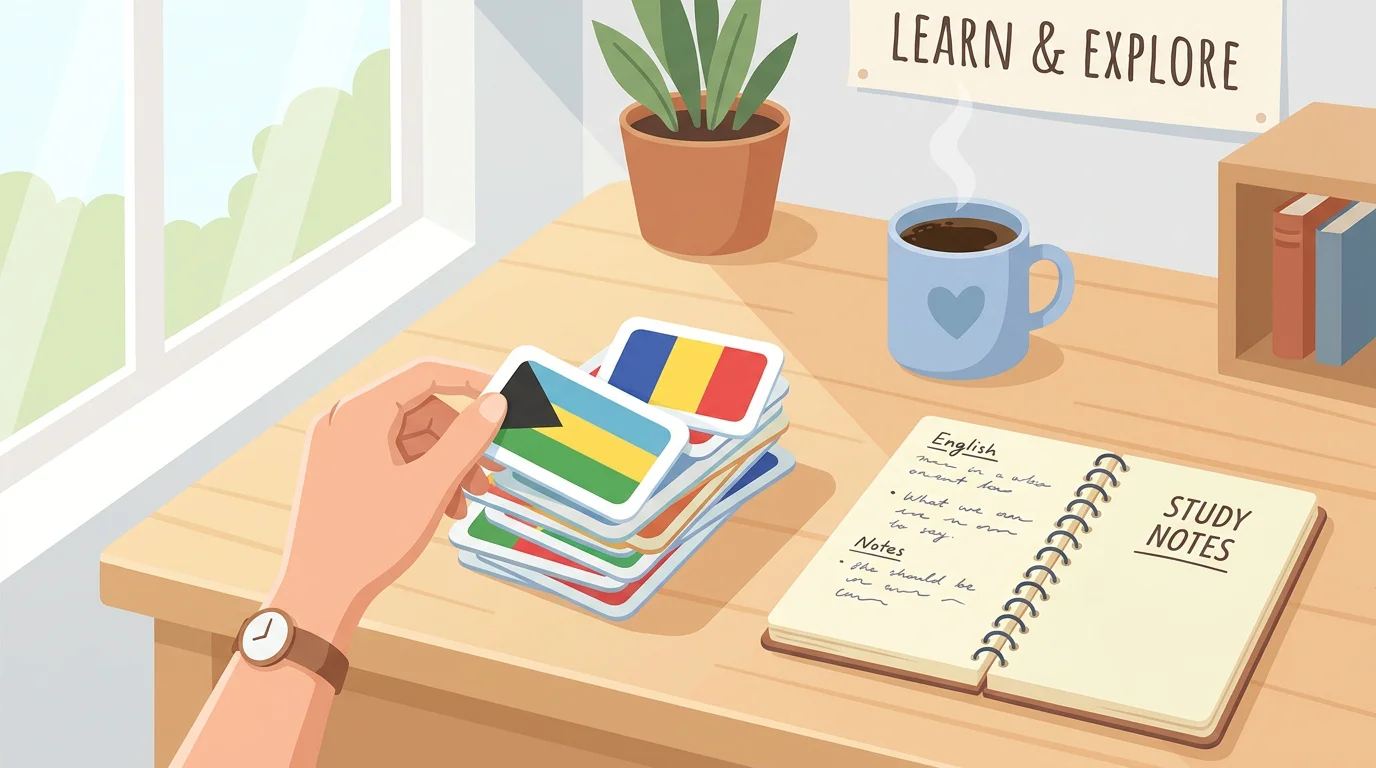
Five minutes a day beats an hour on Sunday. This is where daily flag challenges shine. Our daily challenge at Flagdle gives you a new flag every single day, with progressive tile reveals that gradually uncover the flag as you guess. It's the kind of spaced repetition that actually locks knowledge into long-term memory.
What Makes a Great Flag Quiz Platform?
Not all flag quizzes are created equal. Some just throw 200 flags at you in a grid and call it a day. Others are thoughtfully designed to actually help you learn. Here's what to look for:
| Feature | Flagdle | Typical Quiz Sites |
|---|---|---|
| Progressive reveal mechanic | Yes (9-tile system) | Rare |
| Daily challenge | Yes (new flag every day) | Sometimes |
| Multiple game modes | Yes (capitals, shapes, currencies, GDP, languages) | Usually flags only |
| Free to play | Yes | Varies |
| Countries covered | 195 | 193–254 |
| Timed + untimed modes | Both available | Usually timed only |
Human psychology responds powerfully to visible progress, so a good quiz platform implements tracking metrics that matter, from mastery percentage to performance over time. That feedback loop is what separates a forgettable quiz from one you'll come back to every day.
Beyond Flags: Geography Quiz Games That Go Deeper
Once you've nailed flag recognition, there's a whole world of geography quiz challenges waiting. Capitals, country outlines, neighboring nations, currencies, and even GDP rankings can all be turned into engaging quizzes.
Exploring historical flags shows how national symbols have evolved with political changes. Currency and capital combinations reinforce practical travel knowledge. Population and landmass comparisons provide scale and perspective about our world's nations. Each quiz category feels like a different lens through which to view global geography.
This is exactly why we built multiple mini-games into our daily challenge. When you've identified the flag, you can keep going with capitals, coat of arms, neighbors, and more. If you're looking for variety, check out our flag quiz games collection for endless mode and timed challenges.
Tips for Getting a Perfect Score on Your First Try
Going for 100%? Here are some rapid-fire tips from people who've actually done it:
- Start with the ones you know. Lock in easy points first. Don't get stuck on Eswatini's flag when you haven't answered Japan yet.
- Use color as your first filter. Narrow it down by the dominant color, then look at the pattern (stripes, crosses, emblems).
- Watch for unique shapes. Nepal (double pennant), Switzerland (square), and Vatican City (square) stand out immediately.
- Remember the outliers. Flags with unusual elements, like Mozambique's AK-47 or Bhutan's dragon, are easy to lock in.
- Don't overthink the tricolors. If it's three horizontal or vertical stripes, focus on the exact order and shade of colors.
And if you really want to train systematically, our country flag test is designed to push you through all 195 flags with targeted feedback on the ones you miss.
The Educational Value of Flag Quizzes
Flag quizzes aren't just games. They're genuinely effective learning tools. The best education systems in the world focus on critical thinking, creativity, problem-solving, and hands-on learning, according to Global Citizen Solutions' 2026 education analysis. Flag quizzes tick several of those boxes: they develop visual pattern recognition, cultural awareness, and geographic literacy all at once.
Educators highlight the issue of "inert knowledge," which refers to facts that exist in isolation without practical context. The beauty of a flag quiz is that it ties visual memory to real countries, real histories, and real cultures. It's the opposite of rote memorization.
For teachers and parents, flag quizzes offer a screen-time activity you can actually feel good about. Students who regularly engage with geography quizzes tend to develop stronger spatial reasoning and a more nuanced understanding of the world.
Wrapping Up: Your Flag Journey Starts Now
Whether you're aiming to master every one of the 193+ flags recognized by the UN, or you just want to stop confusing Chad and Romania, a quiz covering all country flags is the most fun and effective way to get there. The key is consistency: play a little each day, learn the stories behind the symbols, and use tools that adapt to your skill level. With platforms like Sporcle reporting millions of plays and Mappr noting how flag quizzes double as cultural journeys, it's clear this isn't just a niche hobby.
What sets our daily challenge apart is the progressive flag reveal: nine tiles hiding the flag, uncovered one by one with each guess, making every attempt feel rewarding. Ready to see how many you can get? Take the quiz and start building your flag knowledge today.
Frequently Asked Questions
How many country flags are there in the world?
There are 193 UN member states, each with its own flag. If you include observer states and commonly recognized territories, the number goes up to around 196 to 254, depending on the source. Most comprehensive quizzes test between 193 and 197 flags.
What's the hardest flag to identify in a quiz?
Flags that look nearly identical trip people up the most. Chad and Romania, Monaco and Indonesia, and Ireland and Côte d'Ivoire are notorious. Our daily challenge at Flagdle uses progressive tile reveals to help you train on exactly these tricky flags.
Can flag quizzes actually help me learn geography?
Absolutely. Flag quizzes use active recall and visual memory, both of which are backed by learning science as effective study techniques. They also build cultural awareness by connecting flags to countries, capitals, and historical context.