

Quick: if someone showed you a green, white, and orange tricolor, could you tell the difference between Ireland and Côte d'Ivoire? Most people can't. That's exactly why a country flag test has exploded in popularity. It's part trivia, part brain workout, and part geography lesson all rolled into one. Whether you're a casual quiz fan or a geography nerd who dreams in map projections, there's a good chance you've seen these quizzes popping up everywhere. If you want to jump right in, our flag quiz to test your knowledge is a great starting point.
Flags might seem like simple rectangles of color. But they carry centuries of history, cultural symbolism, and national identity. Testing yourself on them isn't just fun; it trains your brain in ways you might not expect. Let's break down why these tests are so popular, how to actually get better at them, and what makes a great flag quiz worth your time.
What Exactly Is a Flag Test, and Why Should You Care?
A flag test is exactly what it sounds like: you see a flag, and you guess which country it belongs to. Some versions give you multiple choice options. Others make you type the answer from memory. The format varies, but the core challenge is the same. Can you match the banner to the nation?
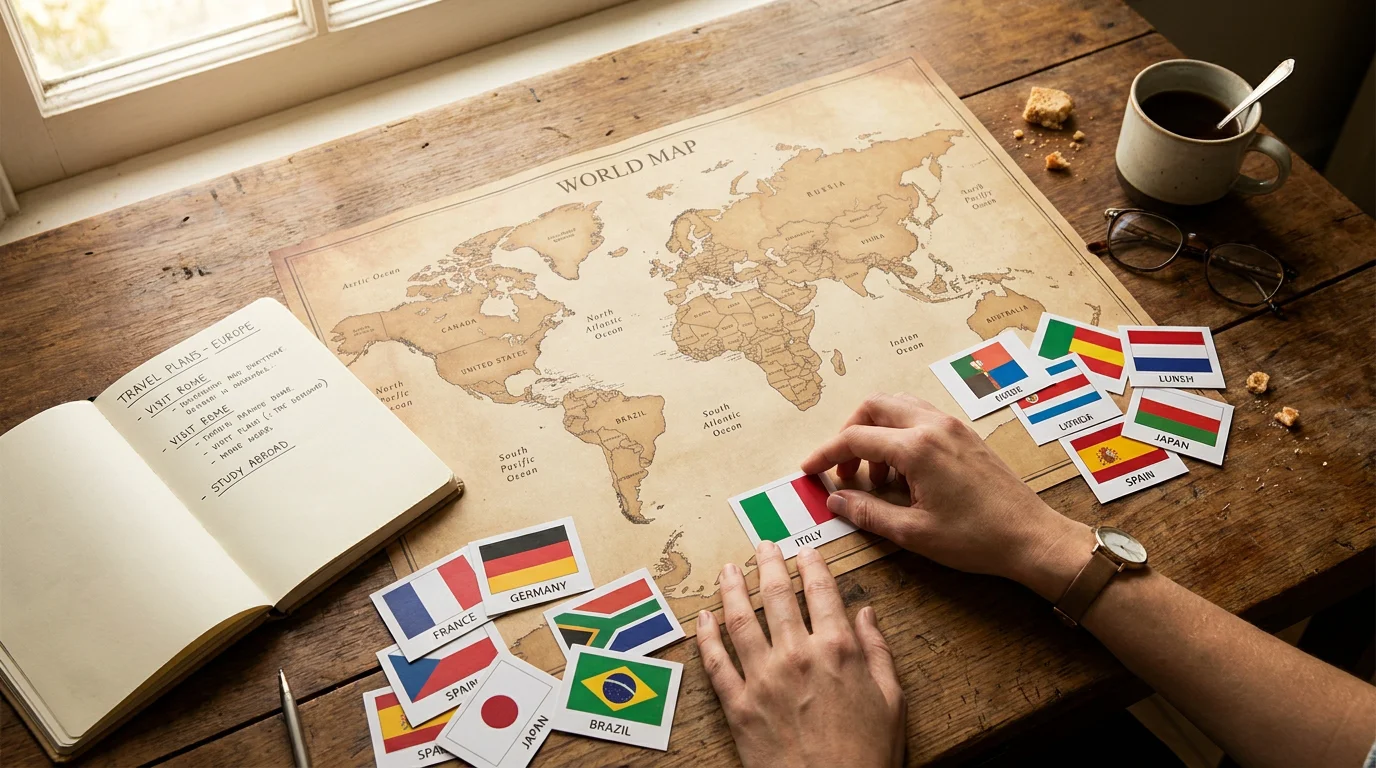
Popular platforms like Sporcle feature quizzes with 197 flags, and some go even further. Seterra's most comprehensive flag game asks you to identify over 270 flags from countries, regions, and territories around the globe. That's a lot of colored rectangles to sort out.
The appeal is universal. Students use them to study for geography exams. Travelers play them before trips. And plenty of people just enjoy the dopamine hit of nailing a tricky flag on the first try. It's low pressure, high reward learning.
The Brain Benefits of Identifying Flags
Flag quizzes aren't just a fun time killer. They actually give your brain a real workout. Recognizing and recalling flags from memory enhances cognitive functions like pattern recognition, spatial memory, and visual processing, strengthening recall by engaging both short-term and long-term memory systems.
Think about it. When you look at a flag, you're processing colors, shapes, symbols, and spatial arrangements all at once. As you learn to distinguish similar designs and remember minute details, the neural pathways involved in attention to detail and long-term memory encoding are reinforced. That's a fancy way of saying your brain literally gets sharper.
Because flags are tied to countries, cultural meaning, and geography, players also build contextual learning skills. You don't just memorize a picture. You connect it to a place, a history, a culture. According to BrainPlay, this makes flag quizzes an "entertaining yet cerebral workout" for global cultural literacy.
How Many Flags Are There, Anyway?
This depends on how you count. The United Nations recognizes 193 member states, plus 2 observer states (Vatican City and Palestine), giving you 195. But plenty of quizzes go way beyond that. Some platforms feature quiz games including 197 world flags and 130 territory flags from every corner of the globe.
Seterra, now part of GeoGuessr, offers a quiz requiring you to identify the flags of over 270 countries, regions, and territories. That includes places like Greenland, Hong Kong, and the Cook Islands, which have their own distinct national and territorial flags. Meanwhile, Sporcle's popular quiz sticks to 197, which is a solid challenge for most people.
The point? You'll never run out of flags to learn. Even geography experts stumble on the obscure ones.
The Trickiest Flags That Stump Everyone
Some flags are iconic. You'd spot Japan's red circle or Canada's maple leaf from across a room. But others? They'll make you second-guess everything you thought you knew. Here are the classic stumbling blocks:
- Romania vs. Chad: Nearly identical blue, yellow, and red vertical tricolors. The blue shades differ very slightly.
- Indonesia vs. Monaco: Both are red on top, white on bottom. The only real difference is the proportions.
- Ireland vs. Côte d'Ivoire: Green, white, and orange, but the stripe order is reversed.
- Luxembourg vs. Netherlands: Red, white, and blue horizontal stripes. Luxembourg uses a lighter blue.
- Australia vs. New Zealand: Both feature the Union Jack and Southern Cross, but with different star configurations.
These flag lookalikes are where true knowledge gets tested. Anyone can learn the famous ones. Sorting out the near-identical pairs is what separates casual players from pros. For more strategies on tackling these tricky matches, check out our country flags guessing tips.
Strategies to Actually Learn Every Flag
Memorizing 195+ flags sounds overwhelming. But with the right approach, it's surprisingly doable. Here's what works:
Learn by Region
Start with regions, learning flags grouped geographically. It's easier to spot similarities and patterns that way. You'll notice the prevalence of pan-African colors (green, yellow, red) across that continent, the common crescent moon in many Muslim-majority nations, and the Nordic crosses linking Scandinavian countries. These patterns become mental shortcuts that stick.
Focus on Distinguishing Details
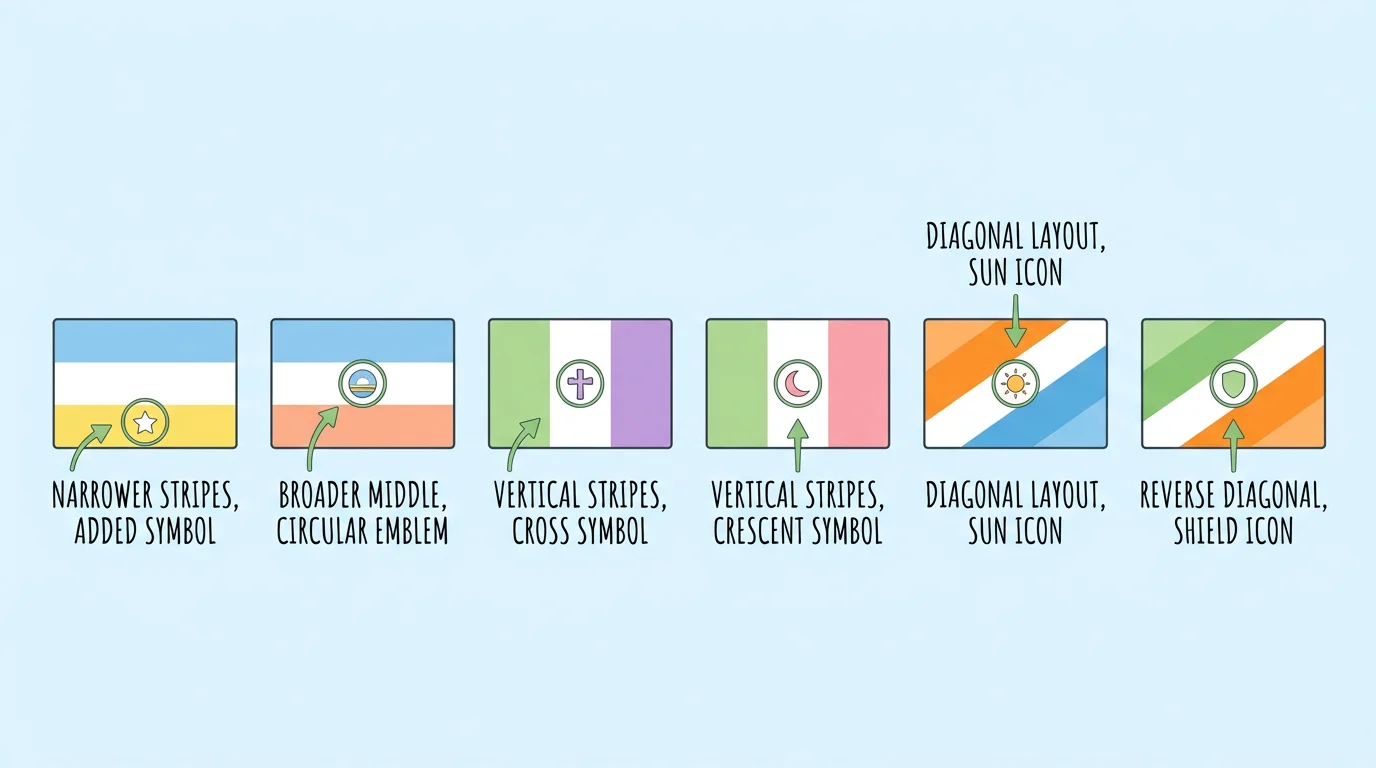
Learn to identify common symbols such as palm trees, suns, and stars, and pay special attention to flags that are nearly identical, differentiating by small details. For example, for the flags of São Tomé and Príncipe and St. Kitts and Nevis, the two stars can remind you of the two islands.
Use Active Recall, Not Passive Browsing
The best flag quizzes are for people who want to learn through active recall, not passive browsing. Don't just scroll through a list of flags. Test yourself, get it wrong, and try again. That cycle of struggle and correction is how lasting memory forms. Our countries flag quiz uses progressive reveal, uncovering a hidden flag tile by tile so you really have to think.
Practice Daily
Short daily sessions beat marathon study blocks. Even 5 minutes a day adds up fast. As one quiz player put it after achieving 100%, it took consistent daily work over many attempts to finally learn all the flags. Daily challenges keep you coming back and reinforce what you've already learned.
What Makes a Great Flag Quiz Stand Out
Not all flag tests are created equal. Some are pure multiple choice, which is fine for beginners. But if you really want to learn, you need a quiz that challenges your recall, not just your recognition. Here's what separates the good from the forgettable:
| Feature | Flagdle | Basic Quiz Apps |
|---|---|---|
| Progressive difficulty | Yes (tiles reveal gradually) | Random or static |
| Daily challenge | Yes (new flag each day) | Sometimes |
| Beyond flags (capitals, currency, GDP) | Yes (8+ mini-games) | Rarely |
| Free to play | Yes | Varies (often freemium) |
| Timed mode | Yes (chrono mode) | Sometimes |
| All 195 countries | Yes | Usually |
The progressive reveal mechanic is a game changer. Instead of seeing the full flag and picking from a list, you get 9 tiles covering the image. Each wrong guess reveals another tile. It forces you to work with partial information, which is exactly how effective memory training works.
Flags as a Gateway to Broader Geography
Here's the thing most people don't expect: once you start learning flags, you can't stop there. You'll naturally start wondering about capitals, populations, languages, and borders. Players report that after learning flags, they could immediately place developing news stories geographically, reference capitals when meeting someone from another country, and identify nations during Olympic opening ceremonies.
That's the real value of a flag test. It's not about memorizing colored rectangles. It's a gateway into understanding the world better. As noted in Britannica's World Flags Quiz, testing your knowledge of world flags is a classic way to deepen your geographic awareness.
If you want to explore beyond just flags, our flag quiz game includes mini-games on capitals, neighbors, currencies, GDP, languages, and country shapes. It's geography class, except actually fun.
Turn Your Flag Knowledge Into a Daily Habit
Testing yourself on country flags is one of the simplest ways to sharpen your brain, learn about the world, and have fun doing it. Whether you can name 20 flags or 200, there's always another one to learn. The trickiest part isn't starting; it's putting the quiz down once you've begun.
With progressive reveal mechanics, daily challenges covering all 195 countries, and a whole ecosystem of geography mini-games, we make it easy (and a little addictive) to build real knowledge one flag at a time. Ready to see where you stand? Take the flag quiz and find out how many you can get right.
Frequently Asked Questions
How many country flags should I know to be considered "good" at a flag quiz?
If you can identify around 100 flags, you're well above average. Getting all 195 is impressive, and getting there fast is elite territory. With daily practice on a platform like ours, most players hit 100+ within a few weeks.
Why do so many country flags look alike?
Shared history, colonial ties, and cultural movements explain most lookalikes. Pan-African colors (green, yellow, red) appear across dozens of African nations, while Nordic crosses link Scandinavian countries. Regional patterns are real, and learning them actually helps you tell flags apart faster.
What's the best way to start learning flags as a complete beginner?
Start with one region at a time. Europe and South America are great because the flags are varied enough to be distinctive. Then move to Africa and Asia, where color patterns repeat more often. Playing a few rounds daily is more effective than cramming once a week.