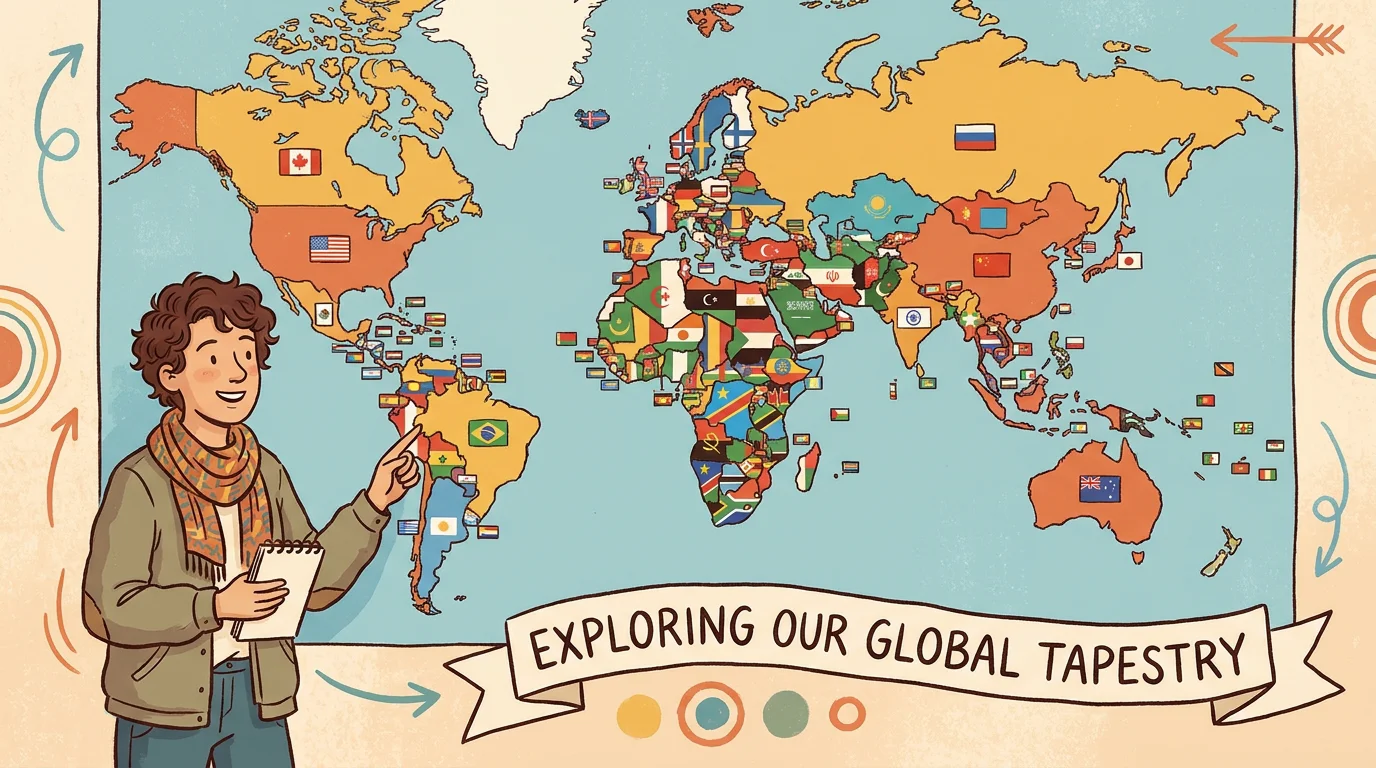

There are roughly 195 recognized countries on the planet, each one flying a unique flag. Think you could identify them all? Most people can nail about 20 to 30 before they start mixing up tricolors and getting lost in a sea of red, white, and blue. The good news? You don't need to be a geography professor to get better. A solid flag guessing game with the right format can turn anyone into a flag whiz, and it's way more fun than staring at flashcards.
The appeal of guessing country flags goes beyond simple trivia. It's a legit brain workout that taps into pattern recognition, visual memory, and cultural literacy. Whether you're a student prepping for a geography exam or a trivia night regular looking for an edge, learning to identify flags is one of the most satisfying knowledge quests out there. Let's break down why it's trending, how to get better at it, and what makes certain quiz formats stand out.
Why Country Flag Guessing Games Are Everywhere Right Now
The rise of daily word games back in 2022 kicked off a whole wave of "guess the thing" puzzles. Flags were a natural fit. They're visual, they're universal, and there's a built-in difficulty curve from "oh, that's obviously Canada" to "wait, is that Chad or Romania?" Sporcle's popular Flags of the World quiz, for example, features 197 questions and was last updated in February 2026, showing the format's staying power.
The real hook is the daily challenge format. Instead of grinding through all 195+ flags at once, modern country flags guess games give you one puzzle a day. Everyone gets the same challenge, which makes it social. You can compare scores with friends, share streaks, and trash talk over coffee. That shared experience is what turned simple geography quizzes into genuine daily habits for millions of players.
What Makes Guessing Flags So Good for Your Brain
This isn't just idle screen time. Playing flag quizzes provides serious brain-boosting benefits; recognizing and recalling flags from memory enhances cognitive functions like pattern recognition, spatial memory, and visual processing, while strengthening recall by engaging both short-term and long-term memory systems. That's a pretty solid payoff for a few minutes of fun each day.
As you learn to distinguish similar designs and remember minute details associated with each flag, neural pathways involved in attention to detail and long-term memory encoding are reinforced. Think about it: when you finally learn to tell apart the flags of Indonesia and Monaco (identical layout, slightly different red), you've trained your brain to notice subtle visual differences. That skill transfers to everything from reading charts to recognizing faces.
Because flags are tied to countries, cultural meaning, and geography, players also build contextual learning skills, making flag quizzes an entertaining yet cerebral workout ideal for sharpening mental acuity and cultivating global cultural literacy. If you're looking for a countries flag quiz that puts those benefits to work, we've built ours around exactly that principle.
The Progressive Reveal: A Smarter Way to Learn Flags
Most traditional flag quizzes show you the entire flag and ask you to name the country. That works, but it's binary: you either know it or you don't. There's not much learning happening in the "I don't" moments. That's where progressive reveal formats change the game.
Here's how it works with our approach: the flag is hidden behind nine tiles. Each guess you make reveals a new tile, gradually uncovering more of the flag's design. This means even if you don't know the answer right away, you're actively processing new visual information with each attempt. You start seeing a stripe, then a symbol, then a color combination, and your brain is working to connect the dots.
This format turns every wrong guess into a learning moment. Instead of just seeing a red "X" and moving on, you're building a mental map of the flag piece by piece. After a few days of this, flags you'd never recognized before start clicking instantly. It's the difference between cramming and actually retaining knowledge.
Tips to Actually Get Better at Guessing Flags
Ready to level up? Here are some strategies that genuinely work.
Learn by Region, Not Randomly
Starting with regions and learning flags by area (like all South American flags at once) makes it easier to spot similarities and patterns. African flags tend to feature green, yellow, and red (Pan-African colors). Scandinavian flags all share the offset cross design. Middle Eastern flags often use Pan-Arab colors: red, white, green, and black. Once you know the "family," identifying individual members gets much easier.
Focus on Unique Elements First
Identifying common symbols such as palm trees, sun motifs, and stars gives you anchors to work from. Nepal's flag is the only non-rectangular national flag. Switzerland and Vatican City have square flags. Japan's design is about as simple as it gets. Start with flags that have unmistakable features, and build outward from there.
Tackle the Lookalikes Head On
Some flags are nearly identical, so learning to differentiate them by small details is key. The classic stumpers include Chad vs. Romania (nearly indistinguishable blues), Ireland vs. Côte d'Ivoire (reversed green and orange), and Indonesia vs. Monaco (slightly different proportions). Make a list of your personal "confusing pairs" and drill them deliberately. A flag quiz game that includes hints or progressive clues can really help here.
How Many Flags Should You Actually Know?
There are 197 world flags when you count all sovereign states and observer states, though some quizzes use 196 countries depending on which territories they include. The exact number shifts depending on who's counting and which political entities are recognized.
Realistically, here's a rough difficulty breakdown:
| Level | Flags Known | What It Looks Like |
|---|---|---|
| Beginner | 30–50 | Major nations: USA, UK, Japan, Brazil, Canada |
| Intermediate | 80–120 | Most of Europe, Asia, and the Americas |
| Advanced | 150–180 | All continents covered, small nations included |
| Expert | 195+ | Microstates, Pacific islands, everything |
Don't stress about hitting expert level overnight. Consistent daily practice matters way more than marathon sessions. Even five minutes a day adds up fast. Our timed flag challenge is perfect for quick daily practice that pushes you just enough.
What to Look For in a Great Flag Quiz Format
Not all flag quizzes are created equal. Here's what separates the good ones from the forgettable ones:
- Progressive hints: Quizzes that reveal information gradually (like our tile system) teach more than simple pass/fail formats.
- Daily challenges: A new puzzle each day keeps you coming back without burnout. It also creates a shared social experience.
- Multiple game modes: Beyond flags, the best platforms test you on capitals, country shapes, currencies, and more. This cross-referencing strengthens your overall geography knowledge.
- Accessibility: Free, browser-based, no downloads. If you need to install something or create an account just to start playing, most people bounce.
The key to geography quiz success lies in recognizing patterns, colors, and symbols. The best quiz formats help you build those recognition skills naturally through repetition and smart feedback loops.
Beyond Flags: Expanding Your Geography Game
Once you've got a solid flag foundation, the natural next step is branching out. Country shapes, capital cities, neighboring countries, official languages, currencies: these are all connected pieces of the same puzzle. Knowing that Kazakhstan's flag is sky blue with a golden sun and eagle is cool. Knowing that Astana is its capital and that it borders Russia, China, and three other "-stan" countries? That's a whole different level of geographic fluency.
This is exactly why we built multiple mini-games into our daily challenge. It's not just about the flag; it's about the full picture of each country. When you connect a flag to a capital to a continent to a currency, the knowledge sticks in a way that isolated trivia never does. You can explore all of these in our flag game hub.
The Social Side of Flag Guessing
Let's be honest: half the fun of daily puzzle games is the bragging rights. Sharing your score, challenging a friend, or posting your streak on social media turns a solo activity into a community event. Flag quiz games combine education with competitive gaming, making geography learning both fun and memorable; unlike traditional study methods, multiplayer and social flag games create excitement through real-time competition.
Teachers have caught on to this, too. Flag quizzes are showing up in classrooms as warm-up activities, and students are actually engaging with geography content they'd otherwise find boring. When there's a daily leaderboard involved, suddenly everyone wants to know where Lesotho is.
Guessing country flags has quietly become one of the most engaging ways to learn about the world, one puzzle at a time. The cognitive benefits are real, the learning curve is satisfying, and the daily format keeps you hooked without overwhelming you. Whether you're trying to impress at trivia night or just want to know what's on that flag you saw at the Olympics, consistent practice with a well-designed quiz is your best bet. Our progressive reveal format, covering 195 countries with daily challenges, makes it easy to build your skills in just a few minutes a day. Ready to see how many you can get? Try our daily flag guessing game and start your streak today.
Frequently Asked Questions
How many country flags are there in the world?
There are 195 internationally recognized sovereign states, each with its own flag. Some quizzes include up to 197 depending on whether they count observer states and disputed territories. The exact number varies by source.
What's the fastest way to learn all the world flags?
Start by learning flags region by region, focus on unique symbols first, and practice daily. A progressive format like Flagdle's daily challenge is especially effective because it reveals the flag gradually, turning every attempt into a learning opportunity rather than a simple right-or-wrong test.
Which country flags are the hardest to guess?
The trickiest flags are usually the "lookalike" pairs: Chad and Romania, Monaco and Indonesia, Ireland and Côte d'Ivoire. Flags of small Pacific island nations (like Tuvalu, Nauru, and Palau) also tend to stump people because they're less commonly seen in media.