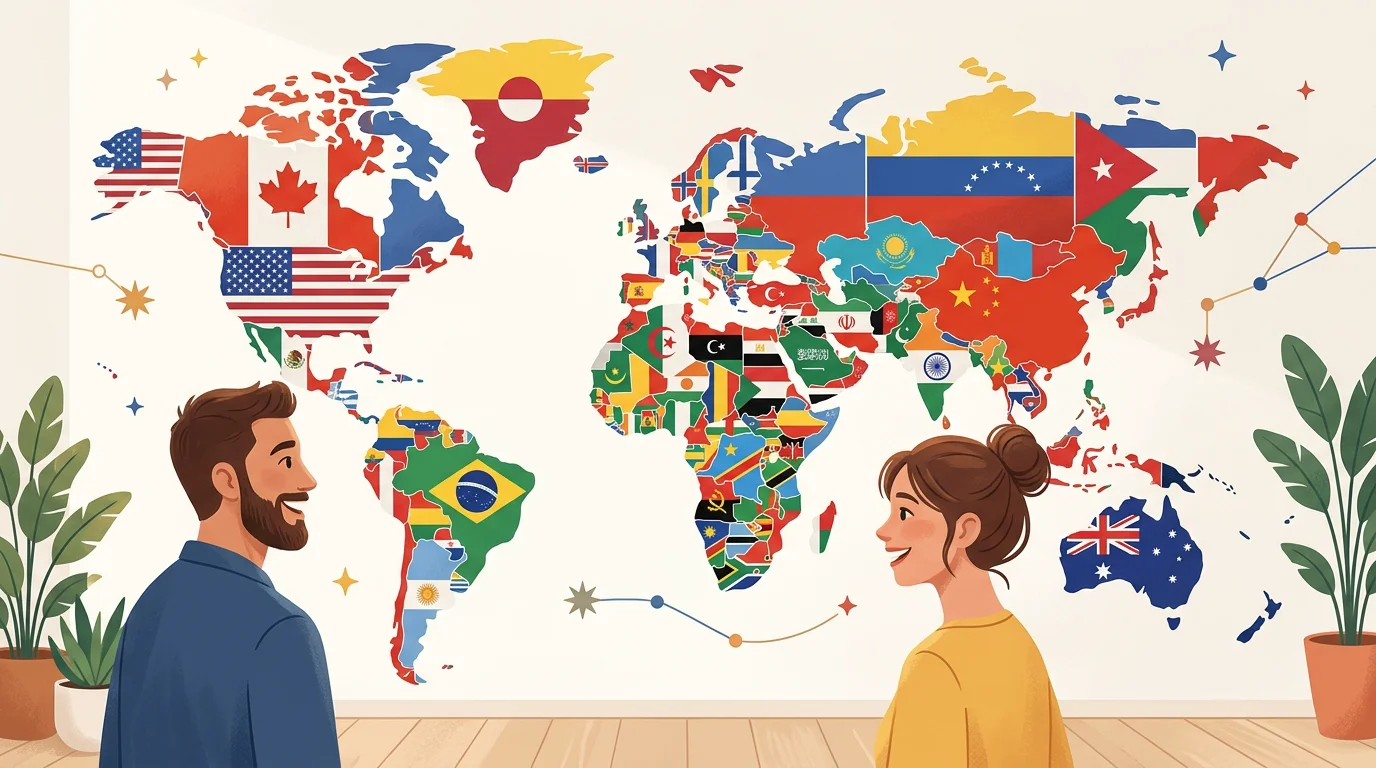
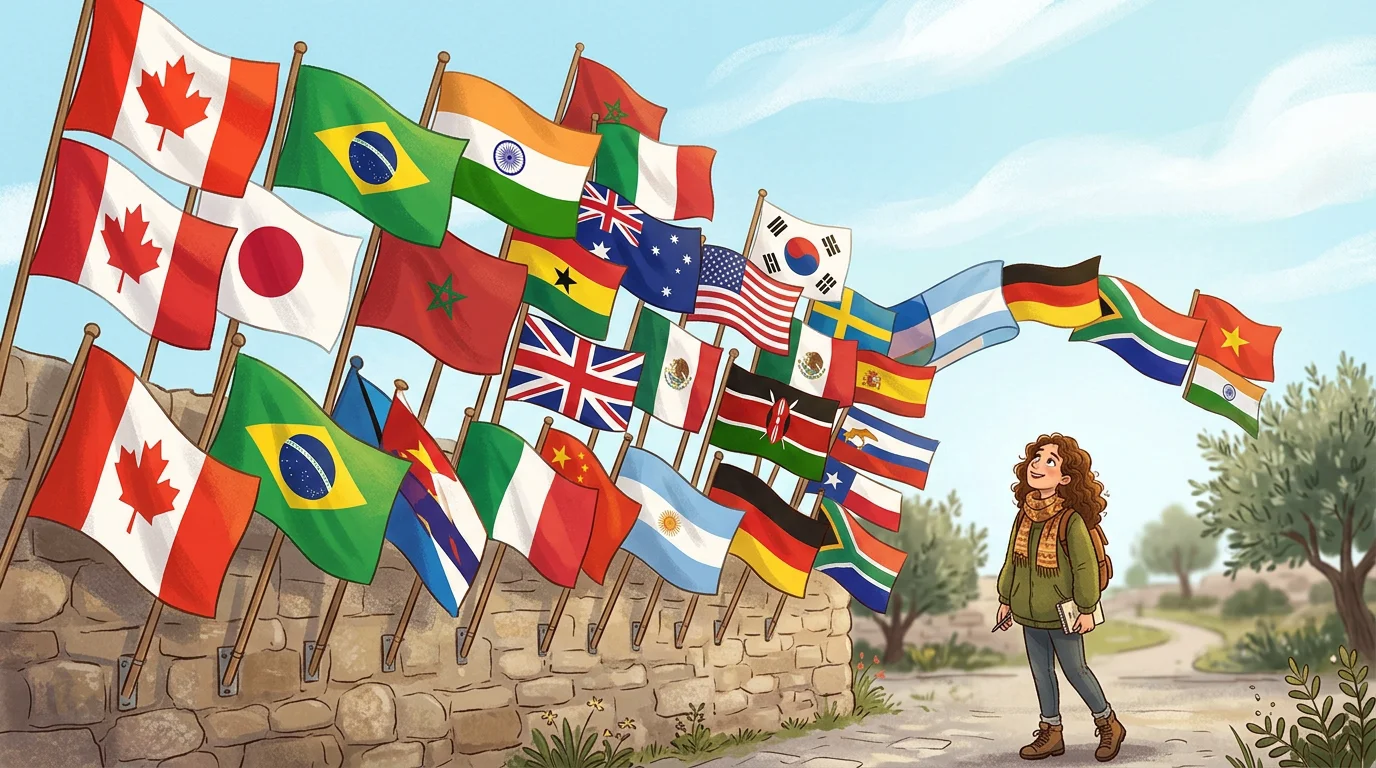

Quick question: how many flags of the world could you actually name right now, off the top of your head? Most people stall somewhere around 40 before the brain goes blank. Yet there are 195 of them, and each one is a tiny compressed story of a country, its history, its values and its geography. If you want a friendly way in without cracking open a textbook, our flag geography across 195 flags guide is a solid starting point.
Here's the thing though: flags aren't random splashes of color. Every stripe, star and crescent was chosen on purpose. Once you understand the patterns behind them, the whole map suddenly gets a lot easier to read, and honestly a lot more fun. So let's walk through what these banners mean, which ones trip everybody up, and how you can lock them into memory for good.
So how many national flags are we actually talking about?
The number people throw around most is 195, and it holds up. That total covers 193 United Nations member states plus two non-member observer states, the Holy See and the State of Palestine. Every one of those sovereign states flies its own official banner.
Where counts start to wobble is with territories, dependencies and regions. Some reference sites list well over 250 flags once you fold in places like Greenland, Puerto Rico or Hong Kong. Others push past 10,000 if you count regional, cultural and historical designs. For learning purposes, though, the clean target is the 195 national flags of recognized countries.
What all those colors and symbols actually mean
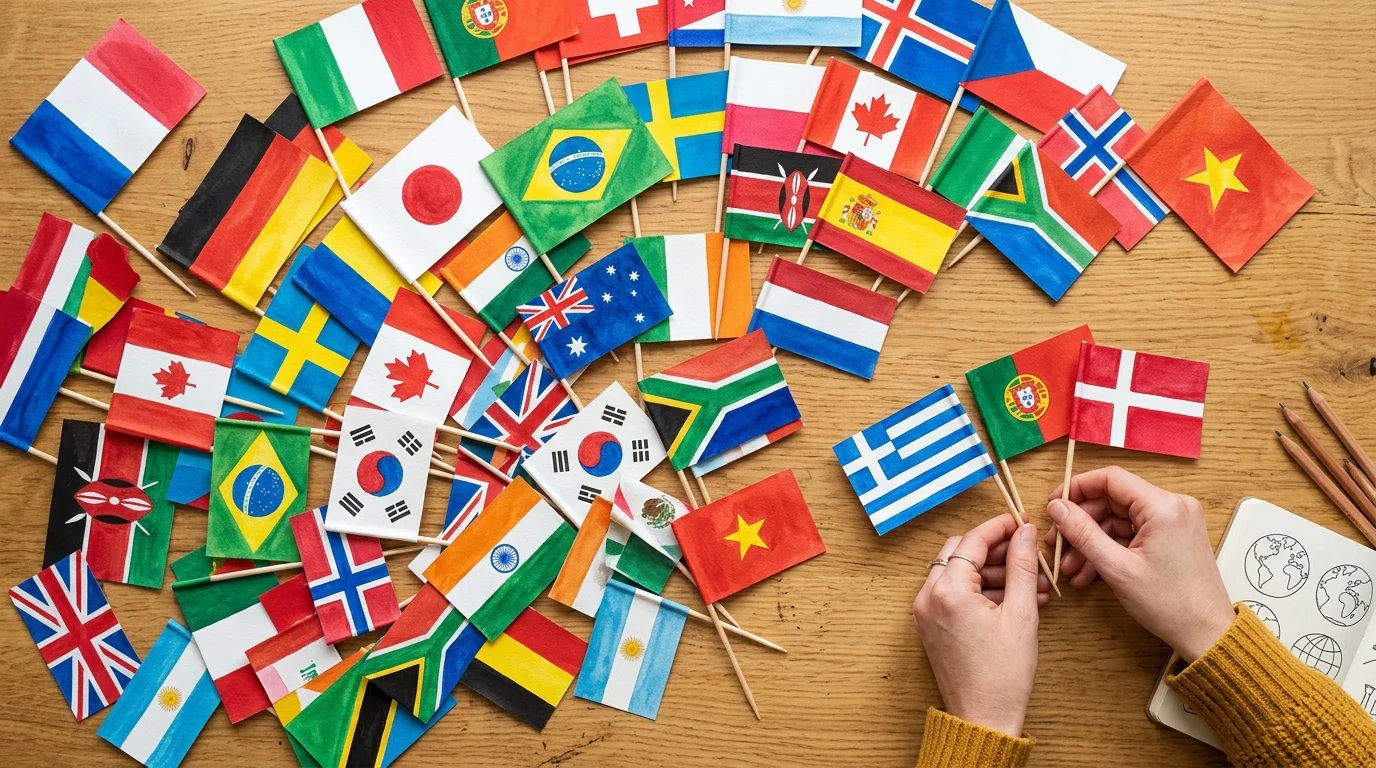
Colors do a lot of heavy lifting on a flag. Red usually signals sacrifice, courage or revolution. White tends to mean peace, purity or minority inclusion. Green often points to land, agriculture or Islam, depending on the region. Blue leans toward trust, sky and sea.
This isn't just vibes, either. In a 2026 semiotic study of the eight South Asian SAARC flags, researchers found green recurring in six of the eight designs, red in five as a marker of sacrifice and liberation, and white in seven as a signifier of peace or minority inclusion. The same color can carry totally different meanings across borders, which is exactly why color symbolism is such a rich subject in the field of vexillology (the study of flags).
Symbols add another layer. Stars often stand for unity or states, a crescent frequently signals Islam, and coats of arms pack in local history. Once you start reading a flag as a sentence instead of a picture, memorizing it gets a whole lot easier.
The oldest flag still flying today
Ever wonder which banner has been waving the longest? That honor goes to Denmark's Dannebrog, a white Nordic cross on a red field. According to Denmark's official site, it became a Danish flag around the mid-14th century, which makes it one of the world's oldest national flags in continuous use.
There's a great legend attached: the story goes that the Dannebrog fell from the sky during a 1219 battle in what's now Estonia, rallying the Danish troops to victory. Historians debate the details, but the symbol's staying power is real. As WorldAtlas notes, the rectangular flag was standardized in the 17th century, yet the design itself has endured for more than 800 years. That kind of continuity is a big part of why it's woven so deeply into Danish identity.
The flags that trip absolutely everybody up
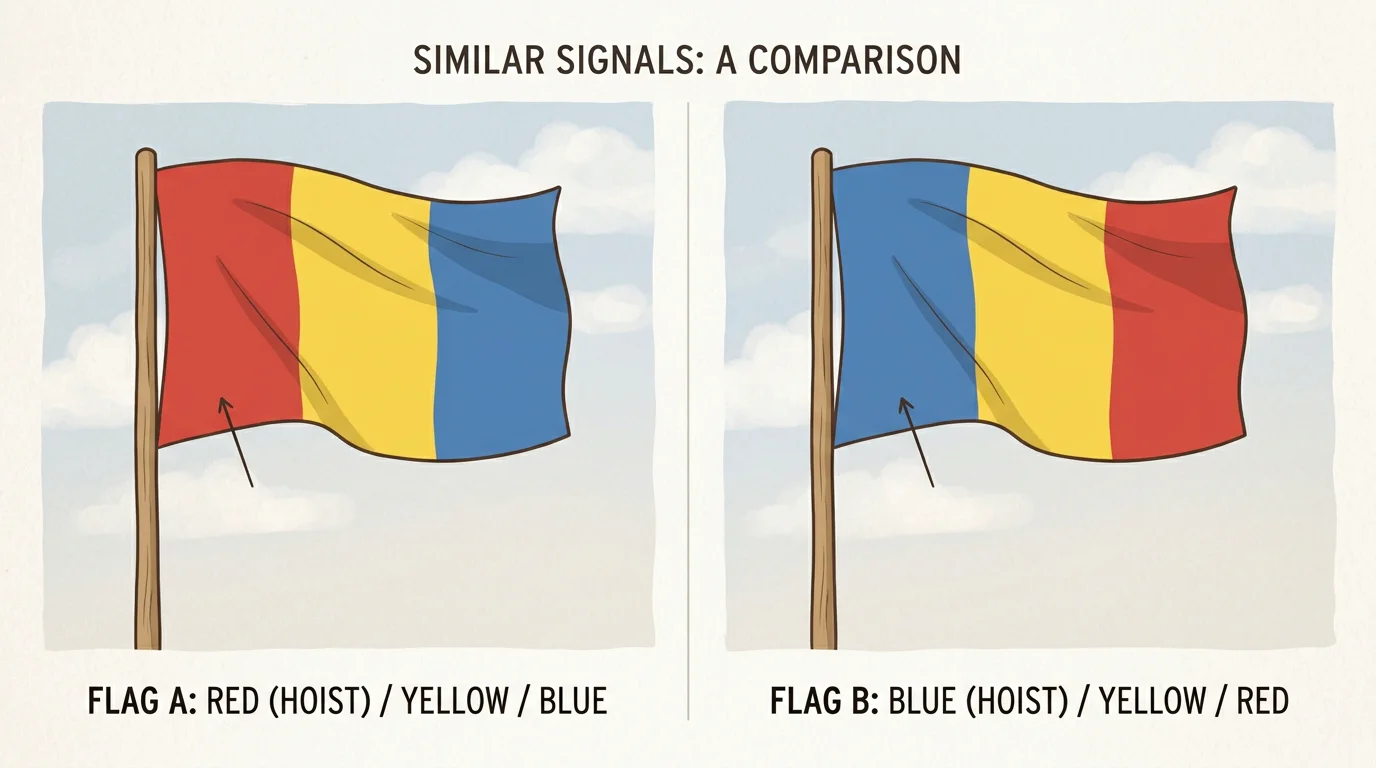
Here's where quizzes get brutal. Some lookalike flags are nearly impossible to tell apart at a glance. Chad and Romania both use blue, yellow and red vertical stripes, and the difference comes down to a subtle shade of blue. Indonesia and Monaco are both just red over white, separated mostly by their proportions.
A few more classic traps:
- Netherlands vs. Luxembourg: same red, white and blue stripes, but Luxembourg's blue is lighter.
- Ireland vs. Côte d'Ivoire: green, white and orange, just flipped left to right.
- Slovakia, Slovenia and Russia: three near-identical Slavic tricolors with different crests.
The only reliable fix is repetition on the tricky pairs specifically. If you want a structured way to grind through every single one, our learn all 193 flags fast walkthrough breaks the whole set down so the confusing ones stop catching you off guard.
Why a piece of cloth stirs such strong feelings
Flags are just fabric, so why do they make people cheer, cry or march? Psychology has some answers. National symbols tap directly into how we build and express group identity.
A well-cited study, "Waving the Flag", examined the psychology behind attachment to national symbols using a sample of 195 undergraduates alongside a national probability sample of 1,775 people. The researchers found that national symbolism drives emotional responses and identity expression, without necessarily boosting political knowledge or engagement. In plain terms: a flag mostly makes you feel like you belong, and that feeling runs deep.
That emotional pull is also what makes flags so memorable to study. You're not just learning shapes, you're learning stories people are willing to defend. If you're curious how much of that has actually stuck for you, our how well do you know the flags of the world? challenge is a quick reality check.
The easiest way to actually learn them all
Cramming 195 designs in one weekend almost never works. Memory research is clear that short, spaced, repeated sessions beat marathon study. So the trick is to make flag practice a tiny daily habit instead of a chore.
Here's how a few common approaches stack up:
| Approach | Time per session | Tracks progress | Cost |
|---|---|---|---|
| Daily flag game (our Flagdle challenge) | Around 2 to 5 minutes | Yes, with daily, weekly and monthly rankings | Free, no account |
| Paper flashcards | 10 to 20 minutes | Manual only | Low, but you build them yourself |
| Wall poster | Passive glances | No | One-off purchase |
| Generic trivia apps | Varies | Sometimes, often behind ads | Free with ads or paid |
The daily-habit format wins because it's low effort and self-correcting. You see one flag, guess, get instant feedback, and move on. For a fuller breakdown of formats and difficulty levels, our Flag Quiz guide to test your world knowledge covers the whole approach. Pair a short daily game with focused drilling on the lookalike pairs, and you'll be surprised how fast the map fills in.
The bigger picture
Learning the flags of the world isn't really about memorizing 195 rectangles. It's about reading the colors, symbols and stories packed into each one, so a wall of banners turns into a map of human history you can actually navigate. Start with the patterns, get comfortable with the notorious lookalikes, and lean on short daily practice instead of one exhausting cram. Do that, and the flags stop being a blur and start feeling like old friends you recognize on sight.
Take action with Flagdle
Knowing why flags matter is one thing; actually remembering all 195 is another. The gap between the two is just practice, and the easiest practice is the kind you barely notice because it only takes a couple of minutes a day.
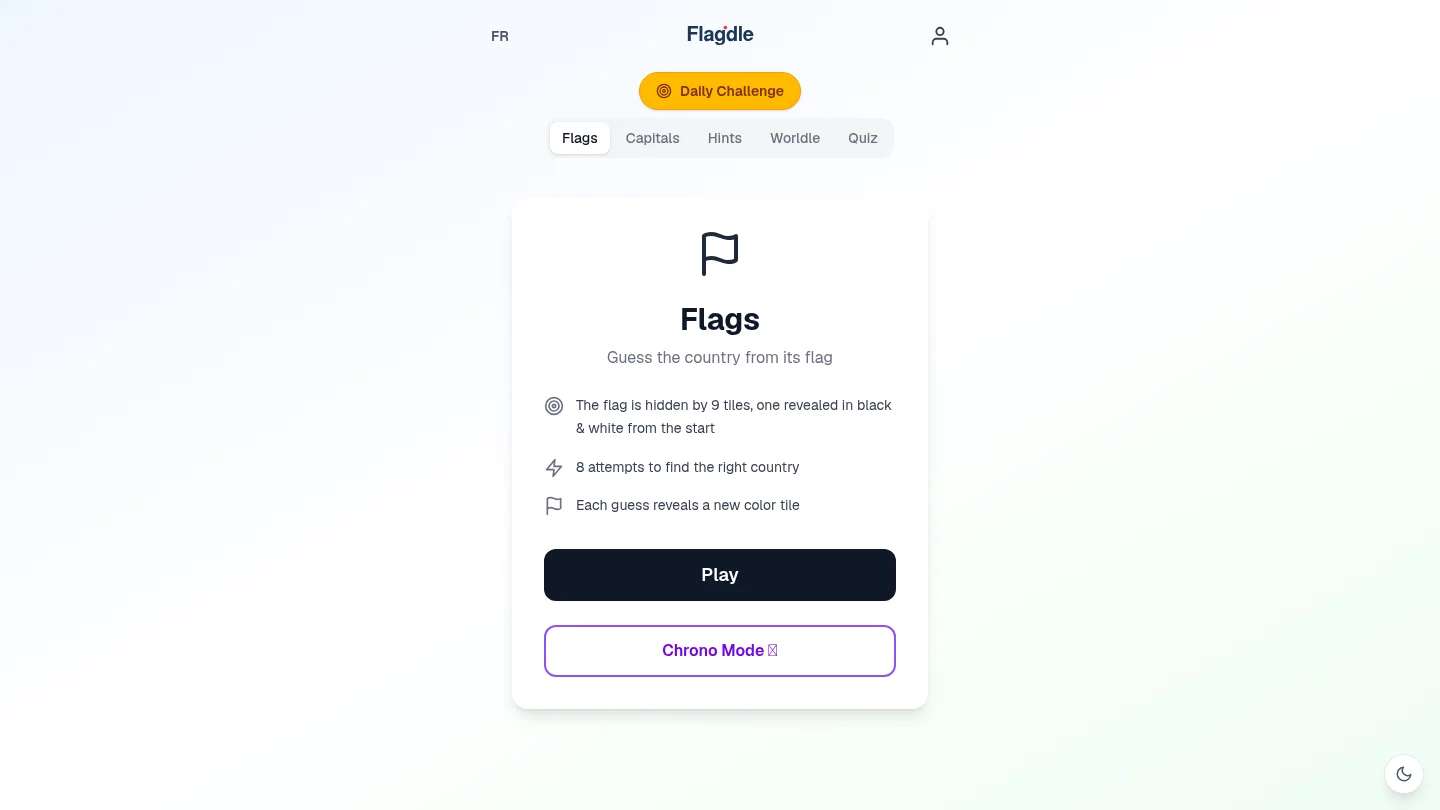
That's exactly what we built. With our free daily flag guessing game, you get one hidden flag revealed tile by tile across three tries, plus modes for capitals, country silhouettes and themed quizzes. It's the same challenge for everyone worldwide, so you can compare scores with friends on the daily, weekly and monthly leaderboards. No account, no intrusive ads, just a quick ritual that covers all 195 UN-recognized countries and makes geography stick.
Frequently Asked Questions
How many flags are there in the world?
There are 195 national flags for recognized sovereign states, made up of 193 UN member states plus two observer states, the Holy See and Palestine. If you include territories, regions and historical designs, the count climbs into the thousands.
Which is the oldest national flag?
Denmark's Dannebrog, a white cross on a red field, is widely recognized as the oldest national flag still in continuous use. It's traced back to around the mid-14th century, with a famous origin legend dating to a battle in 1219.
Why do so many flags look the same?
Many flags share colors and layouts because they draw on the same historical, religious or regional influences, like Slavic tricolors or Pan-African colors. That's why pairs like Chad and Romania or Indonesia and Monaco are so easy to confuse.
What do the colors on flags usually mean?
Broadly, red often signals courage or sacrifice, white peace or purity, green land or faith, and blue trust or the sea. The exact meaning shifts by country, so the same color can tell very different stories across borders.
What's the fastest way to learn all the flags?
Short, daily, repeated practice beats one long cram session every time. A quick game like our daily Flagdle challenge gives you instant feedback and progress tracking, so the flags stick without feeling like homework.