

Think you're a geography whiz? Here's a humbling stat: on JetPunk's popular flags quiz, which has been taken over 3.7 million times, the average score sits at just 49.5%. That means most people can't even name half the world's flags. Whether you're a trivia night regular, a student prepping for exams, or just someone who loves a good challenge, a flag of the world test is one of the most entertaining ways to discover how much (or how little) you know about our planet.
And here's the thing: it's not just about bragging rights. Identifying flags ties into broader geography skills, from understanding cultures and histories to nailing capital cities and regional politics. If you're itching to jump right in, our country flag test is a fantastic starting point. But first, let's talk about why these tests are so addictive, what makes them tricky, and how you can go from guessing to getting 100%.
Why Are Flags of the World Tests So Popular?

Flag quizzes have been around for years, but they've exploded in popularity over the past decade. The format is simple: you see a flag, you guess the country. Done. No complicated rules, no equipment needed, and you can play on your phone during a commute or on a desktop during a lunch break.
A few things fuel the obsession. First, competitive curiosity. Everyone thinks they'll crush a flag quiz until they're staring at the flags of Chad and Romania, wondering if they're the same thing (spoiler: they're almost identical). Second, daily challenges keep people coming back. Games that refresh with a new puzzle every day tap into the same habit loop that made Wordle a global sensation.
Third, there's a genuine educational payoff. Mentimeter notes that flag quizzes are a great tool for testing students' knowledge, covering everything from colors and shapes to the symbolism behind flag designs. Teachers use them, parents use them, and self-proclaimed geography nerds use them to sharpen their skills.
How Many Flags Are There, Anyway?
This sounds like a straightforward question, but it's surprisingly tricky. The United Nations recognizes 193 member states. Add the two observer states (the Holy See and Palestine), and you're at 195. Some quizzes include Taiwan and Kosovo, pushing the count to 197. Others go further, tossing in territories, dependencies, and overseas regions.
World Geography Games, for instance, includes 197 national flags plus 130 territory flags. That's over 320 flags total. Most standard world flag quizzes, though, stick to somewhere between 195 and 197 sovereign nations. That's the sweet spot where the challenge is real but not absurdly obscure.
Knowing the count matters because it sets your benchmark. If a quiz covers 196 flags, and you score 49.5% (the average on JetPunk as of early 2026), you're correctly naming about 97 countries. Not terrible, but there's clearly room to grow.
The Flags That Trip Everyone Up
Some flags are easy. The United States, Japan, Canada, and the United Kingdom are instantly recognizable. But what about Burkina Faso? Comoros? Eswatini? Here's a quick look at the categories that tend to stump quiz takers:
- Near-identical flags: Chad and Romania (vertical blue, yellow, red tricolors), Monaco and Indonesia (horizontal red over white), and Ireland and Ivory Coast (green, white, orange tricolors, but reversed).
- Pan-African tricolors: Mali, Guinea, Senegal, and Cameroon all share green, yellow, and red color schemes. The differences are subtle.
- Small island nations: Flags of Palau, Tuvalu, Nauru, and the Marshall Islands are rarely seen in everyday life, making them tough to recall.
- Central Asian flags: Turkmenistan, Uzbekistan, Kazakhstan, and Tajikistan all feature blue and green tones with crescent moons or stars.
The trick? Repetition. The more you encounter these flags in a quiz setting, the faster your brain locks them in. It's a form of spaced repetition, a learning technique backed by decades of cognitive science research. And that's exactly why playing a flag quiz regularly is so effective.
What Makes a Great Flag Quiz Different from a Mediocre One
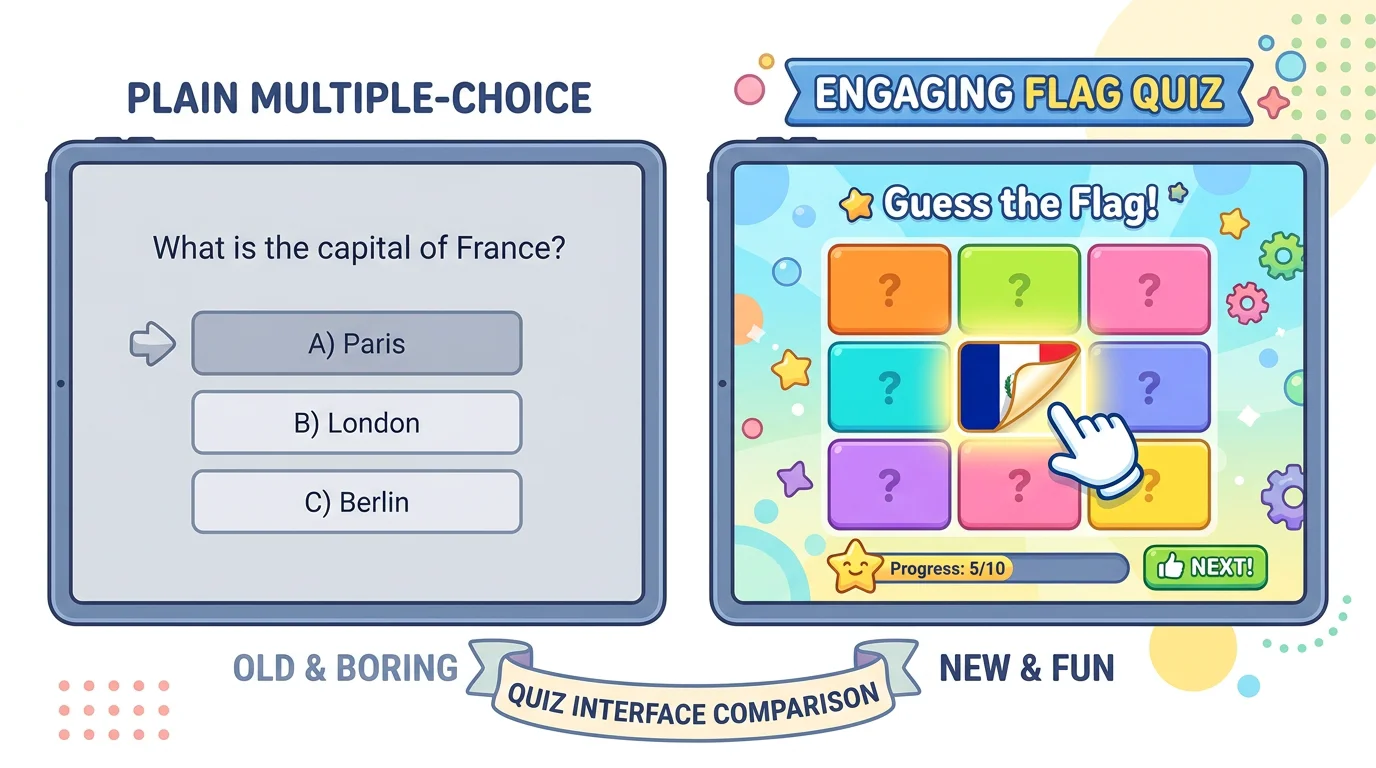
Not all flag quizzes are created equal. Some are basic multiple-choice formats that feel like homework. Others use clever mechanics to make the experience genuinely engaging. Here's what separates the best from the rest:
| Feature | Basic Quiz | Flagdle (Our Daily Challenge) |
|---|---|---|
| Format | Multiple choice (4 options) | Progressive flag reveal with tiles |
| Daily challenge | Usually no | Yes, new flag every day |
| Hint system | None or simple elimination | 9 tiles reveal progressively |
| Countries covered | Varies (50–197) | 195 countries |
| Extra geography modes | Rare | Capitals, shapes, currencies, GDP, neighbors |
| Price | Free or freemium | 100% free |
The progressive reveal mechanic is a game changer. Instead of just showing you four options and hoping you remember, a tile-based system forces you to actually analyze what you're seeing. Each wrong guess uncovers another piece of the flag, giving you new information to work with. It's like solving a puzzle inside a quiz.
If you want to experience this for yourself, our flag of the world game uses exactly this approach. You get 8 attempts, and each one peels back a tile to reveal more of the hidden flag.
Tips to Ace Any Flags of the World Test
Ready to demolish that 49.5% average? Here's how to train like the geography nerds who finish JetPunk's full 196-flag quiz in under five minutes:
- Learn by region. Don't try to memorize all 195+ flags at once. Start with Europe (about 44 flags), then move to Africa (54), Asia (48), the Americas (35), and Oceania (14). Regional grouping makes patterns easier to spot.
- Focus on unique elements. Nepal's flag is the only non-rectangular one. Switzerland's is square. Mozambique's has an AK-47. These oddities stick in your memory.
- Use color as a shortcut. Most Middle Eastern flags use red, white, green, and black (Pan-Arab colors). Caribbean flags often feature bright blues and yellows. Knowing these patterns narrows your guesses fast.
- Play daily. Consistency beats cramming. A daily challenge takes two minutes and builds long-term recall far better than a single hour-long session.
- Test both ways. Practice going from flag to country name AND from country name to flag. This bidirectional recall strengthens your mental associations.
Flags and Geography: More Connected Than You Think
Here's a fun fact most people don't realize: learning flags is actually a gateway to deeper geography knowledge. When you learn that Bhutan's flag features a thunder dragon, you naturally wonder where Bhutan is. When you discover that Kiribati's flag shows a frigate bird over ocean waves, you start thinking about Pacific island nations and climate change.
Flags encode history too. The Union Jack within Australia's flag reflects its colonial past. The crescent and star on Turkey's flag has roots in Ottoman symbolism. The cedar on Lebanon's flag represents resilience. Every symbol tells a story, and flag identification is just the entry point.
That's why the best flag quizzes don't stop at "name that flag." They expand into capitals, borders, currencies, and populations. If you want to go beyond flags and test your entire geography toolkit, you can play the all countries flag quiz for a comprehensive challenge.
Common Formats for Flag Tests Online
You'll find a handful of quiz formats across the web, each with its own strengths:
- Multiple choice: The easiest format. You see a flag and pick from 4 options. Great for beginners but less challenging for experienced players.
- Type-in: You see the flag and type the country name. Spelling counts, which adds difficulty. Platforms like Sporcle and JetPunk use this format.
- Timed challenges: You race against the clock. JetPunk gives you 15 minutes for 196 flags. Pressure reveals how well you truly know your stuff.
- Progressive reveal: The flag is hidden and gradually uncovered. This format rewards pattern recognition and is uniquely engaging.
- Map-based: You see the flag and need to click the country on a map. This adds a spatial dimension to the challenge.
Each format trains a slightly different skill. The best approach? Mix them up. Use multiple-choice to build familiarity, type-in for precision, and progressive reveal for deep visual analysis.
How to Track Your Progress and Set Goals
Getting better at recognizing world flags is all about measurable progress. Here's a simple framework:
- Beginner (0–30%): You know the major countries. Start with a regional quiz focusing on one continent at a time.
- Intermediate (30–70%): You've got most of Europe, the Americas, and East Asia down. Time to tackle Africa and Oceania, where the tricky ones hide.
- Advanced (70–90%): You're nailing most flags but mixing up the look-alikes. Focus sessions on confusing pairs (Chad/Romania, Monaco/Indonesia).
- Expert (90–100%): You can rattle off every flag. Now it's about speed. Try timed runs and aim to beat your personal best.
The beauty of daily quizzes is that your score naturally trends upward over weeks. You don't need to study flashcards for hours. Just a couple of minutes each day and suddenly you're scoring 80%, then 90%, then nailing them all.
Taking a test on flags of the world isn't just a fun internet distraction; it's a legit way to expand your understanding of global geography, history, and culture. With an average quiz score sitting below 50%, there's plenty of room for you to stand out. The key is consistency: play daily, focus on weak spots, and mix up your quiz formats. We built our daily challenge with progressive flag reveals and multiple geography modes so you can train smarter, not just harder. Ready to see where you stand? Jump into our all countries flag quiz and start climbing from average to expert.
Frequently Asked Questions
How many flags do I need to learn for a full world flag test?
Most comprehensive quizzes cover between 195 and 197 flags, representing all sovereign nations. Some also include territories, which can push the total past 300. Start with the 195 UN-recognized countries and work your way up.
What's the fastest way to memorize all world flags?
Use spaced repetition by playing a daily quiz. Our daily challenge on Flagdle reveals flags progressively, which helps build visual memory naturally. Combine that with regional study (one continent at a time) for the best results.
Are flag quizzes actually educational?
Absolutely. Flag quizzes build pattern recognition, reinforce geographic knowledge, and introduce you to cultural symbolism. They're widely used by educators as a fun way to engage students with world geography.