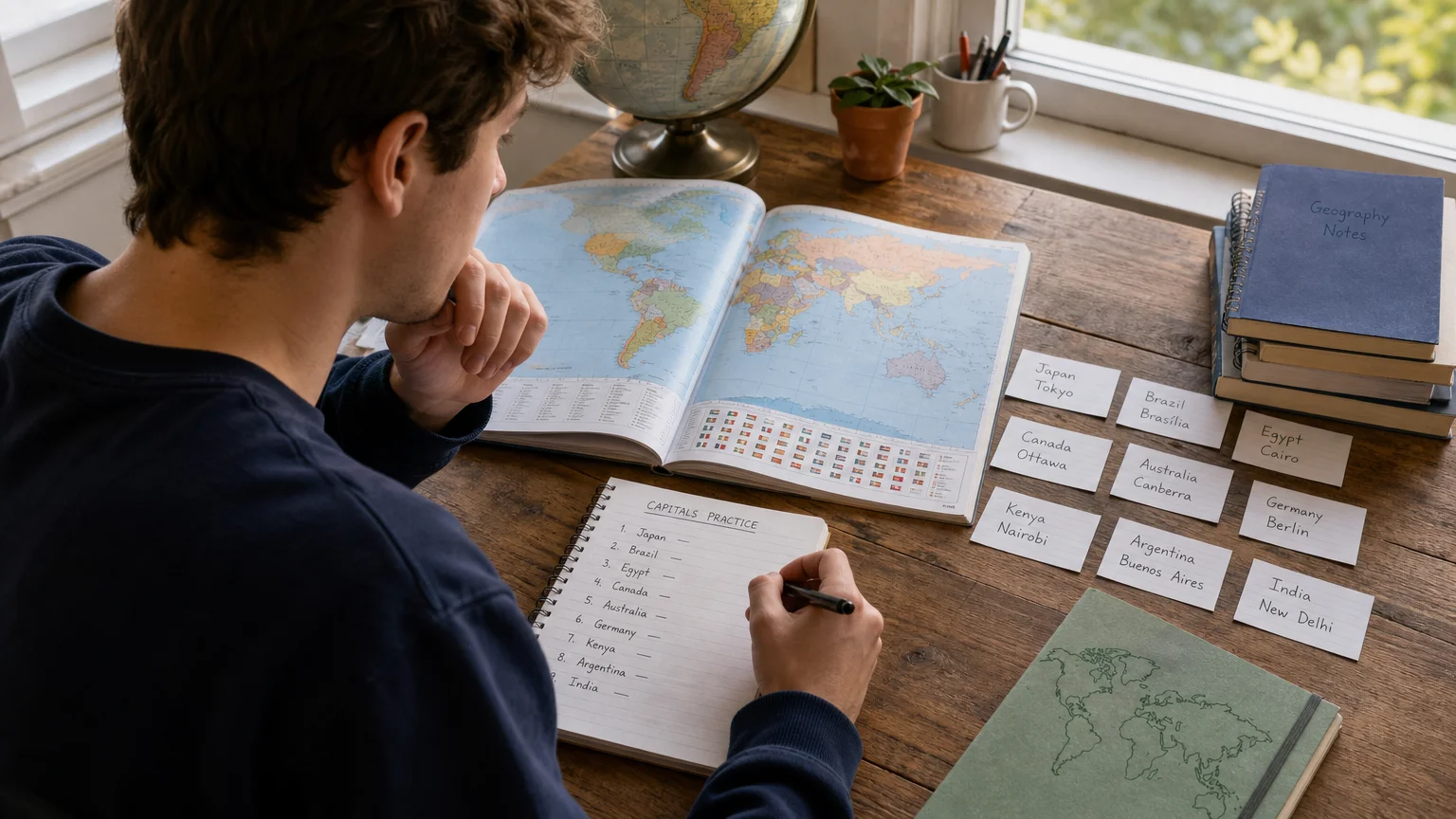

Start with our capital cities of the world game if you want a quick way to test what you know. A good capital cities game should do more than display a long list. It should ask you to retrieve answers, offer helpful clues when you’re stuck, and make it easy to repeat difficult capitals.
That approach also fits how geography games are used for learning. A 2008 study of computer games in geography education examined both student achievement and motivation through gameplay, showing why interactive practice can be more engaging than passive review. The research is discussed in a geography learning study, although games work best when they support regular practice rather than replace it.
What should a capital cities game include?
Imagine opening a quiz and seeing “What is the capital of Mongolia?” You might know the answer, Ulaanbaatar, or you might need a clue. That moment of trying to retrieve the answer is the core of useful capital city practice.
The strongest formats usually combine several elements. Multiple-choice questions provide a gentle entry point, while typing modes test whether you can produce the answer independently. Timed rounds add pressure, but untimed practice gives you space to notice patterns and correct mistakes.
- Active recall: you answer before seeing the solution.
- Progressive clues: hints reduce frustration without removing the challenge.
- Regional practice: you can focus on Europe, Africa, Asia, the Americas, or Oceania.
- Two-way testing: you identify a capital from a country and a country from a capital.
- Review tools: missed answers return often enough to become familiar.
It also helps when a quiz connects capitals with flags, maps, languages, population, or landmarks. Those extra details create memory hooks. For example, remembering Canberra through Australia’s location, history, and geography may be easier than memorising the city name alone.
Why active recall beats reading a list
Reading a list of countries and capitals can feel productive, but recognition is not the same as recall. You may recognise “Ljubljana” when you see it, yet struggle to produce it when asked for Slovenia’s capital. A game exposes that difference immediately.
Each answer creates a small retrieval exercise. If you get it right, the connection becomes easier to access. If you get it wrong, the correction gives you a clear target for another round. This is why short quizzes can be more useful than repeatedly scanning the same table.
Feedback matters too. An answer should tell you not only whether you were right, but also what to remember next time. A capital cities game can support this with clues, explanations, visual associations, or a mistake list.
Don’t aim to memorise every capital in one sitting. Aim to retrieve a few more correctly each time you practise.
Short sessions are especially useful because they lower the barrier to starting. Five minutes before class, during a commute, or while preparing for a trip can be enough to reinforce a small group of answers.
Which game mechanics make learning easier?
In a 2026 dataset covering 25,056 completed geography games, capitals had an average accuracy of 86.9% among the standard multiple-choice modes studied. That result came from one publisher’s player data, so it isn’t a universal benchmark, but it suggests that capital quizzes can be approachable even when shape-based challenges feel harder. The figures appear in a 2026 quiz analysis.
The best mechanic depends on your goal. If you’re starting from zero, multiple-choice questions and visual flashcards can build familiarity. If you’re preparing for an exam, typed answers and timed rounds reveal whether the knowledge is ready for pressure.
Progressive clues
Progressive clues reveal information step by step. You might receive the continent first, then the first letter, then a country fact. This design keeps the round active because you still try to solve the question before receiving the answer.
Visual connections
Flags, silhouettes, maps, and landmarks help you link a capital to a broader place. These connections are useful when several cities feel similar, such as Bratislava, Ljubljana, and Podgorica.
Daily challenges
A shared daily puzzle gives you a simple reason to return. You can compare your result with friends without needing a long session, and the repeated schedule turns occasional study into a habit.
To practise in several formats, try our capital of the world game. Switching between direct capital questions, clues, and country identification can make review less repetitive while keeping the same learning goal.
How can you use a capital game to study?
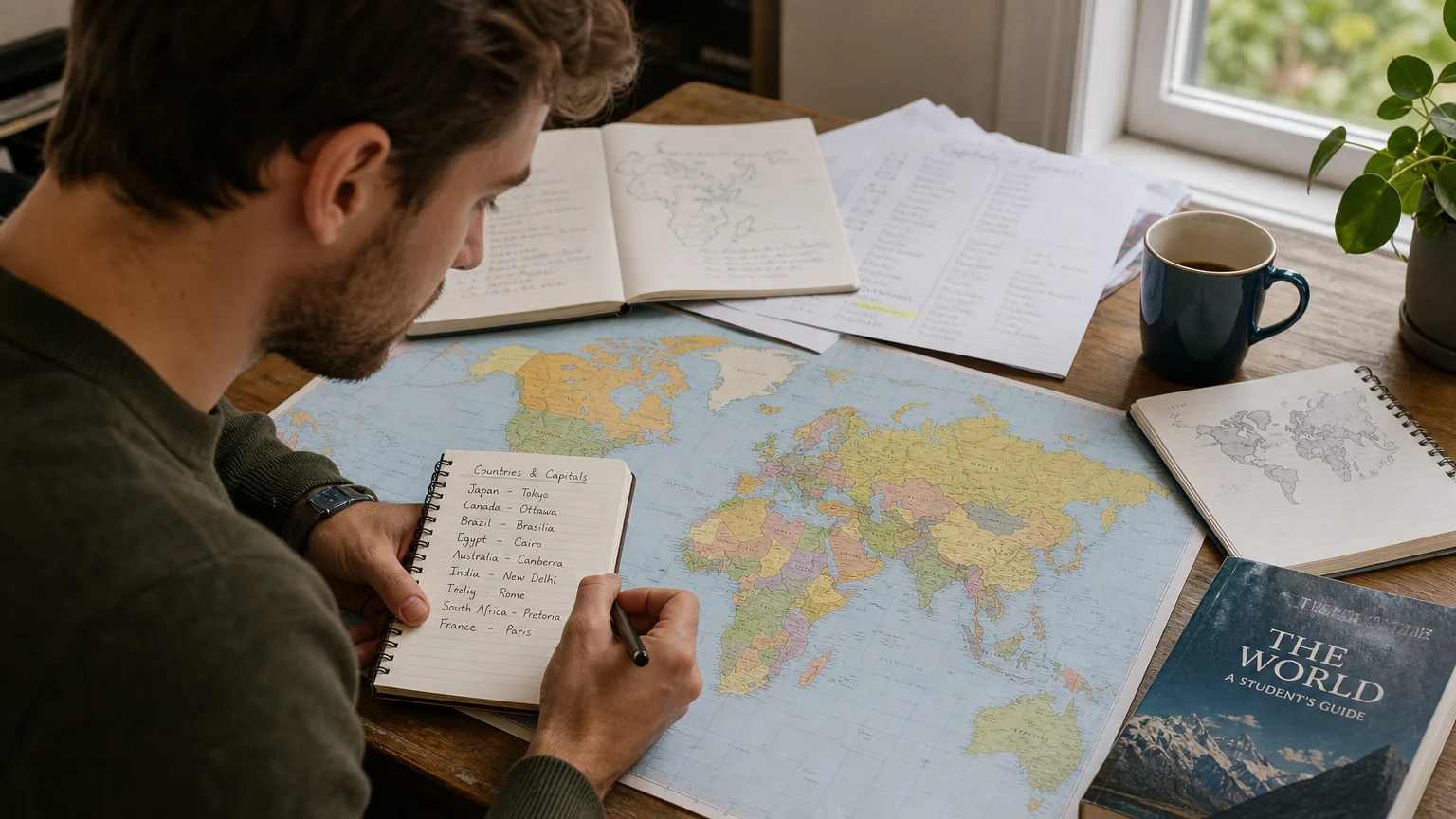
Suppose you have a geography test in two weeks. Don’t begin by trying to learn every capital at once. Start with a region, practise a small group, and then mix familiar and difficult answers together.
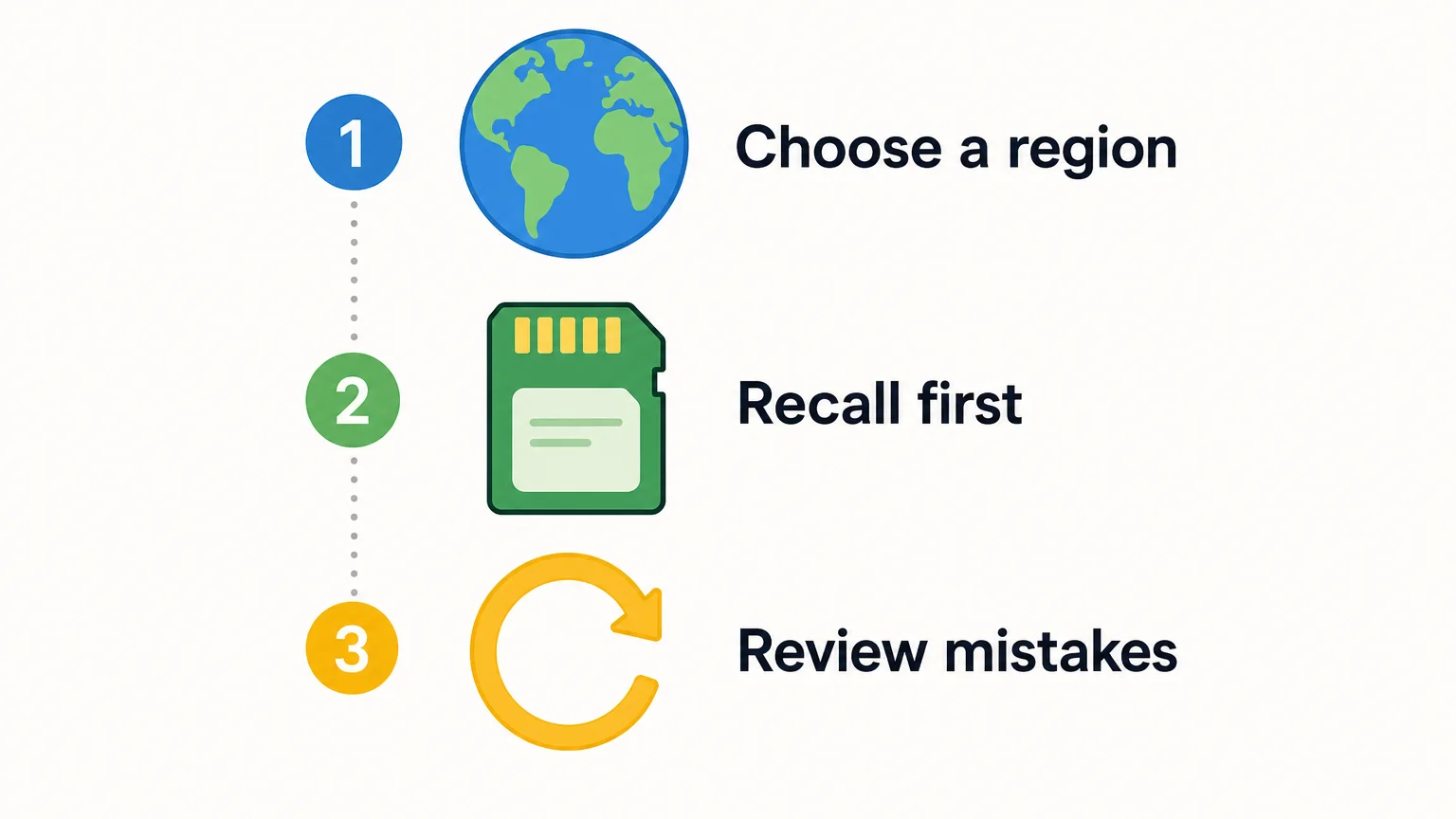
- Choose a manageable region. Begin with ten to fifteen countries instead of the whole world.
- Test yourself without notes. Make a guess before checking the answer.
- Record mistakes. Keep a short list of capitals that need another look.
- Change the direction. Practise country to capital, then capital to country.
- Return later. Review the same group after a day, three days, and one week.
You can also add a location cue. After learning a capital, find the country on a map and identify nearby countries. This turns a single fact into a small network of geographic knowledge.
For classroom use, keep the activity brief. A teacher can display one question at the start of class, let students submit individual answers, and use the result to begin a conversation about the country. The game becomes a launch point for geography, history, culture, or current events.
For more variety, explore our capital quiz games. Different formats can help students with different strengths, especially when one learner prefers visual clues and another prefers typed recall.
How do you choose the right game format?
There isn’t one ideal format for every learner. The right choice depends on whether you want to build familiarity, measure recall, prepare for a test, or enjoy a daily challenge.
| Goal | Useful format | Why it helps |
|---|---|---|
| Starting out | Multiple choice | Reduces pressure and introduces unfamiliar answers |
| Building memory | Flashcards and matching | Creates repeated links between countries and capitals |
| Preparing for an exam | Typing and timed quizzes | Tests independent recall under pressure |
| Studying with others | Daily challenge and leaderboards | Adds routine and friendly comparison |
| Exploring geography | Maps, silhouettes, and clues | Connects capitals with location and country features |
Look for clear feedback, manageable rounds, and enough variety to keep you practising. It’s also worth checking whether the game works well on your phone, supports your preferred language, and lets you replay difficult questions.
Be cautious with games that focus only on speed. Fast answers can be exciting, but speed alone doesn’t prove that the knowledge will remain later. A balanced tool gives you time to learn, opportunities to retrieve, and a way to revisit mistakes.
Why are some capital cities easy to confuse?
Many mistakes happen because people confuse a country’s largest or most famous city with its official capital. Sydney is not Australia’s capital, Istanbul is not Turkey’s capital, and Casablanca is not Morocco’s capital. These errors are understandable because major cities often receive more international attention.
A 2026 report based on more than 100,000 anonymous quiz sessions described this pattern as “megacity bias.” It also highlighted capitals that were created as compromises, moved from older political centres, or remain less prominent internationally. You can read the report’s examples in the 2026 capital difficulty index.
Some countries add another layer of difficulty because different cities hold different political roles. South Africa, for example, is associated with three capitals for separate branches of government. Bolivia is often discussed through both Sucre and La Paz, reflecting a distinction between constitutional and administrative roles.
When a question feels confusing, don’t rely on a vague association. Check the exact relationship between the country and city, then attach a memorable fact to it. A location, historical event, flag detail, or pronunciation cue can make the answer easier to retrieve.
How Flagdle turns capital practice into a daily habit
A daily routine works best when it feels light enough to repeat. We combine capital questions with other geography formats, so you can move between direct recall, progressive hints, flags, country silhouettes, and broader quizzes without leaving the browser.
Our capitals of the world quiz game is designed for short practice, whether you’re reviewing before an exam, preparing for travel, or simply testing your world knowledge. The wider Flagdle experience covers 195 UN-recognised countries, supports French and English, and includes replay options for additional practice.
You don’t need an account to begin. Your statistics are stored locally in the browser, while daily, weekly, and monthly leaderboards give you a way to compare Daily Challenge results. If you clear browser data or switch browsers, locally stored progress may disappear, so keep that limitation in mind.
The main benefit is consistency. One short round today, another tomorrow, and a quick review of missed capitals later can build stronger knowledge than one long memorisation session.
Make every round a learning opportunity
A capital cities game is most useful when it makes you retrieve answers, understand mistakes, and return regularly. Choose a format that matches your goal, start with manageable groups, and connect each city to its country, location, and story. With steady practice, even unfamiliar capitals become easier to recognise and recall.
Take action with Flagdle
If you want to turn geography practice into a simple daily routine, a browser-based challenge can give you structure without requiring a long study session. You can practise alone, compare results with friends, or use a quick round as a classroom warm-up.
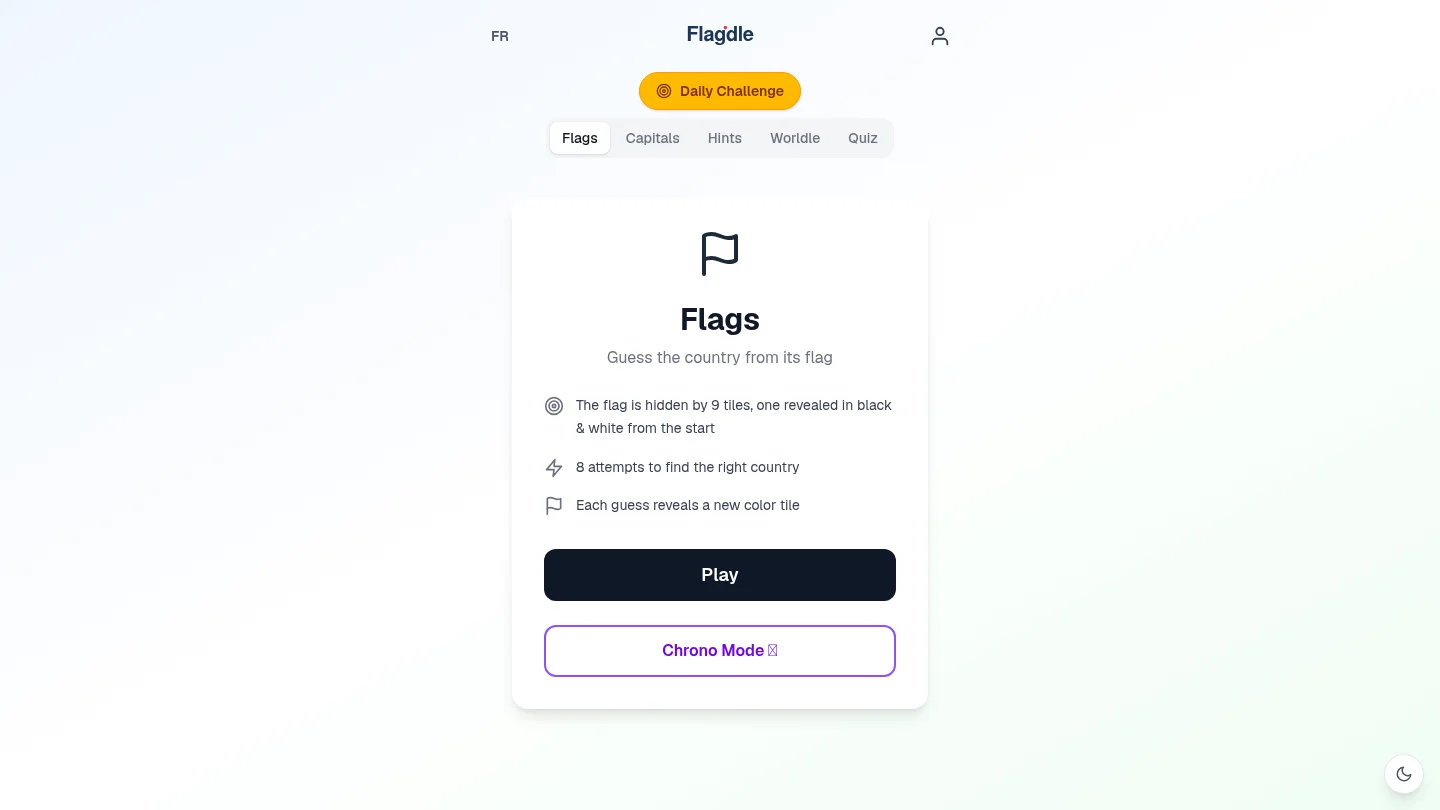
With Flagdle, you can explore capitals alongside flags, hints, country silhouettes, Daily Challenge rounds, and themed quizzes. It’s free to play, requires no account, supports French and English, and works directly in your browser. Play the capital cities game and build your world knowledge one short round at a time.
Frequently Asked Questions
What is a capital cities game?
It’s an interactive quiz that asks you to identify national capitals, usually from a country name, map, flag, clue, or multiple-choice list. Many games add timed rounds, daily challenges, progress tracking, or review modes.
Are capital city games useful for students?
Yes, especially when they require active recall rather than simple reading. Students can use them to practise a small regional set, identify mistakes, and repeat difficult answers before a geography assessment.
Should I use multiple choice or typing mode?
Multiple choice is useful when you’re learning new capitals because it reduces the initial difficulty. Typing mode is better when you want to check whether you can recall an answer without visual support.
How many capitals should I study at once?
Start with around ten to fifteen countries if the material feels new. Once you can recall that group reliably, mix it with older questions so the knowledge remains accessible outside the original study session.
Can I practise capitals with Flagdle?
Yes, Flagdle includes a Capitals mode as part of its browser-based geography games. You can also switch to flags, hints, silhouettes, Daily Challenge rounds, and themed quizzes to reinforce country knowledge from different angles.