
Here's a question for you: can you name the only two countries in the world with perfectly square flags? If you said Switzerland and Vatican City, congrats. If not, don't worry, you're about to learn that and a whole lot more. The world of country flag trivia is one of those rabbit holes that's genuinely fun to fall into, and once you start, you won't want to stop. Whether you're prepping for your next flag quiz guide session or just want to impress your friends at trivia night, you're in the right place.
Flags are more than colored rectangles on poles. They carry stories of revolutions, ancient empires, religious beliefs, and geographic identity. The formal study of flags even has its own name: vexillology. And as of 2026, the subject is having a genuine cultural moment, with cities, states, and countries rethinking their designs for a modern era. Let's dig into some of the wildest, most surprising facts about the flags of the world.
Why Flags Are Way More Interesting Than You Think
Most people see a flag and think, "Oh, those are nice colors." But every single element on a national flag exists for a reason. None of the countries use random colors or symbols for their flags; they all have centuries of history and culture behind them. Red often symbolizes blood shed for independence. Green frequently represents agriculture or Islam. Stars can stand for states, provinces, or guiding ideals.
The study of flags is called vexillology, from the Latin word vexillum, meaning "flag." It's concerned with research into flags of all kinds, both modern and historical, and seeks to understand the important part played by flags in the modern world. It's a real academic discipline, and it's also an incredibly fun one for trivia lovers.
Flags often share designs due to historical connections, political movements, or regional unity. For example, Nordic countries share the cross design; Pan-Slavic nations use red, blue, and white from Russia's flag; and Pan-Arab colors represent Arab independence movements. When you spot those patterns, identifying unfamiliar flags gets a lot easier.
10 Mind-Blowing Flag Facts You Probably Don't Know
Ready to stock up on trivia ammunition? Here are some flag facts that regularly stump even geography buffs:
- Square flags: Only two countries in the world have a square flag: Switzerland and Vatican City. Every other nation uses a rectangle.
- Nepal's unique shape: Nepal is the only country with a flag that isn't rectangular or square. It's made of two stacked triangles.
- Purple is ultra-rare: Only two national flags feature purple: Nicaragua and Dominica. Until the 19th century, purple dye was more expensive than gold.
- Libya's former flag: From 1977 to 2011, Libya had a completely plain green flag with no design, symbol, or insignia whatsoever. It was the simplest national flag in history.
- The Union Jack's reach: Many countries that are, or were, British territories have the Union (U.K.) flag as a canton, including Australia, New Zealand, Fiji, Tuvalu, and even the US state of Hawaii.
- Upside-down distress signal: Flying a flag upside down is internationally recognized as a signal of distress or extreme danger.
- Mozambique's AK-47: Mozambique's flag features an AK-47 rifle, making it the only national flag with a modern firearm.
- Italy's Napoleonic origin: Italians who supported Napoleon Bonaparte first used their tricolor flag in 1796, and Napoleon designed it to look like the French flag.
- The canton explained: The canton refers to the upper corner next to the staff, and it often contains a special design. For example, the canton of the American flag contains 50 stars representing the 50 states.
- Saudi Arabia's two-sided flag: Since the Saudi flag contains sacred writing, the reverse side is a duplicate of the front, and two flags are usually sewn together.
These are exactly the kinds of details that make flag identification games so addictive. The more trivia you absorb, the faster you'll recognize flags you've never seen before. If you want to put this knowledge to the test right away, try our all countries flag quiz and see how many you can nail.
Why Flag Design Is Having a Major Moment in 2026
By 2026, we've seen a massive global shift, with US states like Minnesota ditching their old designs in favor of cleaner, more modern flags. For nearly 100 years, many US state and municipal flags followed a boring pattern of a dark blue background with a complicated state seal in the middle (known in vexillology circles as "SOBs," or "Seals on a Bedsheet"), and by 2026, these designs are being purged in favor of high-impact visual identities.
In 2026, a flag is no longer just a government document on a pole; it's a brand that represents the soul and diversity of the people, according to a 2026 vexillology guide by Fawa News. Modern cities are now hiring professional vexillographers to create "inclusive icons" that citizens can actually feel proud to wear on a t-shirt or hang outside their home.
This redesign wave is generating fresh interest in flag trivia and identification. When a state or city changes its flag, everyone suddenly wants to know: what do the symbols mean? Why was the old one replaced? It's a great time to be a flag nerd.
The Most Commonly Confused Flags (and How to Tell Them Apart)
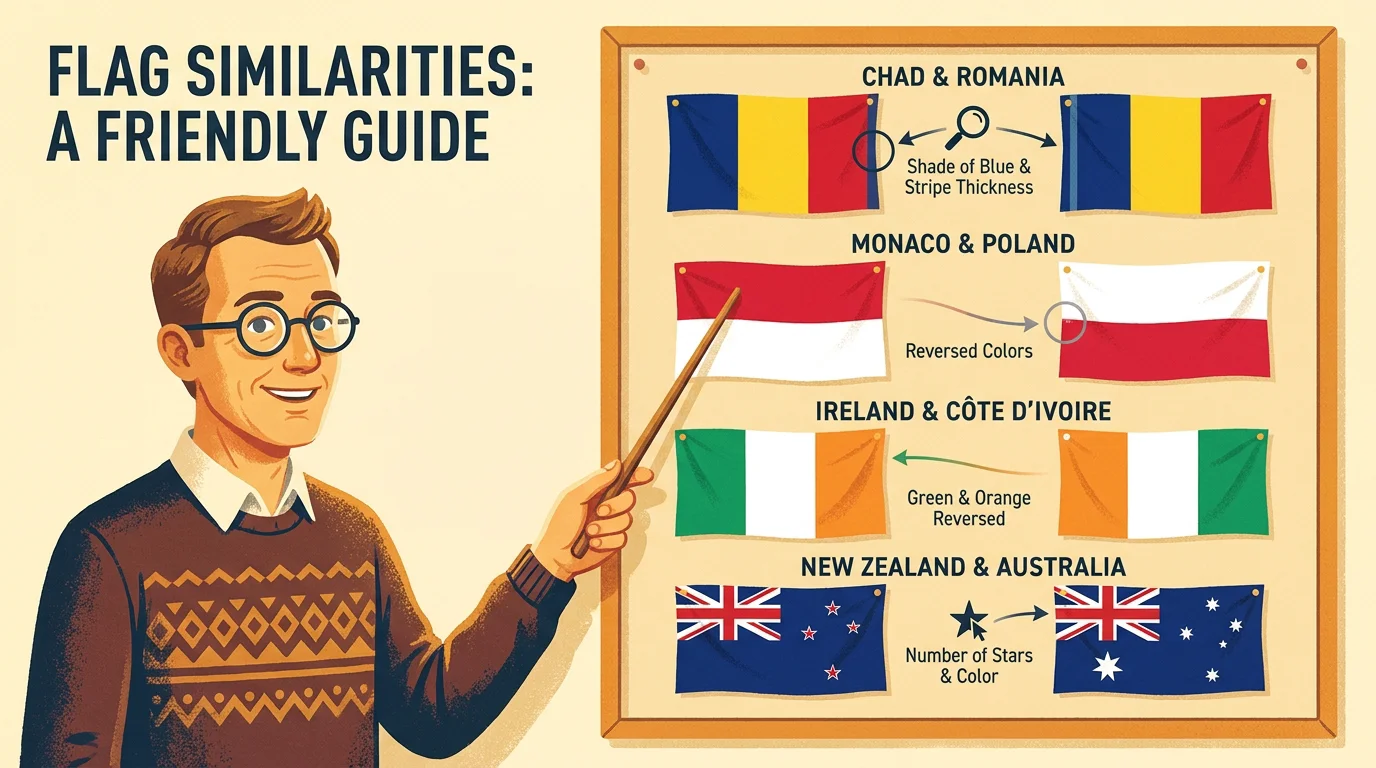
Even seasoned trivia players get tripped up by lookalike flags. Here are some of the trickiest pairs:
| Flag Pair | Key Difference |
|---|---|
| Indonesia vs. Monaco | Nearly identical (red over white), but Indonesia's flag is slightly wider in proportion. |
| Chad vs. Romania | Both are blue, yellow, and red vertical stripes. Chad uses a slightly darker blue (indigo vs. cobalt). |
| Ireland vs. Ivory Coast | Both are green, white, and orange vertical stripes, but Ireland is green-white-orange (left to right) while Ivory Coast is orange-white-green. |
| Australia vs. New Zealand | Both feature the Union Jack canton and Southern Cross stars, but Australia has six stars (including a large Commonwealth Star) while New Zealand has four red stars. |
The trick to mastering these is repetition. Running through a flag of the world test regularly trains your eye to pick up on the tiny details that separate one flag from another. It's like building muscle memory, but for your brain.
How Flag Trivia Makes You Smarter (Seriously)
Think trivia about flags is just a party trick? It's actually a surprisingly effective learning tool. Identifying flags forces your brain to connect visual patterns with geographic, historical, and cultural knowledge. You're not just memorizing colors; you're learning why those colors matter.
National flags are official symbols of sovereignty and national identity, and each flag's colors, symbols, and design patterns have been carefully chosen to represent a nation's history, values, culture, and aspirations, as documented by Geocountries' flags database. When you learn that green in the Italian flag originally represented hope, or that the red circle on Japan's flag symbolizes the sun goddess Amaterasu, you're absorbing world history one flag at a time.
This is exactly why educators and edtech platforms are leaning into flag quizzes as a gateway to broader geography education. A daily flag challenge keeps you coming back, and each round teaches you something new about a country you might never have thought about before.
Tips to Dominate Your Next Flag Quiz
Whether you're gearing up for a pub quiz or competing on an online platform, these strategies will give you an edge:
- Learn the color families: Pan-African flags often use red, green, and yellow/gold. Pan-Arab flags feature red, white, black, and green. Nordic flags all use a cross pattern. Sorting flags by regional "families" cuts your guesswork dramatically.
- Focus on unique elements first: Spot a trident? That's Barbados. A dragon? Wales or Bhutan. A bird of paradise? Papua New Guinea. Unique symbols are your fastest shortcut to a correct answer.
- Study the outliers: Flags that break the rules are easier to remember. Nepal's double pennant, Switzerland's square, Mozambique's rifle, and Cambodia's Angkor Wat are all instant identifiers.
- Use progressive reveal games: Games that show you the flag piece by piece train you to identify countries from partial information. That's a skill that transfers directly to rapid identification. We built our daily challenge around exactly this idea; every day, a new flag is hidden behind tiles that reveal one by one as you guess.
- Practice with the full set: Don't just study the "famous" flags. The difference between a casual player and a trivia champion is knowing Eswatini, Comoros, and Kiribati. Try our countries flag quiz to go through the complete lineup.
Where Flag Trivia Is Heading Next
Flag trivia isn't a static niche. It's growing alongside the broader trends in geography gaming and daily puzzle culture that exploded after Wordle's success. In 2026, geo-guessing games, daily map challenges, and flag identification quizzes are pulling in millions of players worldwide.
The appeal is simple: each round takes under a minute, you learn something real, and there's a satisfying competitive loop. Vexillology isn't just a hobby for history buffs or trivia nerds; it's become a high-stakes game of visual branding, psychology, and national identity. As more flags get redesigned and more countries emerge on the global stage, the trivia pool only gets deeper.
Platforms like FunTrivia, which hosts hundreds of flag-related questions, show how large the community of flag enthusiasts has become. And with mobile-friendly daily challenges, it's never been easier to squeeze in a round during your commute or lunch break.
Turn Your Flag Knowledge Into a Daily Habit
The best way to get good at trivia about country flags isn't cramming; it's consistency. A few minutes a day beats an hour-long study session once a month. That's the beauty of daily challenge formats: they keep you sharp without overwhelming you, and the competitive element (can you beat yesterday's score?) keeps things fun.
If you've made it this far, you clearly love this stuff. And you now know that flags aren't just colored cloth; they're dense little packages of history, identity, and design philosophy. From Nepal's unique shape to Saudi Arabia's double-sewn construction, every flag has a story that makes the world a little more fascinating.
Our daily flag game gives you a fresh challenge every single day, with the flag hidden behind tiles that reveal progressively as you guess. It's free, it works on any device, and it covers all 195 countries. Ready to put your new knowledge to work? Try our country flag test and see how many you can identify today.
Frequently Asked Questions
What's the hardest country flag to identify?
Flags with very similar tricolor designs tend to be the trickiest. Chad and Romania are nearly identical, and Indonesia and Monaco look almost the same. The best way to get better at spotting the differences is daily practice on a platform like ours, where progressive clues train your eye over time.
How many country flags are there in the world?
There are 195 recognized sovereign nations, each with its own official flag. If you include territories, dependencies, and other entities, the count rises to over 250. That's a lot of flags to learn, but most people can master the full set with a few weeks of consistent practice.
Why is the study of flags called vexillology?
The term comes from the Latin word vexillum, which was a type of military standard used by Roman legions. The discipline covers everything from flag history and symbolism to design best practices. It's a surprisingly vibrant field, especially in 2026, as cities and states around the world are actively redesigning their flags.